In the professional services world—whether you are a consultant in London or a creative director in New York—you eventually hit a “ceiling.” This ceiling is defined by the number of hours in a day. Since your revenue is tied to your time, your growth is capped by your own physical limits.
At AI Growth Gear, we call this the Expert’s Dilemma. You want to grow, but you don’t want to hire a massive team that dilutes your brand’s “soul” or increases your overhead to stressful levels.
The secret to breaking this ceiling in 2026 isn’t working harder; it’s building a Digital Twin for your operations.
The Math of Growth
Most boutique owners spend 60% of their time on “Administrative Friction”—invoicing, lead qualification, meeting prep, and basic research. These are $20/hour tasks being performed by a $200/hour expert.
By implementing specific AI Gears, we help our clients flip that ratio.
The Lead Filter: An AI Agent that qualifies leads before they ever reach your calendar.
The Briefing Engine: A system that researches a client and prepares a 1-page strategic brief while you sleep.
The Content Multiplier: Taking one 10-minute video of you speaking and turning it into a month’s worth of high-end social posts.
When you remove the friction, you don’t just save time—यू (you) multiply your billable capacity.
Quality Over Headcount
The old way to scale was to hire junior staff. But junior staff require training, management, and a high salary. In 2026, the leanest agencies are the most profitable.
By using Aesthetic Automation, a founder can maintain a “Boutique” feel—giving every client that high-end, personal touch—while the AI handles the data-heavy lifting in the background. Surbhi’s background at NIFT taught us that luxury is often about what you don’t see. The client sees a seamless, high-end experience; they don’t need to see the gears that made it happen so quickly.
The 10x Consultant
Imagine being able to take on three times the number of clients without adding a single minute to your work week. That is the power of a well-oiled AI strategy. It allows you to move from being a “worker” in your business to being the “Architect” of it.
Is Your Business Gear-Ready?
Scaling isn’t about doing more; it’s about being more efficient with what you already have. If you are ready to stop trading your life for billable hours, it’s time to look at your operational gears.
In film production, there is a reason why a movie doesn’t just consist of actors and a script. It needs a Director. The director ensures that every shot, every line, and every edit serves the larger vision. Without that oversight, even the most expensive production falls apart into a series of disconnected scenes.
As we consult with businesses across the UK and US, we see a recurring fear: “If I automate my business, will I lose the soul of my brand?” The answer is only “Yes” if you treat AI like a replacement. At AI Growth Gear, we treat AI as a high-performing crew that requires a skilled Director. This is what we call the Human-in-the-Loop (HITL) philosophy.
The Myth of “Set it and Forget it”
The biggest mistake a business can make in 2026 is believing that AI is a magic wand. You cannot simply “plug in” an agent and expect it to understand your brand’s nuances, your customers’ emotional needs, or your ethical boundaries.
True “Gear-driven” growth requires a feedback loop. AI handles the heavy lifting—the data crunching, the first drafts, the scheduling—while the human handles the judgment.
Why My Film Background Matters to Your ROI
During my time in film production, I learned that a great story is told in the edits. AI is fantastic at generating volume, but humans are essential for selection.
When we build an AI workflow for a client, we don’t just hand over a tool. We build “Director Checkpoints.” These are stages in the automation where the system pauses for human approval or refinement. This ensures that:
The Tone stays consistent: Your AI shouldn’t sound like a different person every time it sends an email.
The Ethics remain sound: AI doesn’t inherently understand the cultural nuances of a London-based client versus a New York-based one.
The Strategy evolves: Data tells you what happened; humans tell you why it matters.
Building Your Digital Crew
Imagine your business as a production. Your AI agents are your camera operators, your lighting crew, and your editors. They work fast, they don’t get tired, and they follow instructions perfectly. But you are the Director.
The HITL approach allows you to scale your output by 10x without losing 1% of your quality. It’s about leveraging the machine to give the human more time to be creative, strategic, and—most importantly—present.
Gearing Up for Authenticity
In a world that is becoming increasingly automated, authenticity is the new gold standard. By keeping a human in the loop, you aren’t slowing down your growth; you are protecting your brand’s most valuable asset: its identity.
At AI Growth Gear, we don’t just give you the tech; we give you the script and the direction to ensure your business’s story is told exactly how you intended.
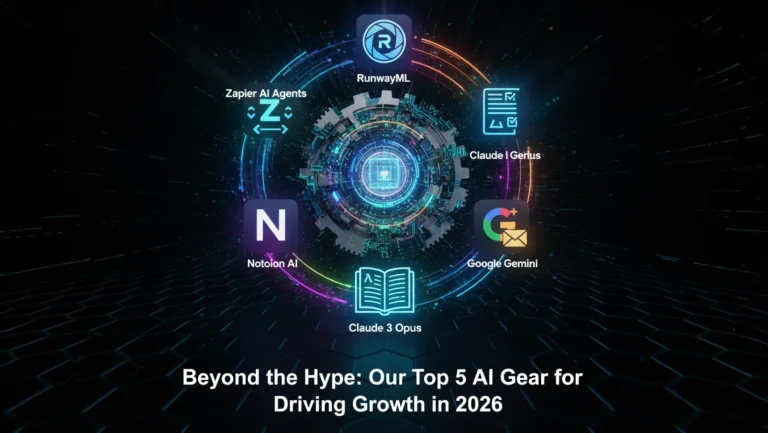
Every week, it feels like a hundred new AI tools launch. The promises are grand, the demos are dazzling, but for the busy business owner, it’s just another layer of confusion. Which ones actually work? Which ones are built for growth, not just novelty?
At AI Growth Gear, our philosophy is simple: Don’t chase every shiny object; invest in the right gears. With my background managing the fast-paced operations at Enoxx News, and Surbhi’s eye for seamless integration from NIFT and film, we don’t recommend a tool unless it truly elevates an existing workflow. We’ve put countless hours into testing, integrating, and often, breaking these tools so you don’t have to.
So, as we navigate 2026, here are our top 5 battle-tested AI “Gears” that are truly driving growth for businesses in the US and UK.
1. The Orchestrator: Zapier AI Agents (for Seamless Workflow Automation)
Think of Zapier as the central nervous system of your digital operations. Now, imagine giving it a brain. Zapier AI Agents aren’t just about connecting apps; they’re about giving an AI an objective and letting it execute multi-step tasks across your entire tech stack.
Why it’s essential: Instead of manually moving data from your CRM to your email marketing, or updating your project management tool based on a customer query, an Agent handles it. It’s perfect for streamlining lead nurturing, customer onboarding, and even internal reporting. It truly embodies the “Agentic AI” we champion.
2. The Visual Storyteller: RunwayML (for Dynamic Video & Visuals)
The demand for video content is relentless. Traditional video production is slow and expensive. Enter RunwayML. While still evolving, its capabilities in generating short video clips from text, transforming existing footage, and even isolating elements are game-changing.
Why it’s essential: For brands needing to create quick, high-quality social media clips, product explainers, or animated graphics, RunwayML democratizes video creation. It allows you to maintain aesthetic quality without a full production team, resonating deeply with Surbhi’s visual-first approach.
3. The Intelligent Copywriter: Claude 3 Opus (for High-Quality Content Creation)
While ChatGPT got all the headlines, Claude 3 Opus (and its siblings Haiku and Sonnet) has quietly become our go-to for sophisticated long-form content and nuanced brand voice. Its ability to handle complex prompts and produce less “AI-sounding” text is remarkable.
Why it’s essential: From drafting compelling blog posts and email sequences to generating detailed market analyses, Claude 3 Opus consistently delivers. It helps maintain the “Aesthetic Automation” principle by producing copy that feels genuinely human and on-brand, freeing up your team for strategic refinement.
4. The Knowledge Manager: Notion AI (for Organized Operations & Idea Generation)
If your business lives in Notion (and many successful ones do), then Notion AI is a non-negotiable. It’s an integrated AI assistant that lives directly within your workspaces, databases, and documents.
Why it’s essential: Instantly summarize lengthy meeting notes, draft marketing copy based on project briefs, automate task generation, and even brainstorm content ideas directly within your existing knowledge base. It transforms Notion from a powerful workspace into an intelligent operational hub, drastically improving team productivity.
5. The Data Whisperer: Google Gemini for Workspace (for Smart Insights & Efficiency)
We live in our inboxes and spreadsheets. Google Gemini for Workspace integrates AI directly into Gmail, Docs, Sheets, and Slides. This means AI can draft emails, summarize lengthy document threads, analyze data in Sheets, and even create presentations with simple prompts.
Why it’s essential: It’s about leveraging the tools you already use daily. Gemini streamlines communication, automates data analysis, and assists with content creation right where you work. It’s subtle, powerful, and an absolute game-changer for internal efficiency and external communication, ensuring every interaction is precise and purposeful.
Equip Your Growth
Choosing the right AI “gear” isn’t about having the most tools; it’s about having the most effective ones. These five solutions, when integrated strategically, can transform your business from being trapped in the “Efficiency Trap” to being a nimble, growth-driven machine.
Don’t just automate; orchestrate. Let’s equip your business with the intelligence it needs to thrive in 2026.
In the world of high fashion and cinema, there is a term we often use: Texture. It’s the subtle imperfection in a fabric, the specific grain of a 35mm film, or the slight tremor in a voice that tells the audience something is real.
As we move through 2026, we are witnessing a digital crisis. The internet is being flooded with “perfect” content. We see AI-generated images that are too glossy, AI-written captions that are too enthusiastic, and AI videos that feel just a bit too… hollow. In the US and UK markets, consumers are developing a sixth sense for this. They are tuning out.
This is where the concept of Aesthetic Automation comes in.
The NIFT Lens: Design is a Language, Not a Tool
My journey at the National Institute of Fashion Technology (NIFT) wasn’t just about learning how things look; it was about learning how they communicate. When I moved into film production and eventually co-founded Enoxx News, that lesson stayed with me.
AI is a powerful engine, but it is “taste-blind.” It can generate a thousand logos in a minute, but it doesn’t know which one carries the weight of a legacy brand or the edge of a modern startup.
At AI Growth Gear, we believe that automation without aesthetics is just noise. If you are using AI to scale your business but losing your brand’s unique “texture” in the process, you aren’t growing—you’re diluting.
The 2026 Shift: From “Perfect” to “Authentic”
A few years ago, the goal was to make AI look as polished as possible. Today, the trend is shifting toward Authentic Automation. Top-tier brands in London and New York are no longer looking for the most “advanced” AI; they are looking for the most “human” AI. They want automation that understands subtext, irony, and minimalist design. They want the “gears” to stay hidden behind a beautiful, human-centric interface.
To achieve this, we apply three core design principles to every AI workflow:
Curation Over Creation: The role of the human has shifted from being the one who draws the line to the one who chooses the best line. We use our background in film and fashion to curate AI outputs so they feel intentional, not accidental.
The “Imperfect” Prompt: We don’t ask AI for “perfect” results. We prompt for character, for specific lighting styles (like Chiaroscuro), and for a tone of voice that sounds like a person, not a marketing brochure.
Visual Cohesion: One of the biggest mistakes small businesses make is using five different AI tools that create five different “looks.” We build unified “Aesthetic Sets” so your brand remains recognizable across every automated touchpoint.
Gearing Up Your Brand
Automation should be your brand’s silent partner, not its replacement. Whether we are automating your social media presence or building an AI-driven video workflow, the goal is always the same: Efficiency that looks and feels like Art.
The “Gear” in our name represents the mechanics of your business, but the “Growth” represents the life and soul of your brand. In 2026, the most successful companies will be those that use technology to become more human, not less.
Don’t let your brand become a victim of the “uncanny valley.” Let’s build a system that honors your vision while leveraging the speed of tomorrow.
There is a specific kind of exhaustion that every small business owner in the US and UK knows all too well. It’s that feeling of being a “professional firefighter.” You start your Monday with a grand vision for growth, but by 10:00 AM, you are buried in the weeds—answering basic customer service emails, manually updating your CRM, and trying to figure out why your latest social post didn’t hit the mark.
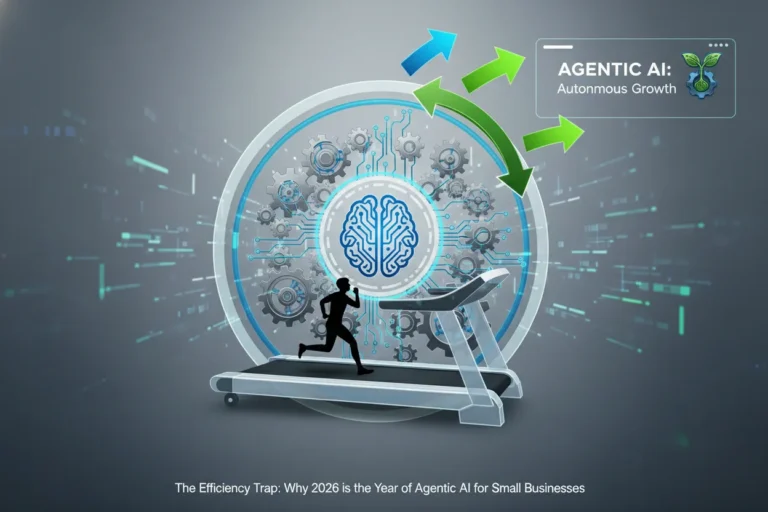
This is the Efficiency Trap. It’s the paradox of the modern digital age: we have more tools than ever, yet we’ve never been busier with low-value tasks. We are running on a digital treadmill, exhausted by the “noise” of the business, with zero time left to actually steer the ship.
As we move through 2026, the solution isn’t just “more AI.” We’ve moved past the novelty phase of basic chatbots. The real escape route is Agentic AI.
From Tools to Teammates
For the last few years, most of us have used AI reactively. You give a prompt to ChatGPT, and it gives you a response. It’s helpful, but it’s still a “manual” tool. You are the one who has to remember to ask the question, verify the data, and move the output to where it needs to go.
Agentic AI changes the fundamental nature of this relationship. Instead of a tool that waits for your command, an AI Agent is a digital teammate that understands a specific objective.
If you tell an agent, “Nurture this lead until they are ready for a call,” it doesn’t just write a draft. It monitors your inbox, follows up at the right intervals based on the lead’s behavior, checks your real-time availability on Calendly, and sends the invite. It manages the entire workflow autonomously. In 2026, the competitive edge belongs to those who stop “prompting” and start “delegating.”
The “Gear” Philosophy: Why Operations are the New Moat
At AI Growth Gear, we look at business through a lens of high-end operations. My co-founder, Surbhi Chauhan, brings a unique perspective from the worlds of fashion communication (NIFT) and film production. In those industries, a brilliant creative vision is worth nothing if the “gears” of production fail.
Most small businesses are currently suffering from a “production” problem. They have a great product, but their backend is a patchwork of manual processes. Agentic AI acts as the mechanical heart of your business. It allows a lean team of three people to have the operational output of a mid-sized corporation.
Three Pillars for the 2026 Business Owner
To break out of the Efficiency Trap this year, your strategy must sit on three pillars:
Aesthetic Automation: In a market flooded with generic, “robotic” content, design matters more than ever. Your AI-driven communication must feel human and high-end. If it looks like a machine made it, your customers will tune out.
Strategic Oversight: We don’t believe in “set it and forget it.” The most successful 2026 businesses use agents to handle the 80% of repetitive, data-heavy work, leaving the final 20%—the high-value, emotional, and strategic decisions—to the human experts.
Seamless Orchestration: Your AI needs to be an “orchestrator,” not a silo. It needs to live inside your email, your project management tools (like Monday.com or Asana), and your website.
Owning the Gears
The reality of 2026 is that the barrier to entry for starting a business has never been lower, but the barrier to scaling one has never been higher. The digital noise is deafening.
You can choose to keep fighting the treadmill yourself, or you can build the digital infrastructure that does the heavy lifting for you. Agentic AI isn’t a futuristic luxury anymore; it’s the only way to ensure that you, the founder, can finally step out of the daily grind and back into the vision that started it all.
It’s time to stop being a part of the machine and start owning the gears.
If you follow AI even a little bit, you’ve probably heard that Google Gemini is supposed to be the company’s big answer to ChatGPT. In this Google Gemini review, I’m focusing on how Gemini AI actually feels in day‑to‑day use in 2026, and whether it genuinely beats ChatGPT or just offers a different flavour of the same thing. This Gemini vs ChatGPT review is based on typical tasks: writing, research, coding, and general productivity for users in the US and UK.
Setup and Interface: Gemini Feels Naturally Built Into Google
The first obvious advantage Gemini has is integration. While ChatGPT mostly lives in its own web app (unless you use plugins or third‑party tools), Gemini is woven directly into Google products that people in the US and UK already use daily.
In Gmail and Google Docs, Gemini can suggest replies, rewrite emails, draft blog posts, and summarise long text without leaving the page. On Android phones and Chromebooks, Gemini is increasingly replacing the old Google Assistant, so it feels like part of the operating system rather than an extra app.
ChatGPT, on the other hand, still works best as something you open in a separate tab or app and copy‑paste from. For some people that’s fine, but if you live inside Google’s ecosystem, Gemini’s integration is a big practical win.
Writing and Content Generation: ChatGPT Still Has the Edge for “Voice”
For writing tasks, the gap between Gemini AI and ChatGPT is smaller than it used to be, but it hasn’t disappeared.
Gemini is very good at structured writing: outlines, lists, how‑to guides, meeting notes and summaries. It tends to stay organised, on‑topic and fairly concise. If you need a clean first draft of a blog post, a product description, or a set of bullet points for a presentation, Gemini does the job without much drama.
ChatGPT, especially in its latest versions, still feels a bit more “human” in tone. It’s better at storytelling, humour, and capturing a particular style of writing. When you ask for a conversational article or a creative angle, ChatGPT often sounds more natural and less like a corporate manual.
So in this part of the Gemini vs ChatGPT review, the result is mixed: Gemini wins on structure and tight integration with Docs, while ChatGPT remains slightly stronger for voice and personality.
Search, Facts and Live Information: Gemini Plays on Home Ground
When it comes to live information, Gemini finally looks like the AI that Google promised. Because it sits directly on top of Google Search, it can pull in fresh results, link to sources, and show you where it found the information.
For example, if you ask for “best AI tools for small businesses in the UK in 2026” or “latest changes in US student loan rules”, Gemini is usually quicker to ground its answer in current web pages. You can see links, visit the original sites, and dig deeper.
ChatGPT has browsing modes and integrations, but they still feel like an extra layer bolted on top. Sometimes it browses, sometimes it doesn’t, and occasionally it hallucinates details more confidently than Gemini does.
That doesn’t mean Gemini is perfect: it can still misread pages or over‑simplify complex topics. But for search‑style questions, especially those relevant to US and UK news, Gemini now feels more reliable more often.
Coding and Technical Tasks: Close Competition, Slight Preference
Both Gemini AI and ChatGPT are strong coding assistants in 2026, and for most everyday developers there is less difference than marketing suggests.
Gemini is excellent when used with Google’s developer tools and cloud services. It can help generate code snippets, explain error messages, and suggest improvements in a fairly straightforward way. If you’re already in the Google Cloud world, that tight connection is useful.
ChatGPT still has a slight edge in explaining code step‑by‑step and offering multiple versions of a solution. Many developers in the US and UK have already built their personal workflow around ChatGPT, and that familiarity matters.
If you’re starting from scratch, you can comfortably pick either. If you’re deep into Google’s stack, Gemini will feel more natural. If you’ve been using ChatGPT for a year or more, there isn’t a strong reason to abandon it purely for coding.
Privacy, Pricing and Value for Money
On pricing, Gemini and ChatGPT both use a mix of free and paid tiers. Google’s free Gemini is competitive for casual users, and the paid versions are mainly attractive for heavy usage or business integrations.
For many US and UK users, the real question is not just price but trust. Google has a long history of collecting user data, and some people are cautious about giving Gemini access to their documents and emails, even if it is technically necessary for the features to work. OpenAI has had its own controversies, but it still feels slightly more “separate” from your daily accounts.
If you already rely heavily on Google Workspace, paying for Gemini’s advanced features can make sense: you are getting an AI layer across tools you’re already paying for. If you prefer to keep AI separate from your inbox and personal files, a standalone ChatGPT subscription may feel safer.
Final Verdict – Is Gemini Better Than ChatGPT in 2026?
So, the big question of this Gemini vs ChatGPT review: is Google Gemini actually better?
The honest answer is: it depends how you work.
Gemini is best for:
People who live inside Google Search, Gmail, Docs and Android
Structured work: summaries, outlines, emails, reports and quick research
Users who want AI blended directly into their existing tools
ChatGPT is still better for:
More creative writing, storytelling and conversational content
Users who like a single, central AI workspace separate from their other accounts
Developers and power users who already built habits and prompts around ChatGPT
In 2026, Google Gemini has finally become a serious rival instead of just a late response. It doesn’t completely replace ChatGPT, but for many US and UK users, especially those deep in Google’s ecosystem, it might quietly become the AI they reach for first.