Automate Ecommerce Descriptions & Pricing with AI

If you are a Shopify store owner or an Amazon FBA seller, you know that scaling your catalog comes with a massive administrative hangover. Every new SKU you add requires SEO-optimized copy, feature extraction, and competitive pricing strategies. Doing this manually for ten products is annoying; doing it for ten thousand is impossible.
The smartest e-commerce managers are no longer throwing human hours at these repetitive tasks. Instead, they are leveraging artificial intelligence to build automated systems that write high-converting copy and adjust prices in real-time.
Here is your tutorial on how to use AI for ecommerce to automate your product descriptions and supercharge your pricing strategy.
Part 1: Automating Product Descriptions at Scale
Writing generic product descriptions is a surefire way to kill your conversion rate. Shoppers want to know the benefits, but search engines need the features and keywords. Trying to balance both across thousands of products is where AI shines.
Moving Beyond the “One-by-One” Prompt If you are opening ChatGPT, pasting in a manufacturer’s spec sheet, and asking it to write a description one by one, you aren’t really automating. True automation requires bulk generation.
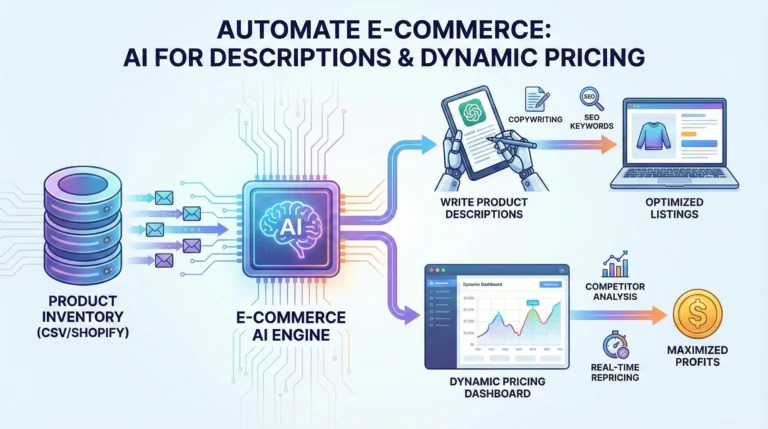
To build an automated content factory, you need to connect your product database (like a Google Sheet or CSV export of your Shopify inventory) directly to an AI language model using tools like Zapier, Make.com, or specialized apps like Copy.ai and Hypotenuse AI.
The Workflow:
- The Trigger: A new product is added to your store database with basic attributes (Name, Color, Material, Dimensions).
- The Prompt Template: Your automation tool sends these attributes to OpenAI with a strict prompt: “Act as an expert e-commerce copywriter. Using the provided specs, write a 100-word product description. Start with an emotional hook, follow with three bulleted benefits, and naturally weave in these SEO keywords. Tone: Premium and minimalist.”
- The Output: The AI generates the description and instantly updates your Shopify or WooCommerce listing via API.
What used to take a copywriter a full week can now be executed across 5,000 SKUs while you grab a coffee.
Part 2: Winning the Buy Box with Dynamic Pricing AI
Having great product copy gets customers to your page, but pricing gets them to click “Add to Cart.” In the past, repricing meant setting basic rules (e.g., “always price my product $1 cheaper than Competitor X”). Today, rule-based pricing is obsolete.
Enter dynamic pricing AI.
Major players like Amazon make millions of repricing decisions every single day, evaluating relative market value without relying on manual input. Now, thanks to tools like Prisync, Intelis, and DynamicPricing AI, independent store owners have access to that exact same enterprise-level technology.
How AI Pricing Works: Instead of just scraping a competitor’s website, modern AI pricing tools ingest dozens of variables simultaneously. They analyze:
- Real-time competitor stock levels (If your competitor sells out, the AI automatically raises your price to capture a higher margin).
- Historical sales velocity and seasonal demand trends.
- Your specific procurement costs and target profit margins.
- Customer price elasticity (how sensitive your specific audience is to a $2 price hike).
Setting the Guardrails: The beauty of an ecommerce automation tutorial focused on pricing is that you remain in control. You never have to worry about the AI accidentally pricing a $100 jacket for $5. You set the absolute minimum margin floor (the “guardrails”), and the AI constantly tests price points above that floor to find the exact dollar amount that maximizes your total profit, not just your revenue.
Final Thoughts
The divide in e-commerce is no longer about who has the best product; it is about who has the best operational velocity. By automating your ChatGPT product descriptions and integrating dynamic pricing AI, you remove the human bottleneck from your catalog management. This frees you up to focus on what actually grows a business: sourcing better products, building a brand identity, and acquiring new customers.