Agentic Automation: The Future of Workflow Automation

The Shift From Task Automation to Autonomous Systems
For years, workflow automation meant one thing: automate repetitive tasks.
Businesses deployed RPA bots to click buttons, copy data between systems, and follow predefined rules. It worked — to a point. Costs dropped. Manual errors decreased. Efficiency improved.
But in 2026, the conversation has shifted.
Companies are no longer asking, “How do we automate this task?”
They’re asking, “How do we automate outcomes?”
That shift is where agentic automation enters the picture.
What Is Agentic Automation?
Agentic automation refers to AI systems designed to act like autonomous agents rather than scripted bots.
Instead of following rigid instructions, these AI agents:
- Understand objectives
- Plan multi-step workflows
- Adjust decisions based on changing inputs
- Optimize performance over time
- Execute tasks across multiple systems
In simple terms:
Traditional automation executes instructions.
Agentic automation pursues goals.
If RPA is a digital worker following a checklist, agentic automation is a digital project manager figuring out the best way to get the job done.
Why 2026 Is the Turning Point
Several factors are converging to make 2026 a breakthrough year for agentic automation:
1. Mature AI Models
Large language models and reasoning engines are now capable of multi-step thinking, contextual understanding, and strategic decision-making.
2. Better Workflow Orchestration Tools
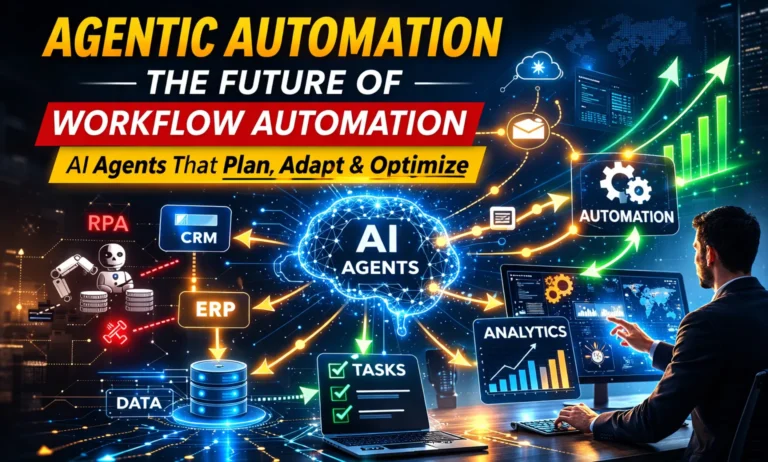
Modern orchestration platforms allow AI agents to interact with CRMs, ERPs, marketing systems, analytics dashboards, and internal databases seamlessly.
3. Business Pressure for Agility
US and UK enterprises face increasing pressure to reduce operational overhead while scaling faster. Static bots cannot keep up with dynamic markets.
4. Data Explosion
Companies generate massive amounts of data daily. Agentic systems can analyze and act on that data continuously — something rule-based bots struggle with.
The result? Businesses are moving from automation scripts to intelligent orchestration layers.
What Is Workflow Orchestration in This Context?
Workflow orchestration is the coordination of multiple automated processes into one intelligent, goal-driven system.
Instead of separate bots for:
- Lead qualification
- CRM updates
- Email nurturing
- Reporting
An agentic system oversees the entire pipeline. It monitors performance, adjusts messaging, escalates exceptions, and reallocates resources when needed.
It doesn’t just execute — it manages.
Agentic Automation vs RPA: What Businesses Should Know
To understand the future, we need to compare it with the present.
1. Decision-Making Capability
RPA:
Follows predefined rules. If X happens, do Y.
Agentic Automation:
Analyzes context and decides the best action based on objectives.
Example:
An RPA bot sends a standard follow-up email.
An AI agent decides whether to follow up, change tone, escalate to sales, or pause outreach based on engagement data.
2. Adaptability
RPA:
Breaks when systems change or workflows evolve.
Agentic Automation:
Adapts to new inputs, system updates, and unexpected scenarios.
This flexibility significantly reduces maintenance costs.
3. Scope of Automation
RPA:
Automates tasks.
Agentic Automation:
Automates entire processes and optimizes them continuously.
Instead of automating invoice entry, an AI agent can oversee the entire accounts payable workflow — from invoice detection to fraud checks and payment timing.
4. Human Involvement
RPA:
Requires ongoing human supervision and frequent updates.
Agentic Automation:
Operates with minimal supervision, escalating only when judgment or compliance decisions are required.
It augments humans instead of replacing them.
5. ROI Potential
RPA typically delivers incremental efficiency gains — often 20–40% improvement in specific tasks.
Agentic automation can deliver transformational gains by:
- Reducing operational headcount pressure
- Improving decision speed
- Increasing revenue conversion rates
- Minimizing error-based losses
- Enabling 24/7 optimization
For enterprises, this moves automation from a cost-saving initiative to a growth strategy.
Where Agentic Automation Delivers the Most Value
In 2026, we’re seeing the strongest impact in:
- Sales workflow automation
- Marketing orchestration
- Customer support triaging
- Financial process management
- Supply chain coordination
- Enterprise IT operations
Particularly in high-income markets like the US and UK, businesses are adopting agentic systems to remain competitive against leaner, AI-native startups.
Should Businesses Replace RPA?
Not immediately.
RPA still has value for simple, stable, repetitive tasks. It’s reliable and cost-effective.
However, forward-thinking organizations are layering agentic automation on top of existing RPA infrastructure — using RPA for execution and AI agents for orchestration.
This hybrid approach offers the best of both worlds.
The Bigger Picture: Automation as Strategy
The most important takeaway isn’t technological — it’s strategic.
Workflow automation is no longer just about saving time.
It’s about building systems that:
- Learn
- Adapt
- Scale
- Optimize themselves
Agentic automation represents the next evolution in business automation — moving from static scripts to intelligent operational ecosystems.
In 2026 and beyond, the companies that win will not be the ones with the most bots.
They’ll be the ones with the smartest orchestration layers.
Final Thoughts
Agentic automation is not hype — it’s a structural shift in how businesses think about workflows.
RPA automated the past.
Agentic systems are shaping the future.
For organizations in the US, UK, and other advanced markets, the question is no longer if AI will manage workflows — but how quickly they can adopt it strategically.
The future of workflow automation is autonomous, adaptive, and outcome-driven.
And that future has already begun.