Sales Automation

  • ·

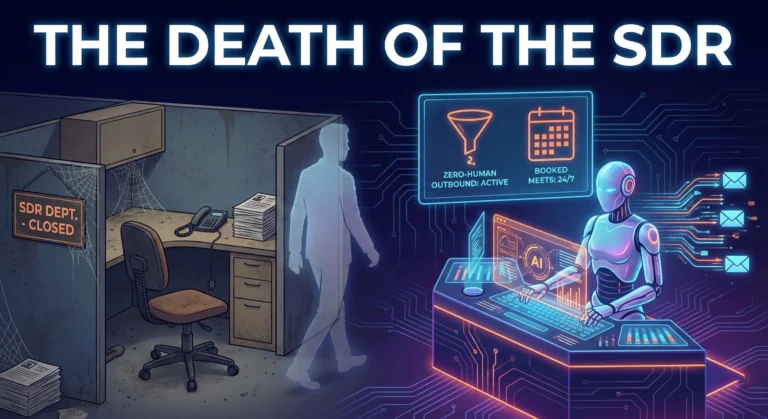
    The Death of the SDR: Building a “Zero-Human” Outbound Team

    Let’s be brutally honest for a moment. The “SDR Sweatshop” model is finally dead.

    We all knew it was broken back in 2023. But here in February 2026, continuing to run it is financial negligence. Taking bright, ambitious 22-year-olds and forcing them to act like spam-bots—sending 150 generic emails a day just to get a 0.5% reply rate—isn’t a strategy anymore. It’s insanity.

    The fundamental shift of the last two years isn’t just that AI got better at writing. It’s that AI got “agency.”

    We have moved past needing humans in the loop for low-value tasks. The future of high-growth B2B sales is the “Zero-Human” Outbound Team.

    The Math Just Doesn’t Work Anymore

    The demise of the Sales Development Representative (SDR) role comes down to cold, hard economics.

    An entry-level SDR in San Francisco, London, or New York costs anywhere from $80,000 to $120,000 fully loaded (salary, commission, tools, benefits). They work roughly 8 hours a day, they burn out in 14 months, and they spend 40% of their time just screwing around in Salesforce.

    In 2026, an autonomous AI agent—like 11x’s Alice, Artisan’s Ava, or a custom-built Agentforce flow—costs a fraction of that. It works 24/7/365. It never gets demoralized by rejection. It never forgets to follow up. It researches 1,000 leads in the time it takes a human to research ten.

    The ROI gap is now too wide for any CFO to ignore. If your competitor is using agents to book meetings at $50 a pop, and you’re using humans to book them at $500 a pop, you have already lost.

    Autonomy vs. Assistance

    The mistake most VPs of Sales are making right now is confusing “AI Co-pilots” with “AI Agents.”

    • A Co-pilot helps a human write an email faster. The human is still the bottleneck.
    • An Agent does the whole job. It finds the lead on LinkedIn, reads their recent posts to find a hook, drafts the email, sends it, reads the reply, handles basic objections, and books time on the Account Executive’s calendar. No human touches the process until the prospect says, “Sure, let’s talk.”

    We are now building outbound engines where the only human input is defining the Ideal Customer Profile (ICP), and the only human output is a booked Zoom call.

    The New Sales Org Chart

    So, do we fire everyone? No. But the pyramid is inverting.

    The bottom layer of the sales stack—the brute-force prospecting layer—is being automated away. The role of the “SDR Manager” is rapidly evolving into an “AI Ops Manager.” This person doesn’t motivate 20-somethings; they manage prompt libraries, monitor agent hallucination rates, and ensure data hygiene.

    This is liberation, not destruction. Humans are terrible at repetitive, robotic tasks. We are fantastic at empathy, complex negotiation, and relationship building.

    By outsourcing the grunt work to agents, your Account Executives (AEs) stop chasing ghosts and start spending their time actually selling to qualified buyers.

    The Final Pivot

    The transition is painful. It requires tearing down playbooks that have worked for a decade. But the companies that win in 2027 won’t be the ones with the biggest army of SDRs making cold calls. They will be the ones with the smartest swarms of autonomous agents.

    Stop hiring people for a job that no longer exists. It’s time to build the machine.
  • ·

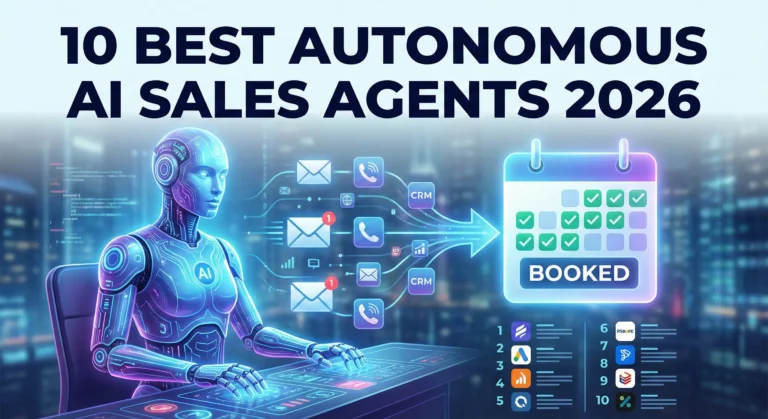
    10 Best Autonomous AI Sales Agents in 2026 (That Actually Book Meetings)

    Let’s rip the band-aid off: The traditional SDR model is broken. Burning out young graduates by making them send 100 generic emails a day isn’t just cruel; in 2026, it’s bad business. Response rates are plummeting, and CAC (Customer Acquisition Cost) is skyrocketing.

    The solution isn’t “better templates.” It’s Digital Workers.

    We aren’t talking about chatbots that sit on your website waiting for visitors. We are talking about Autonomous Outbound Agents—AI that wakes up, logs into your CRM, finds leads, researches them, and sends hyper-personalized emails (or even makes calls) without you lifting a finger.

    I’ve tested the top contenders. Here are the 10 best AI Sales Agents that are actually worth your budget this year.

    1. 11x.ai (Alice)

    Best For: Pure autonomous outbound. If you’ve been on LinkedIn lately, you’ve heard of Alice. She is the closest thing to a “set it and forget it” AI SDR.

    • What she does: Alice finds leads, researches their LinkedIn activity, and drafts emails that sound frighteningly human.
    • The Killer Feature: She doesn’t just “blast.” She waits. She understands timing and follow-up cadence better than most junior reps.

    2. Artisan (Ava)

    Best For: Teams who want an “All-in-One” AI Employee. Artisan positions its agent, Ava, not as a tool but as a hire.

    • What she does: Ava automates the entire outbound stack. She has a built-in database of 300M+ B2B contacts (so you don’t need ZoomInfo) and handles the email warming and sending herself.
    • The Killer Feature: The “Waterfall” personalization. Ava stitches together data from news, funding rounds, and hiring posts to write emails that actually make sense.

    3. Salesforce Agentforce (SDR Agent)

    Best For: Enterprise teams living in Salesforce. For years, Salesforce AI was just “Einstein” giving you scores. Agentforce is different. It uses the new “Atlas” reasoning engine to actually do the work.

    • What it does: It lives inside your Sales Cloud. It qualifies inbound leads 24/7 and can autonomously nurture them until they are ready to buy.
    • The Killer Feature: Security. It respects your enterprise data governance. It won’t hallucinate your Q4 targets to a competitor.

    4. HubSpot Breeze (Prospecting Agent)

    Best For: Mid-market companies using HubSpot. If Salesforce is the tank, HubSpot Breeze is the sports car. It’s fast to deploy and lives natively in your CRM.

    • What it does: It researches companies in your target market and adds them to your CRM with “enriched” data, then drafts the outreach for you.
    • The Killer Feature: Ease of use. You don’t need a systems integrator to set this up. You turn it on, and it works.

    5. Clay (Claygent)

    Best For: Deep research and data enrichment. Clay isn’t a traditional “sender,” but its agent, Claygent, is the secret weapon of the world’s best growth hackers.

    • What it does: You give it a task like “Find me every VP of Sales in London who is hiring and loves golf.” Claygent scrapes the web, checks job boards, reads LinkedIn posts, and builds you a list that is 99% accurate.
    • The Killer Feature: It replaces your research team. It can visit 1,000 websites in minutes to verify if they use your competitor’s software.

    6. Regie.ai

    Best For: Enterprise-grade personalization and “Auto-Pilot.” Regie started as a writing assistant but has evolved into a full-blown agent.

    • What it does: It uses “Auto-Pilot” to continuously scan for triggers (like a funding announcement) and instantly enrolls that prospect into a sequence.
    • The Killer Feature: It solves the “blank page” problem. It dynamically builds campaigns based on who the prospect is, not just what template you picked.

    7. SalesCloser.ai

    Best For: Voice and Video demos. Most agents just write text. SalesCloser can talk.

    • What it does: It can join a Zoom call, give a product demo, and handle objections in real-time using voice.
    • The Killer Feature: It can handle the “discovery call” for smaller accounts that your human AEs don’t have time for.

    8. Reply.io (Jason AI)

    Best For: High-volume agencies. If you are an agency running outreach for 50 clients, Jason AI is your workhorse.

    • What it does: It handles the back-and-forth. When a lead replies “Not interested,” Jason handles it. When they say “Call me Tuesday,” Jason books it.
    • The Killer Feature: It integrates with everything, making it a great “layer” on top of your existing messy stack.

    9. Lindy.ai

    Best For: Custom workflows. Lindy is flexible. You can build a “Sales Lindy,” a “Support Lindy,” or a “Recruiting Lindy.”

    • What it does: It’s great for tasks that require jumping between apps—like “Check my email, update the CRM, then Slack the AE.”
    • The Killer Feature: You can “teach” it new skills just by recording your screen.

    10. AiSDR

    Best For: Budget-conscious teams. If 11x and Artisan are too pricey, AiSDR is the solid challenger.

    • What it does: It automates the email loop—drafting, sending, and qualifying—at a fraction of the cost of a full-time hire.
    • The Killer Feature: It reacts to objections. If a lead says “too expensive,” AiSDR knows how to pivot to a “budget-friendly” value prop.

    The Bottom Line

    If you are an Enterprise shop, go with Agentforce. If you are a startup or growth team, look at 11x or Artisan.

    But whatever you do, stop hiring humans to do a robot’s job. Your competitors already have.