AI Affiliate Marketing

Affiliate marketers are increasingly using AI tools to streamline content creation, analyze marketing data, and optimize promotional strategies. Artificial intelligence can assist with generating blog content, creating marketing assets, and automating repetitive tasks involved in affiliate marketing workflows.

This category explores how AI-powered tools can be applied to affiliate marketing strategies, including content production, SEO research, and audience engagement.

AI Growth Gear analyzes technologies that help affiliate marketers scale their operations while maintaining efficiency and consistency in their marketing efforts.

  • ·

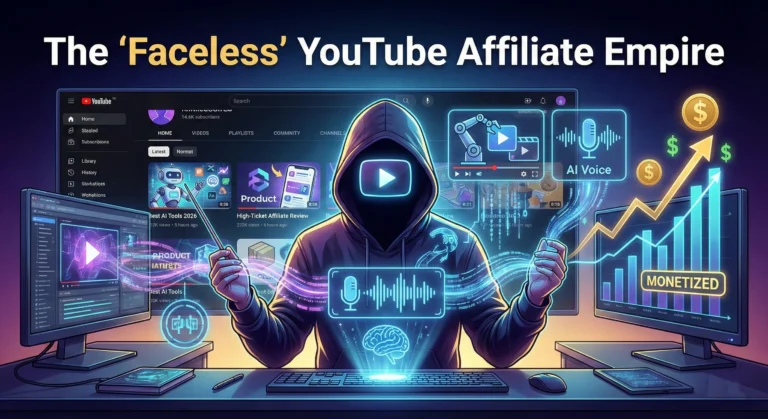
    The “Faceless” YouTube Affiliate Empire

    Let’s be honest. The thought of setting up a ring light, staring down a camera lens, and trying to act excessively energetic for ten minutes sounds exhausting to most of us.

    For years, the advice was: “If you want YouTube affiliate money, you have to be a personality.” You had to be the brand.

    In 2026, that advice is obsolete.

    We have entered the golden age of the “Faceless Channel.” These aren’t the janky, slideshow videos with robotic voices from five years ago. Today’s faceless channels use AI tools so sophisticated that viewers often don’t realize they are watching synthetic media. They are slick, professional, and incredibly profitable assets that run almost on autopilot.

    If you are an introverted solo-preneur looking for a high-leverage side hustle, this is your playbook.

    1. Stop Picking “Penny Niches”

    The biggest mistake beginners make is choosing niches with low payouts. Forget “Top 10 Amazon Kitchen Gadgets Under $20.” The margins are too thin to sustain a real business.

    In 2026, the faceless goldmine is in high-ticket digital products and services. You want niches where a single affiliate commission lands you $50 to $500.

    • B2B SaaS Reviews: Deep dives into CRM software, AI marketing tools, or project management platforms. Businesses spend big money here.
    • Financial Tech: Comparing premium credit cards, investment platforms, or crypto security devices.
    • High-End Education: Reviewing expensive certification courses or bootcamps.

    You need fewer views to make real money in these spaces. A channel with 5,000 targeted views on “Best Enterprise AI Sales Tools” will out-earn a channel with 100,000 views on “Funny Cat Toys.”

    2. The 2026 “Invisible Stack”

    The technology has matured. You no longer need to hire an editor or a voice actor to compete with the big channels. You just need to be a good director of AI agents.

    • The Brain (Scripting): Don’t just ask ChatGPT to “write a script.” Use models like Claude or Gemini Pro to analyze top-performing competitor videos and analyze their structure. Then, prompt the AI to write a script that focuses on information density—giving the viewer pure value without the fluff.
    • The Voice (Audio): The robotic monotone is dead. Tools like ElevenLabs or OpenAI’s Voice Engine now offer hyper-realistic voices with breath, inflection, and emotion. You can even clone your own voice once and never speak into a mic again.
    • The Visuals (Video): This is the game-changer of 2026. We have moved beyond simple stock footage mixing. New text-to-video models allow you to generate specific B-roll scenes, animate diagrams, or create slick motion graphics just by describing them.

    3. Bridging the “Trust Gap”

    Here is the catch: audiences in the US and UK are savvy. If your video feels too synthetic—like it was purely churned out by a machine with no human oversight—they will click away.

    The secret to a successful faceless empire is being a “Cyborg.” You use AI for the heavy lifting, but you inject undeniable human proof.

    If you are reviewing software, don’t just show generic stock footage of people typing. Use screen recording software to show the actual dashboard of the tool you are reviewing. Show the mouse moving. Show the actual results.

    The AI provides the polish; you provide the evidence.

    The Bottom Line

    The barrier to entry for YouTube has never been lower, but the bar for quality has never been higher. The winners won’t be the loudest personalities; they will be the smartest operators who know how to leverage AI to build digital real estate that earns money while they sleep.
  • ·

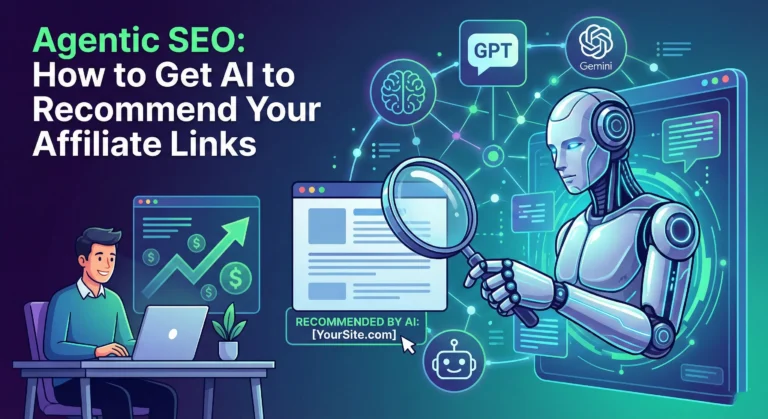
    Agentic SEO: How to Get AI to Recommend Your Affiliate Links

    Let’s be real for a second: when was the last time you scrolled past the AI summary to click on a random blog link?

    If you’re like most users in 2026, the answer is “rarely.”

    For solo entrepreneurs and affiliate marketers, this is terrifying. We spent years worshiping the Google algorithm, learning to structure our H1s and stuff keywords into alt tags. But the game has changed. We aren’t just optimizing for a search engine anymore; we are optimizing for agents—AI models like Gemini, ChatGPT, and Claude that don’t just give users a list of options, but give them an answer.

    This is Agentic SEO (sometimes called GEO or AEO). And if you want your affiliate links to survive, you need to stop writing for clicks and start writing for citations.

    Here is the straightforward, no-fluff guide on how to get AI agents to recommend your products.

    1. The “Answer Capsule” Strategy

    AI models are impatient readers. When they scan your content, they are looking for a direct, factual answer to a specific question. If you bury your affiliate recommendation in paragraph four after a long-winded intro about “the history of running shoes,” the AI will ignore you.

    You need to use Answer Capsules.

    This is a specific formatting trick where you place a direct, 40-60 word answer immediately after an H2 question.

    • Bad: There are many factors to consider when buying a microphone…
    • Good: The best budget microphone for podcasting in 2026 is the Rode PodMic. It offers broadcast-quality sound for under $100 and rejects background noise better than the Blue Yeti.

    By front-loading the facts, you make it easy for the AI to “grab” that snippet and serve it to the user—usually with a citation link back to your site.

    2. Data is the New Keyword

    In the old days, we competed on keyword density. Today, we compete on Information Gain.

    LLMs (Large Language Models) are trained to prioritize unique data. If your review of a software tool just rewrites the features list from the company’s homepage, the AI has no reason to cite you. It already knows that info.

    To win, you need to create new data points that the AI doesn’t have.

    • Don’t just say “The battery lasts a long time.”
    • Say: “In our stress test, the battery lasted 14 hours and 12 minutes.”

    When you provide specific, hard numbers, AI agents flag your content as a primary source. This dramatically increases the chance that when a user asks, “Which laptop has the best validated battery life?”, the AI will pull your stat and your link.

    3. The “Reddit” Factor

    Here is a weird twist: to rank your website, you might need to spend more time off of it.

    AI models like Perplexity and Google’s Gemini rely heavily on “human consensus” to verify facts. They look at platforms like Reddit, Quora, and G2 to see what actual humans are saying.

    If you are a solo affiliate, you can’t just be a ghost. You need to build a brand “entity.” If people on Reddit are discussing your blog post as a good resource, or if you are mentioned in forum discussions as a trustworthy reviewer, the AI picks up on that signal. It treats your site as a verified authority.

    The Action Step: Don’t just spam links. Engage in communities. Be the expert who answers questions. When the AI sees your brand name associated with “helpful answers” across the web, it starts trusting your site’s content too.

    4. Structure for Machines (Schema is King)

    Finally, you have to speak the robot’s language. In 2026, “Schema Markup” isn’t optional technical mumbo-jumbo; it’s mandatory.

    You need to use JSON-LD schema to explicitly tell the AI what your page is about. Are you reviewing a product? Use Product schema. Are you writing a tutorial? Use HowTo schema.

    This gives the AI a structured map of your content, making it effortless for it to extract your price comparisons, pros/cons, and ratings. The easier you make it for the AI to understand your data, the more likely it is to use it.

    The Bottom Line

    The “generic” affiliate site is dead. The “AI-Recommended” expert is the new king. Stop writing generic fluff and start building a library of hard data, direct answers, and structured facts. That is how you win the trust of the machines—and the clicks of the humans.