Let’s be honest. The thought of setting up a ring light, staring down a camera lens, and trying to act excessively energetic for ten minutes sounds exhausting to most of us.
For years, the advice was: “If you want YouTube affiliate money, you have to be a personality.” You had to be the brand.
In 2026, that advice is obsolete.
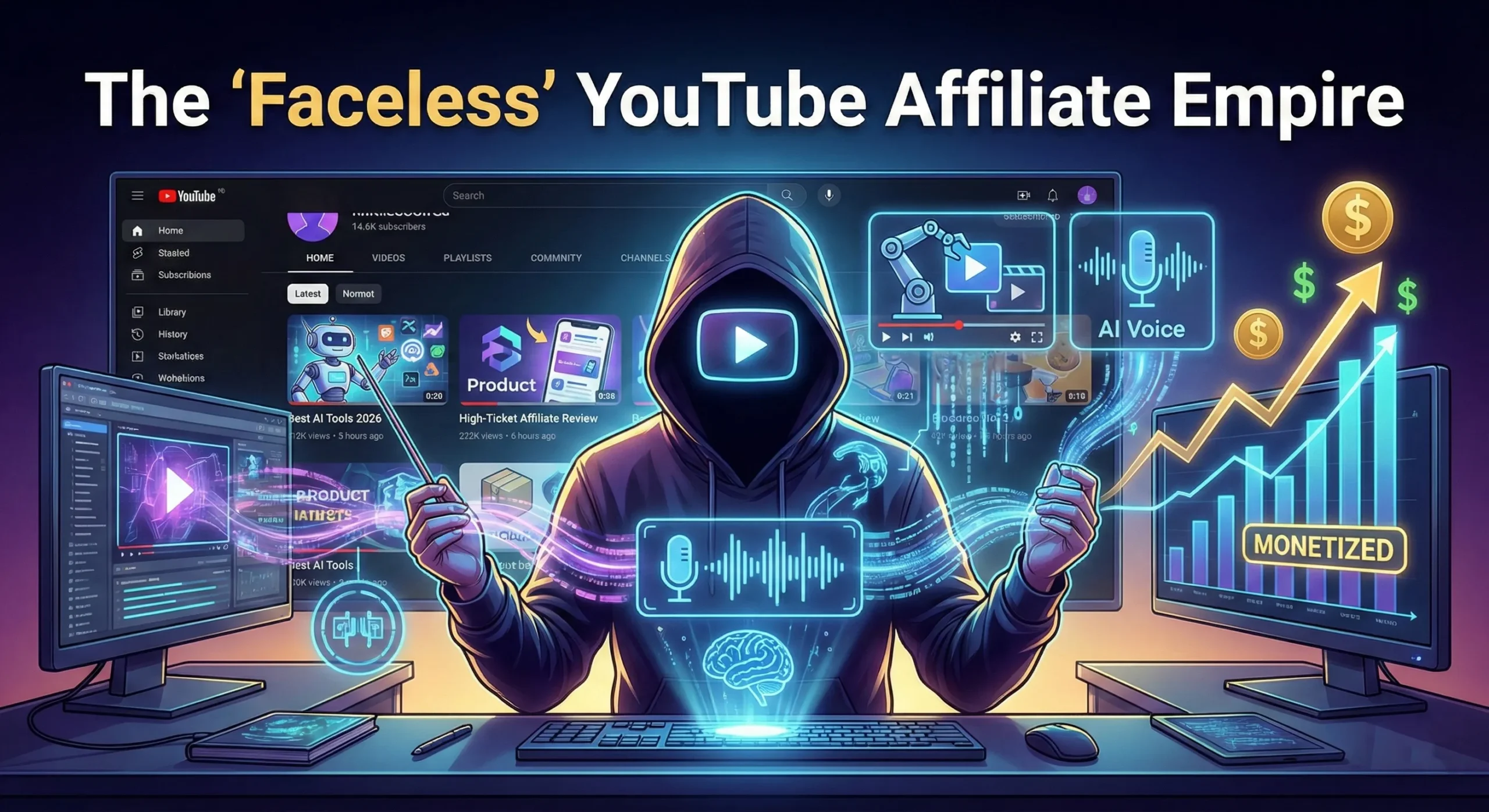
We have entered the golden age of the “Faceless Channel.” These aren’t the janky, slideshow videos with robotic voices from five years ago. Today’s faceless channels use AI tools so sophisticated that viewers often don’t realize they are watching synthetic media. They are slick, professional, and incredibly profitable assets that run almost on autopilot.
If you are an introverted solo-preneur looking for a high-leverage side hustle, this is your playbook.
1. Stop Picking “Penny Niches”
The biggest mistake beginners make is choosing niches with low payouts. Forget “Top 10 Amazon Kitchen Gadgets Under $20.” The margins are too thin to sustain a real business.
In 2026, the faceless goldmine is in high-ticket digital products and services. You want niches where a single affiliate commission lands you $50 to $500.
B2B SaaS Reviews: Deep dives into CRM software, AI marketing tools, or project management platforms. Businesses spend big money here.
High-End Education: Reviewing expensive certification courses or bootcamps.
You need fewer views to make real money in these spaces. A channel with 5,000 targeted views on “Best Enterprise AI Sales Tools” will out-earn a channel with 100,000 views on “Funny Cat Toys.”
2. The 2026 “Invisible Stack”
The technology has matured. You no longer need to hire an editor or a voice actor to compete with the big channels. You just need to be a good director of AI agents.
The Brain (Scripting): Don’t just ask ChatGPT to “write a script.” Use models like Claude or Gemini Pro to analyze top-performing competitor videos and analyze their structure. Then, prompt the AI to write a script that focuses on information density—giving the viewer pure value without the fluff.
The Voice (Audio): The robotic monotone is dead. Tools like ElevenLabs or OpenAI’s Voice Engine now offer hyper-realistic voices with breath, inflection, and emotion. You can even clone your own voice once and never speak into a mic again.
The Visuals (Video): This is the game-changer of 2026. We have moved beyond simple stock footage mixing. New text-to-video models allow you to generate specific B-roll scenes, animate diagrams, or create slick motion graphics just by describing them.
3. Bridging the “Trust Gap”
Here is the catch: audiences in the US and UK are savvy. If your video feels too synthetic—like it was purely churned out by a machine with no human oversight—they will click away.
The secret to a successful faceless empire is being a “Cyborg.” You use AI for the heavy lifting, but you inject undeniable human proof.
If you are reviewing software, don’t just show generic stock footage of people typing. Use screen recording software to show the actual dashboard of the tool you are reviewing. Show the mouse moving. Show the actual results.
The AI provides the polish; you provide the evidence.
The Bottom Line
The barrier to entry for YouTube has never been lower, but the bar for quality has never been higher. The winners won’t be the loudest personalities; they will be the smartest operators who know how to leverage AI to build digital real estate that earns money while they sleep.
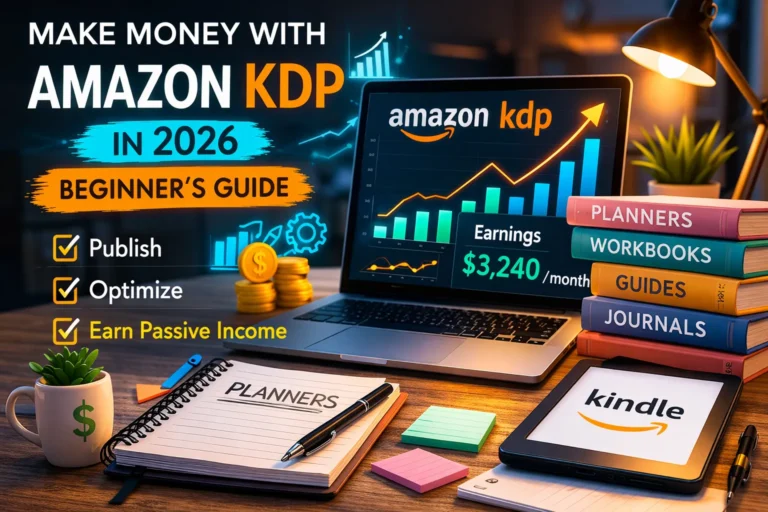
How to Make Money with Amazon KDP in 2026 (Beginner’s Guide)
Many beginners jump into Amazon KDP expecting instant passive income — and quit within months when results don’t appear. The issue isn’t the platform. It’s the strategy.
Kindle Direct Publishing (KDP) remains one of the most accessible digital product businesses in 2026. But it rewards research, positioning, and consistency — not random uploads.
Let’s break down how to approach KDP realistically and profitably.
📌 What Makes KDP Still Relevant in 2026?
Amazon is still the largest book marketplace globally. Unlike social platforms, where visibility fades quickly, books on Amazon continue generating traffic long-term through search.
You’re not “posting content.” You’re building digital assets.
KDP works especially well for:
Low-content books (planners, journals, trackers)
Workbooks and guided notebooks
Niche hobby guides
Professional templates converted into printable books
AI-assisted research-based guides
The key is niche precision.
🚀 Step 1: Choose a Niche That Has Demand — Not Just Trend
Instead of chasing generic ideas like “fitness journal,” think micro-niches.
For example:
ADHD planners for remote workers
Budget planners for single parents
Homeschool science experiment logbooks
Anxiety tracking journals for teens
These aren’t random. They solve specific problems.
💡 A quick validation method: Search your idea on Amazon. If:
There are books with reviews (demand exists)
But competition is not saturated with thousands of similar covers
And search suggestions appear in the dropdown
You’re on the right track.
⚡ Step 2: Create With Structure, Not Guesswork
You don’t need to be a designer. Tools like Canva, AI layout assistants, and research tools can speed up the process.
For low-content books:
Maintain clean margins
Use consistent page layout
Avoid over-designed interiors
Focus on usability
For informational books:
Add clear chapter structure
Include real examples
Provide actionable frameworks
Keep formatting professional
AI tools can assist with outlines and idea expansion — but avoid publishing generic AI-generated manuscripts. Add real-world thinking and clarity.
📊 Step 3: Optimize for Amazon SEO
Publishing is not enough. Visibility matters.
Key optimization areas:
✅ Title & Subtitle
Include searchable keywords naturally. Example: “ADHD Daily Planner for Remote Professionals (6-Month Productivity System)”
✅ Backend Keywords
Use all 7 backend keyword fields wisely. Avoid repeating title words.
✅ Categories
Choose less competitive subcategories. Ranking #3 in a niche category is better than #2000 in a broad one.
💰 How Much Can You Earn?
KDP income varies widely.
Royalty structure:
60% for paperbacks (minus printing costs)
70% for eBooks (in selected price ranges)
Most beginners make:
$50–$300/month initially
With 5–10 well-optimized books
Serious publishers treat it like a portfolio business.
Instead of 1 viral book, aim for: 📌 15–20 targeted assets over time.
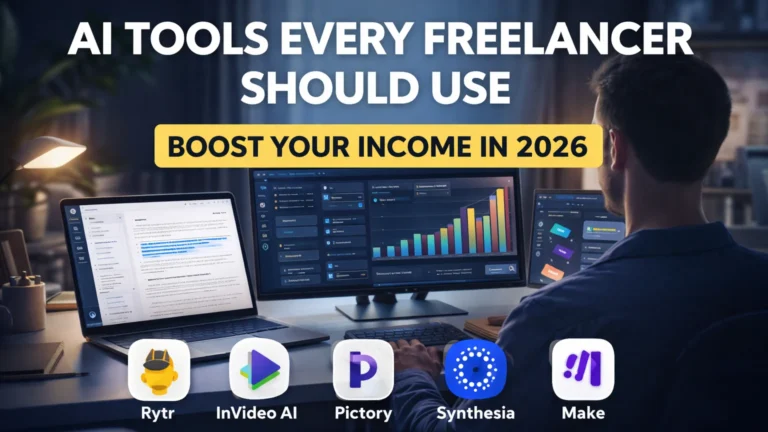
A freelancer leveraging AI tools to manage multiple income streams, with real-time analytics and growth insights displayed on a modern digital dashboard.
Let’s be real for a second: when was the last time you scrolled past the AI summary to click on a random blog link?
If you’re like most users in 2026, the answer is “rarely.”
For solo entrepreneurs and affiliate marketers, this is terrifying. We spent years worshiping the Google algorithm, learning to structure our H1s and stuff keywords into alt tags. But the game has changed. We aren’t just optimizing for a search engine anymore; we are optimizing for agents—AI models like Gemini, ChatGPT, and Claude that don’t just give users a list of options, but give them an answer.
This is Agentic SEO (sometimes called GEO or AEO). And if you want your affiliate links to survive, you need to stop writing for clicks and start writing for citations.
Here is the straightforward, no-fluff guide on how to get AI agents to recommend your products.
1. The “Answer Capsule” Strategy
AI models are impatient readers. When they scan your content, they are looking for a direct, factual answer to a specific question. If you bury your affiliate recommendation in paragraph four after a long-winded intro about “the history of running shoes,” the AI will ignore you.
You need to use Answer Capsules.
This is a specific formatting trick where you place a direct, 40-60 word answer immediately after an H2 question.
Bad:There are many factors to consider when buying a microphone…
Good:The best budget microphone for podcasting in 2026 is the Rode PodMic. It offers broadcast-quality sound for under $100 and rejects background noise better than the Blue Yeti.
By front-loading the facts, you make it easy for the AI to “grab” that snippet and serve it to the user—usually with a citation link back to your site.
2. Data is the New Keyword
In the old days, we competed on keyword density. Today, we compete on Information Gain.
LLMs (Large Language Models) are trained to prioritize unique data. If your review of a software tool just rewrites the features list from the company’s homepage, the AI has no reason to cite you. It already knows that info.
To win, you need to create new data points that the AI doesn’t have.
Don’t just say “The battery lasts a long time.”
Say: “In our stress test, the battery lasted 14 hours and 12 minutes.”
When you provide specific, hard numbers, AI agents flag your content as a primary source. This dramatically increases the chance that when a user asks, “Which laptop has the best validated battery life?”, the AI will pull your stat and your link.
3. The “Reddit” Factor
Here is a weird twist: to rank your website, you might need to spend more time off of it.
AI models like Perplexity and Google’s Gemini rely heavily on “human consensus” to verify facts. They look at platforms like Reddit, Quora, and G2 to see what actual humans are saying.
If you are a solo affiliate, you can’t just be a ghost. You need to build a brand “entity.” If people on Reddit are discussing your blog post as a good resource, or if you are mentioned in forum discussions as a trustworthy reviewer, the AI picks up on that signal. It treats your site as a verified authority.
The Action Step: Don’t just spam links. Engage in communities. Be the expert who answers questions. When the AI sees your brand name associated with “helpful answers” across the web, it starts trusting your site’s content too.
4. Structure for Machines (Schema is King)
Finally, you have to speak the robot’s language. In 2026, “Schema Markup” isn’t optional technical mumbo-jumbo; it’s mandatory.
You need to use JSON-LD schema to explicitly tell the AI what your page is about. Are you reviewing a product? Use Product schema. Are you writing a tutorial? Use HowTo schema.
This gives the AI a structured map of your content, making it effortless for it to extract your price comparisons, pros/cons, and ratings. The easier you make it for the AI to understand your data, the more likely it is to use it.
The Bottom Line
The “generic” affiliate site is dead. The “AI-Recommended” expert is the new king. Stop writing generic fluff and start building a library of hard data, direct answers, and structured facts. That is how you win the trust of the machines—and the clicks of the humans.
Video content is dominating the internet. Platforms like YouTube, TikTok, Instagram Reels, and LinkedIn video have made video one of the most powerful ways to reach audiences online.
However, producing high-quality videos traditionally requires editing skills, expensive software, and significant time investment.
Artificial intelligence is now transforming this process.
AI video tools allow creators to generate videos from scripts, automatically edit clips, add voiceovers, and even create AI presenters. For entrepreneurs, bloggers, and marketers, this means producing professional video content without needing a full production team.
In this guide, we explore the best AI video tools for content creators and how they can help you scale content production faster and more efficiently.
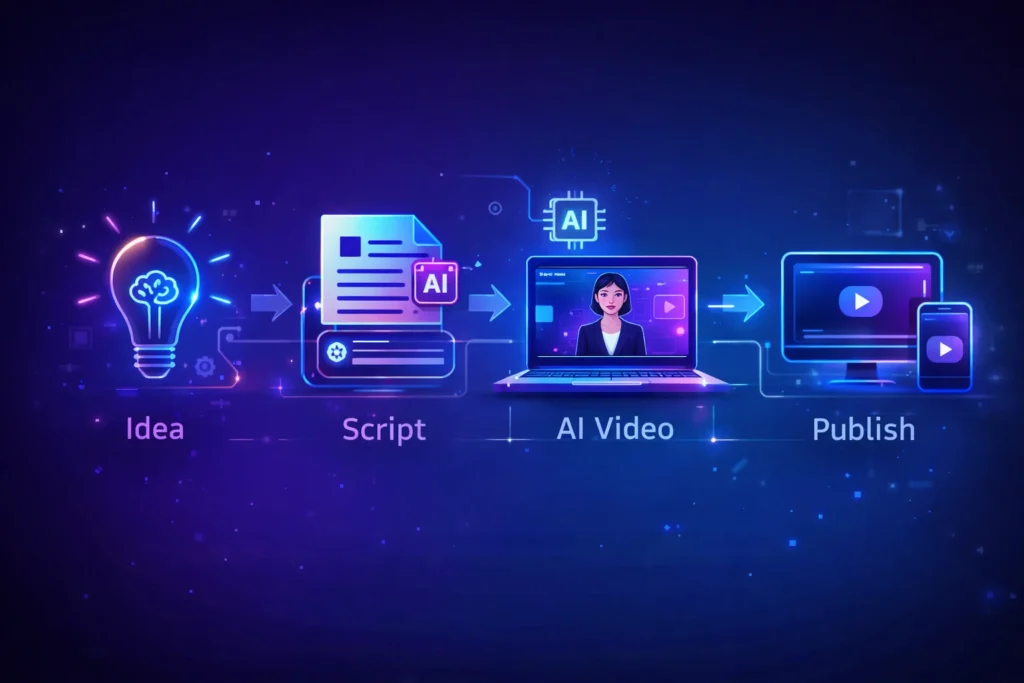
An infographic illustrating the AI video creation workflow, where content creators transform an idea into a script, generate AI-powered videos, and publish them across digital platforms.
Why AI Video Tools Matter 🎥
Video production used to be complicated and time-consuming. AI technology now allows creators to automate many parts of the process.
With the right AI video tools, creators can:
• Produce videos much faster • Reduce editing time dramatically • Convert blog posts into videos • Create faceless YouTube channels • Scale social media marketing campaigns
For freelancers, content creators, and online businesses, these tools help produce more content with fewer resources.
Quick Tool Summary
■ Best Overall:Pictory AI ■ Best Budget Option:InVideo AI ■ Best for Beginners: Lumen5 ■ Best for AI Avatars:Synthesia ■ Best for Advanced Creators: Runway ML
Top AI Video Tools for Content Creators
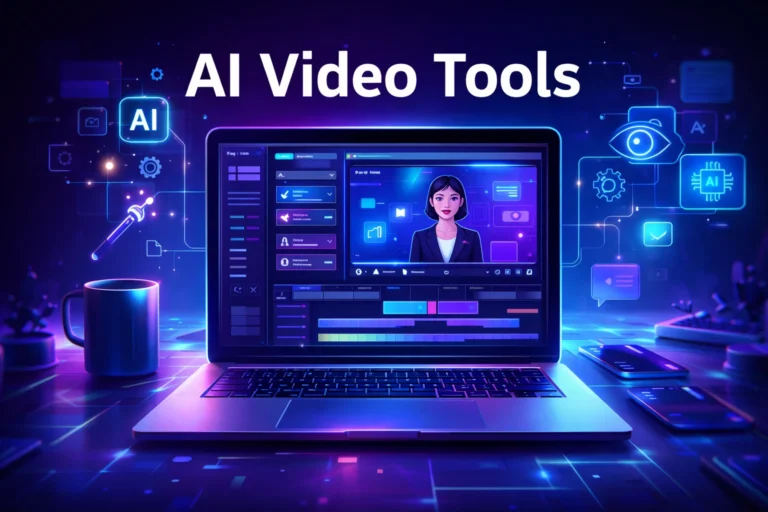
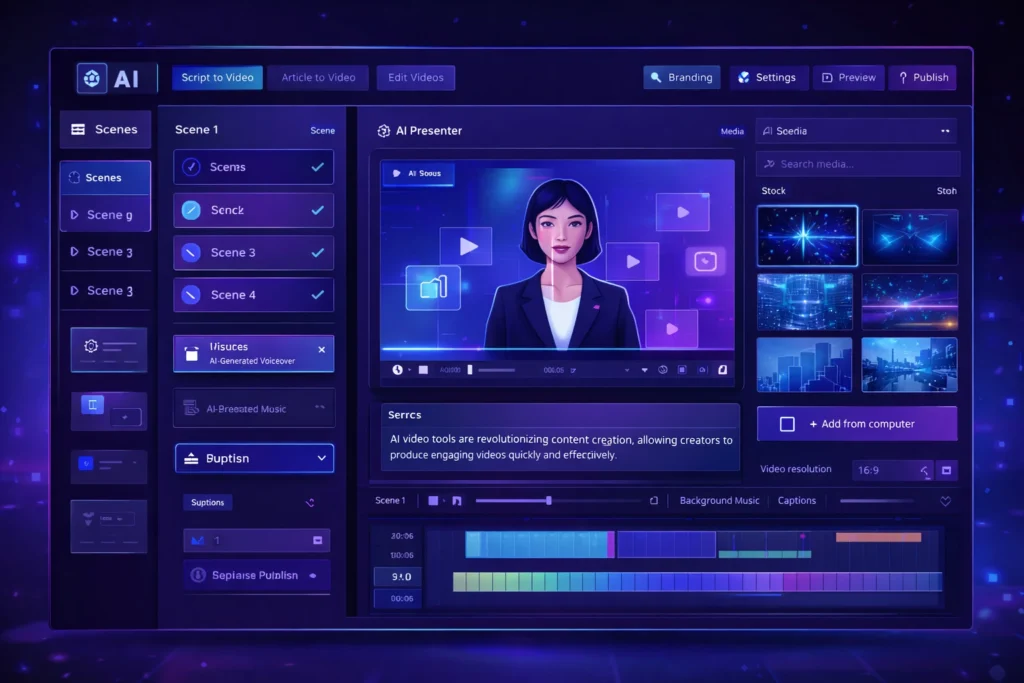
A modern AI video generator dashboard interface displaying an AI presenter, video editing timeline, and automation tools used by content creators to generate videos quickly.
Pictory AI is widely used by bloggers and YouTubers to convert scripts or articles into engaging videos. It automatically matches your script with visuals, adds captions, and generates voiceovers.
This makes it ideal for creating faceless YouTube content or repurposing blog posts.
Key Features
• Script-to-video automation • AI voiceovers • Automatic captions • Large stock footage library
Pros
• Very beginner friendly • Fast video creation
Cons
• Limited customization • Paid plans required for longer videos
Best For
Bloggers, YouTubers, and marketers creating educational or faceless video content.
Synthesia allows creators to generate videos using realistic AI avatars. Instead of recording yourself, you can simply write a script and the AI presenter delivers the message.
This is especially useful for business videos, training materials, and product explainers.
Key Features
• AI avatar presenters • Support for 120+ languages • Text-to-video generation • Professional video templates
Pros
• Professional looking presenters • Great for corporate and educational videos
Cons
• Premium pricing • Limited emotional expressions in avatars
Best For
Businesses, educators, and creators producing professional presentations.
Runway ML is one of the most advanced AI video platforms currently available. It includes powerful AI editing tools, video generation models, and creative features used by filmmakers and digital creators.
This platform is perfect for creators who want more advanced control over video production.
Key Features
• AI video generation tools • Automatic background removal • AI-powered video editing • Creative effects powered by AI models
Pros
• Advanced creative capabilities • Used by professional creators
Cons
• Learning curve for beginners • Higher cost for heavy usage
Best For
Professional creators, filmmakers, and advanced video editors.
InVideo AI focuses on creating videos directly from text prompts. Users simply describe the video they want, and the platform automatically generates visuals, voiceovers, and music.
It’s especially popular among marketers and social media creators.
Key Features
• AI text-to-video generator • Automated script creation • Huge media library • Social media optimized templates
Pros
• Affordable pricing • Simple user interface
Cons
• AI voice quality varies • Limited advanced editing features
Best For
Social media marketers and beginners creating short-form video content.
AI video tools are used for many different purposes.
Common use cases include:
• Creating faceless YouTube channels • Producing Instagram Reels or TikTok content • Repurposing blog articles into videos • Creating product marketing videos • Producing online course materials
Entrepreneurs and digital marketers are increasingly using AI tools to scale content creation across multiple platforms.
Benefits and Limitations
Benefits
• Faster content production • Lower production costs • No advanced editing skills required • Scalable content marketing strategy
Limitations
• Limited creative control in some tools • Subscription costs for premium features • AI-generated content may require manual editing
Despite these limitations, AI video technology continues to improve rapidly.
How to Get Started 🚀
If you are new to AI video tools, follow these steps:
Choose a beginner-friendly platform such as Pictory or InVideo.
Start with short video projects.
Experiment with AI voiceovers and templates.
Optimize videos for platforms like YouTube or TikTok.
Most platforms offer free trials, allowing creators to test the tools before upgrading.
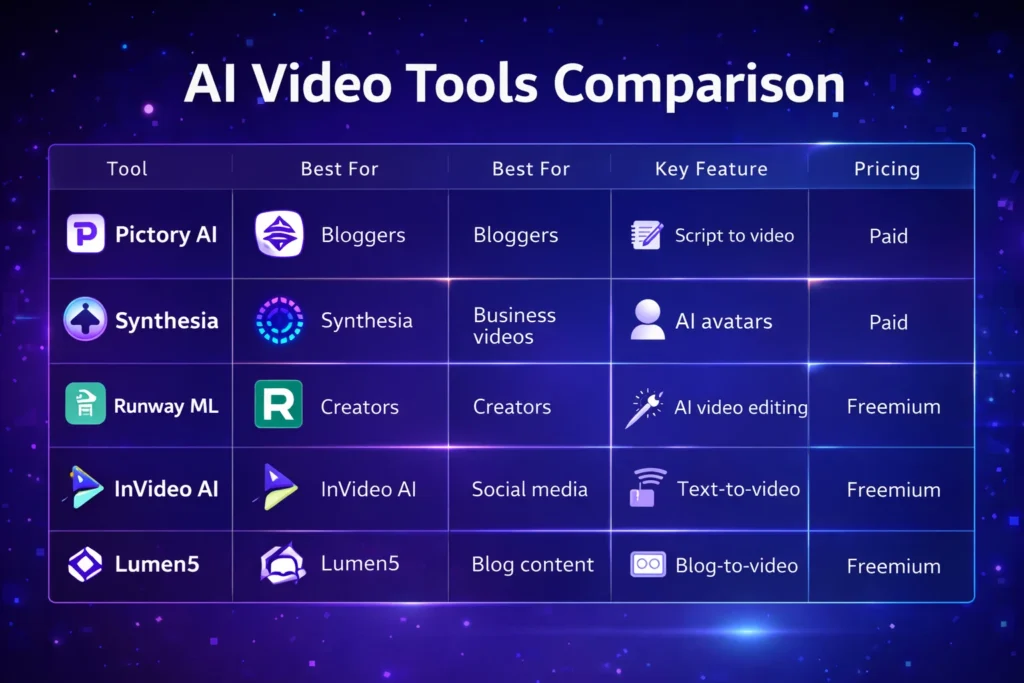
A visual comparison chart highlighting key features, best use cases, and pricing models of leading AI video tools used by content creators.
Conclusion
AI video tools are transforming the way content creators produce video content.
Instead of spending hours editing footage, creators can now generate professional videos using artificial intelligence. Platforms like Pictory, Synthesia, Runway ML, InVideo AI, and Lumen5 make it easier than ever to create high-quality video content.
For entrepreneurs, bloggers, and digital marketers, adopting AI video tools can significantly improve productivity and help scale content marketing efforts.
As AI technology continues evolving, these tools will become an essential part of the modern creator’s workflow.
The statistics are undeniable: video dominates online engagement. But for years, creating high-quality video content has been a monumental task, demanding expensive equipment, skilled crew, and endless hours in the editing suite. This “production bottleneck” has traditionally kept many ambitious brands from fully leveraging video.
Enter AI Video Generators.
In 2026, these tools are no longer just novelties. They are rapidly evolving into powerful platforms that democratize video creation, allowing businesses—from bustling agencies in London to innovative startups in New York—to produce engaging content at unprecedented speed and scale.
But with a new tool emerging every week, how do you choose the right one? At AI Growth Gear, with our foundation in film production and aesthetic communication, we see AI video as more than just pressing a button; it’s about translating vision into compelling motion, with precision and soul.
Why AI Video is No Longer Optional
Speed to Market: Generate marketing videos, social clips, and product explainers in minutes, not days.
Cost Efficiency: Drastically reduce reliance on traditional production budgets, freeing up resources for strategy.
Scalability: Produce personalized video content for diverse audiences without increasing headcount.
Consistency: Maintain brand voice and visual style across all video assets through templating and AI assistance.
What to Look For: A Director’s Checklist for AI Video Generators
Not all AI video generators are created equal. Based on our extensive testing and understanding of professional production needs, here’s what to prioritize:
Aesthetic Output (The Surbhi Chauhan Factor): This is paramount. Does the AI produce videos that look genuinely professional, or do they fall into the “uncanny valley” of robotic, overly polished, or bland visuals? Look for tools that allow granular control over style, lighting, and realistic character animation. Can it capture the texture of your brand?
Ease of Use & Workflow Integration: A tool is only useful if it fits seamlessly into your existing operations. Is the interface intuitive? Can you upload scripts easily? Does it integrate with your content calendar or project management tools (like Notion or Zapier)?
Customization & Brand Control: Can you upload your own brand assets (logos, fonts, color palettes)? Does it offer a range of customizable templates? The more control you have over the final output, the better it aligns with your brand identity.
Voice & Lip-Sync Accuracy: If you’re using AI avatars or text-to-speech, pay close attention to the naturalness of the voice and the lip-sync quality. A robotic voice or mismatched lips can instantly break immersion and trust.
Cost vs. Value: Free tools are tempting, but often come with limitations on quality, features, or branding. Evaluate subscription models based on the number of minutes, avatars, or advanced features you truly need. Calculate the ROI: how much time and money will it actually save you compared to traditional methods?
Ethical Considerations & Rights: Understand the tool’s terms of service regarding content ownership and the ethical use of AI-generated faces or voices. Ensure you have the necessary rights for commercial use.
The Future is in Motion
AI video generators are not here to replace human creativity, but to augment it. They free up creatives to focus on strategic storytelling, conceptualization, and the subtle “director’s touch” that elevates content. By carefully selecting the right AI video gear, you can transform your content strategy, capture more attention, and truly scale your brand’s message.
Ready to bring your brand to life in motion? The right AI video partner is waiting.
Artificial intelligence is transforming how people earn money online. Tasks that once required entire teams can now be handled by a single person using the right AI tools.
For entrepreneurs, freelancers, bloggers, and content creators, AI side hustles offer a powerful opportunity to build additional income streams with minimal startup costs.
From AI-powered writing services to automated video production and digital design businesses, many professionals are already earning money online using artificial intelligence.
The key is identifying AI side hustles that actually generate income, rather than chasing trends that do not deliver results.
In this guide, we explore practical and proven AI side hustles that entrepreneurs and creators are using successfully in 2026.
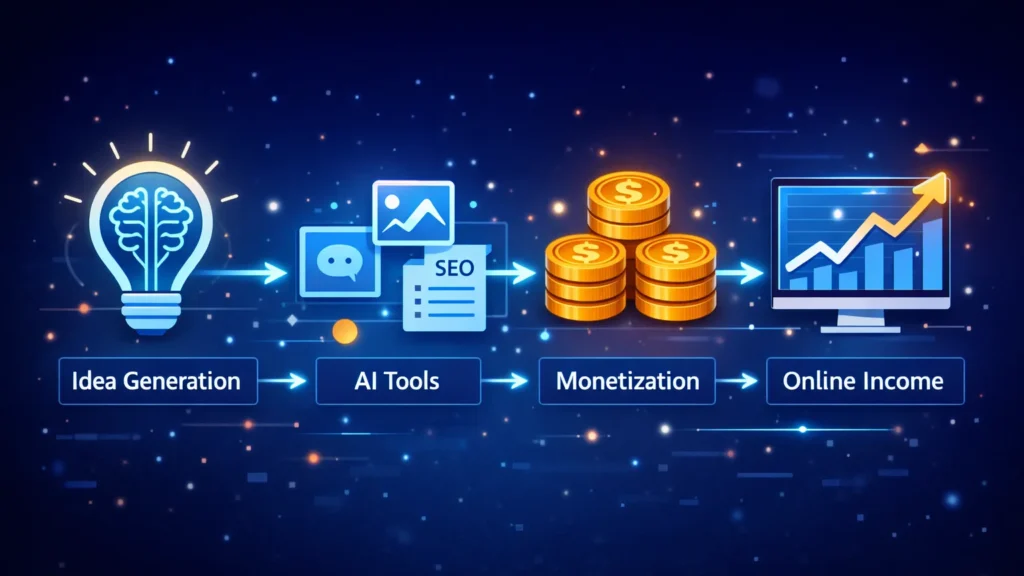
Successful AI side hustles typically follow a workflow: idea generation, using AI tools to create value, monetizing the service, and generating online income.
Quick Tool Summary
■ Best Overall: Jasper AI ■ Best Budget Option: Copy.ai ■ Best for Designers: Midjourney ■ Best for Automation: Zapier ■ Best for Video Content:Pictory AI
Why AI Side Hustles Matter 💡
Artificial intelligence has dramatically reduced the barriers to launching online businesses.
Instead of investing heavily in tools, hiring teams, or spending months learning technical skills, individuals can now use AI to simplify many processes.
AI helps entrepreneurs:
• Produce content faster • Automate repetitive work • Offer scalable digital services • Launch online products quickly
Some of the biggest advantages of AI side hustles include:
• Low startup costs • Flexible remote work opportunities • Scalable online income • Access to global markets
Because of these benefits, AI side hustles are becoming one of the fastest-growing online business trends.
AI Side Hustles That Actually Work 🚀
Here are some of the most practical AI-powered income opportunities.
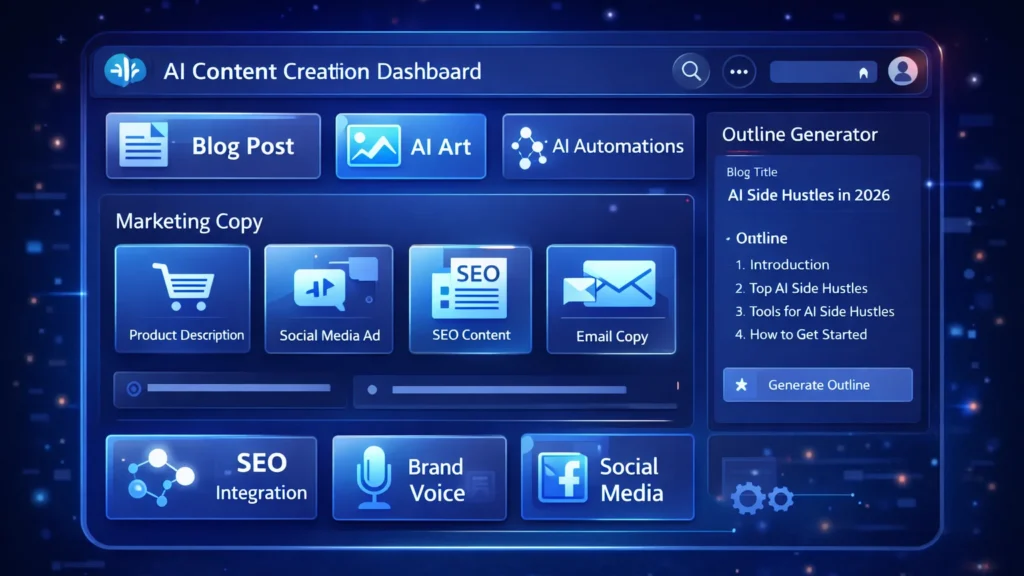
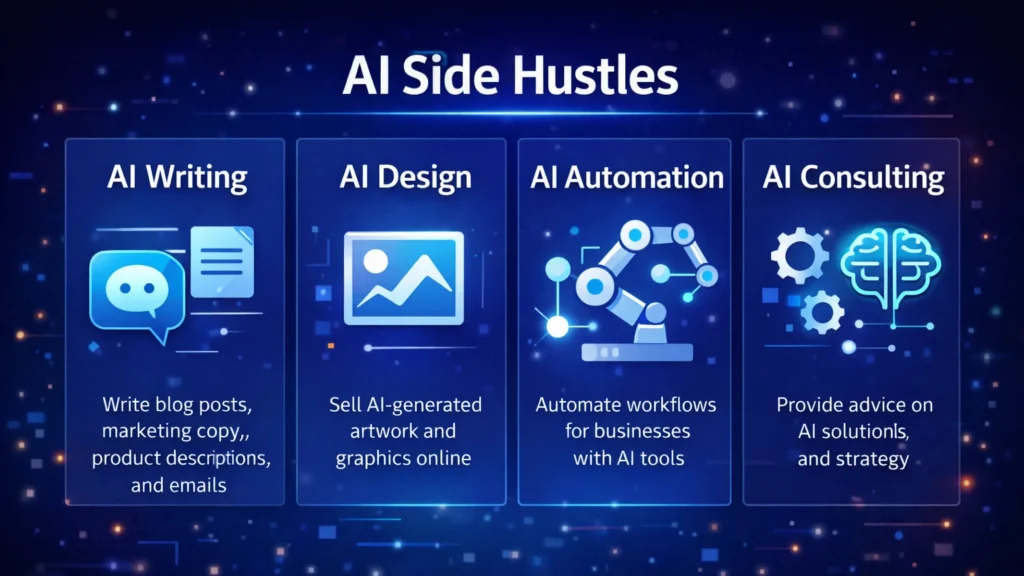
Modern AI platforms combine writing tools, design generators, and automation features to help entrepreneurs build scalable online businesses.
AI Content Writing Services
Businesses constantly need content for blogs, websites, and marketing campaigns.
With AI writing tools, freelancers can produce high-quality content much faster than traditional writing methods.
Popular services include:
• Blog writing • SEO article creation • Website copywriting • Email marketing content
Freelancers often offer these services on platforms like:
• Upwork • Fiverr • Freelancer • LinkedIn
AI Design and Digital Products
AI image generation tools have opened a new market for digital creators.
Entrepreneurs are selling:
• AI art prints • Stock images • Book cover designs • Website graphics
These products can be sold on marketplaces such as:
• Etsy • Creative Market • Gumroad
AI Automation Consulting
Many small businesses want automation systems but lack the technical knowledge to build them.
Automation consultants help businesses create workflows such as:
• Email marketing automation • CRM integrations • Lead generation systems • Customer onboarding workflows
This service is becoming one of the highest-value AI consulting opportunities.
Faceless YouTube Channels
AI tools now allow creators to run YouTube channels without appearing on camera.
Many creators operate multiple channels using AI-driven workflows.
AI Tools That Power These Side Hustles
Jasper AI
Jasper AI is one of the most widely used AI writing platforms for bloggers, marketers, and businesses. It helps generate blog posts, marketing copy, and SEO content quickly while maintaining high quality.
Key Features
• Long-form blog writing • AI marketing templates • Brand voice customization • SEO integrations
Pros
• Produces high-quality content • Saves hours of writing time
Cons
• Higher pricing compared to some tools • Advanced features take time to learn
Best For
Bloggers, affiliate marketers, and agencies producing large amounts of content.
• Bloggers producing SEO articles faster • Agencies scaling marketing content • Designers selling AI-generated artwork • YouTubers creating automated video content • Consultants building AI automation systems
These use cases demonstrate how AI can transform traditional freelance work into scalable digital businesses.
Benefits and Limitations ⚖️
Benefits
• Increased productivity • Reduced business costs • Faster content creation • Automation of repetitive tasks
Limitations
• AI output still requires editing • Growing competition in AI services • Some tools require subscriptions
Successful AI entrepreneurs combine AI efficiency with human creativity and strategy.
How to Get Started 🛠️
Starting an AI side hustle does not require advanced technical skills.
Follow these steps:
Choose a specific AI niche or service
Learn the essential tools required
Build a small portfolio of sample work
Offer services on freelance platforms
Scale your workflow using automation tools
Consistency and experimentation will help you discover the most profitable opportunities.
AI side hustles range from content writing and AI design to automation consulting and digital product creation.
Conclusion
AI side hustles are no longer experimental ideas. They are real business opportunities used by entrepreneurs, freelancers, and digital creators around the world.
By leveraging AI tools for writing, design, automation, and content creation, individuals can launch profitable online income streams with relatively low risk.
The most successful creators focus on solving real problems and delivering value, rather than simply using AI technology.