
|

Best AI Tools for Social Media Automation in 2026

Content creator using AI tools for social media scheduling with analytics dashboard and automation workflow

Managing multiple social media accounts manually can quickly become overwhelming. From creating content to posting consistently and analyzing results, it takes time and effort. That’s where AI tools for social media automation come in.

These tools help you generate content, schedule posts, optimize performance, and even design creatives — all with minimal manual work. Whether you’re a marketer, freelancer, or business owner, using AI can significantly boost your productivity and engagement.

In this guide, we’ll explore the best AI tools for social media automation, including powerful platforms like AdCreative.ai, Ocoya, and Copy.ai.

AI system automating social media posts from creation to publishing across multiple platforms
AI tools streamline content creation and automatically publish posts across social platforms

Social media success depends on consistency, creativity, and timing.

AI tools help you:

  • Save hours every week
  • Post consistently
  • Improve engagement rates
  • Scale content production

For businesses, this means faster growth with fewer resources.


🏆 Best Overall — Ocoya
💰 Best Budget — Copy.ai
🚀 Best for Beginners — Buffer
⚡ Best for Ads & Creatives — AdCreative.ai

Close-up of laptop showing content calendar with scheduled posts and analytics graphs
Plan and organize your social media strategy using a structured content calendar

Description:
Ocoya is an all-in-one AI marketing tool designed specifically for social media automation. It combines content creation, scheduling, and analytics in one platform.

Key Features:

  • AI caption generator
  • Social media scheduler
  • Hashtag suggestions
  • E-commerce integrations

Pros:

  • Complete automation solution
  • Easy to use
  • Great for content + scheduling

Cons:

  • Limited advanced analytics
  • Requires subscription

Best For:
Marketers and small businesses

👉 Try Ocoya →


Description:
AdCreative.ai focuses on generating high-converting ad creatives using AI, making it ideal for social media advertising campaigns.

Key Features:

  • AI-generated ad creatives
  • Conversion-focused designs
  • Performance scoring
  • Multiple ad variations

Pros:

  • Excellent for paid ads
  • High-quality creatives
  • Data-driven

Cons:

  • Not a full scheduler
  • Premium pricing

Best For:
Advertisers and eCommerce brands


Description:
Copy.ai helps you generate captions, posts, and marketing copy for social media in seconds.

Key Features:

  • AI caption generator
  • Content templates
  • Multi-language support
  • Fast output

Pros:

  • Affordable
  • Beginner-friendly
  • Saves time

Cons:

  • No scheduling feature
  • Needs editing

Best For:
Freelancers and beginners


Description:
Buffer is a simple and reliable social media scheduling tool with AI assistance for content ideas.

Key Features:

  • Post scheduling
  • Analytics
  • Clean UI

Pros:

  • Easy to use
  • Affordable
  • Great for beginners

Cons:

  • Limited automation features

Best For:
Small businesses


Description:
Hootsuite offers advanced automation, scheduling, and analytics powered by AI.

Key Features:

  • Multi-platform management
  • AI recommendations
  • Deep analytics

Pros:

  • Enterprise features
  • Strong reporting

Cons:

  • Expensive

Best For:
Agencies


📊 Practical Use Cases

  • Schedule a week’s content in minutes
  • Generate captions instantly
  • Create ad creatives with AI
  • Manage multiple accounts
  • Analyze engagement automatically

⚖️ Benefits and Limitations

Benefits:

  • Saves time
  • Boosts productivity
  • Improves consistency
  • Scales content creation

Limitations:

  • Requires subscriptions
  • Limited human creativity
  • Learning curve

🛠️ How to Get Started

  1. Choose a tool based on your goal
  2. Connect your social accounts
  3. Generate content using AI
  4. Schedule posts
  5. Track performance

Content creator working with multiple screens showing analytics dashboards and AI tools
Boost productivity by managing social media with AI tools and real-time analytics

📊 Comparison Table

ToolBest ForKey FeaturePricing
OcoyaAll-in-oneAI + SchedulingMid-range
AdCreative.aiAdsAI CreativesPremium
Copy.aiContent WritingAI CopywritingBudget
BufferBeginnersSimple SchedulingAffordable
HootsuiteAgenciesAdvanced AnalyticsExpensive

✅ Conclusion

AI tools for social media automation are transforming how businesses and creators manage their online presence. With tools like Ocoya, AdCreative.ai, and Copy.ai, you can automate content creation, improve engagement, and scale your growth effortlessly.

If you’re just starting, go with Copy.ai or Buffer. If you want full automation, Ocoya is your best bet. And for ads, AdCreative.ai is unmatched.



Similar Posts

  • ·

    Visual Backend Builders for Custom AI Apps

    The no-code movement started with simple frontend drag-and-drop website builders. Today, the real revolution is happening entirely behind the scenes. For technical founders, fractional CTOs, and lean dev teams building custom AI applications, the bottleneck isn’t the user interface; it’s the backend logic.

    How do you securely connect your proprietary database to an enterprise LLM, build custom API endpoints, and orchestrate complex routing without spending months writing backend code? The answer lies in visual backend builders.

    At AI Growth Gear (part of the Enoxx News network), we focus heavily on the infrastructure that makes AI scalable. These tools are designed for the “low-code” or highly technical no-code developer who understands logic, databases, and APIs but wants to skip the syntax errors and deployment headaches.

    If you are building an AI app that requires serious backend power, these are the visual API builders you need to master.

    BuildShip: The Visual AI Workflow Engine

    BuildShip has rapidly become a favorite for developers who need to build complex AI features and deploy them as scalable APIs. It is essentially a visual interface for writing backend code, specifically optimized for AI tasks.

    • The Technical Play: Let’s say you are building an app that takes a user’s audio file, transcribes it, runs sentiment analysis via Claude 3, and then saves the result to your database. BuildShip allows you to visually connect these nodes—Stripe for billing, Whisper for transcription, Anthropic for analysis, and Supabase for storage. If you hit a wall with the visual nodes, BuildShip allows you to use its AI assistant to write a custom JavaScript or TypeScript function block right in the middle of the workflow. You get the speed of visual building with the absolute flexibility of custom code.

    Xano: The No-Code Database & API Backend

    If your AI application is highly data-intensive, you need a backend that can handle millions of records without lagging. Xano is widely considered the most powerful no-code backend available, offering a scalable PostgreSQL database and a robust API builder.

    • The Technical Play: Xano is perfect for building the backend of a custom RAG (Retrieval-Augmented Generation) application. You can store your company’s massive internal documents in Xano, use its built-in functions to convert those documents into vector embeddings (often via OpenAI’s API), and then build custom API endpoints that allow your frontend app to query that vector data securely. It handles complex data transformations and logic that would crash lighter platforms, making it ideal for enterprise-grade internal tools.

    Make (Advanced AI Routing): The Logic Orchestrator

    While often thought of as a simple Zapier alternative, Make (formerly Integromat) is actually a visual programming language capable of handling incredibly complex, multi-path routing and error handling.

    • The Technical Play: Make shines when your AI application requires complex “if/then” logic and needs to talk to dozens of different external services. For example, you can build an AI routing system where an incoming user query is first analyzed by a fast, cheap LLM to determine intent. If the query is simple, Make routes it to a pre-written response. If it’s complex, Make routes it to a slower, more expensive model (like GPT-4), formats the response, and sends it back to the user via Slack, Email, or your custom frontend. It allows you to build highly resilient, cost-optimized AI systems visually.

    The Bottom Line

    Building a sophisticated AI application no longer requires a massive backend engineering team. By leveraging visual backend builders like BuildShip, Xano, and Make, technical founders can architect scalable databases, build custom API endpoints, and orchestrate complex LLM logic in a fraction of the time.

  • ·

    Top No-Code AI Builders for Micro-SaaS

    The traditional software development model is broken for solo entrepreneurs. If you are targeting high-value B2B markets in the US and UK, spending months and hundreds of thousands of dollars on a dev team to build an MVP is a massive, unnecessary risk.

    The alternative driving today’s startup ecosystem is the AI micro-SaaS. By combining powerful Large Language Model (LLM) APIs with sophisticated no-code builders, a single founder can launch, monetize, and scale a custom AI product in a matter of weeks. Here at AI Growth Gear—part of the Enoxx News network led by Surbhi Chauhan—Editor-in-Chief Ajay K Saklanii frequently highlights how lean tech stacks and smart automation are leveling the playing field for solo operators.

    Whether you are building a specialized AI copywriting tool for real estate agents or an automated data extraction portal for financial firms, these are the premier no-code platforms to build your B2B micro-SaaS in 2026.

    Bubble: The Full-Stack Powerhouse

    When you need to build complex web applications with heavy backend logic, Bubble remains the undisputed heavyweight champion of the no-code world.

    • The Micro-SaaS Play: Bubble isn’t just a basic site builder; it handles user authentication, secure payment processing (via Stripe integrations), and complex database management. For an AI product, its API Connector is the critical feature. You can seamlessly hook your Bubble frontend into OpenAI, Anthropic, or specialized enterprise models. If you are building a B2B SaaS that requires dynamic prompts, user-specific data storage, and multi-tier subscription plans, Bubble gives you the visual infrastructure to build an enterprise-grade software wrapper without writing a single line of backend code.

    Softr: The High-Speed Client Portal Builder

    If your micro-SaaS relies heavily on organizing, displaying, and interacting with data, Softr is built for absolute speed. It turns Airtable databases or Google Sheets into fully functional, beautifully designed web apps in hours, not weeks.

    • The Micro-SaaS Play: Softr is perfect for building AI-curated directories, gated content portals, or internal agency tools that you plan to white-label and sell to other businesses. Recently, they have integrated native AI features that allow you to generate text and images directly within the app. For a lean startup looking to test a concept in the UK or US markets quickly, you can spin up a functional Softr app, connect it to your database, and start collecting subscription revenue before your competitors have even finished wireframing.

    FlutterFlow AI: The Code-Exportable Native App Builder

    The biggest historical criticism of no-code is vendor lock-in—the fear that you don’t actually own your source code. FlutterFlow solves this entirely. Built on top of Google’s robust Flutter framework, it allows you to build highly responsive web and native mobile apps visually.

    • The Micro-SaaS Play: FlutterFlow has heavily integrated AI directly into its building process. You can generate entire page layouts, database schemas, and even custom UI components using text prompts. More importantly, you can export the clean, readable Flutter code at any time. For founders building high-ticket AI mobile applications (like predictive analytics dashboards for field sales teams), FlutterFlow provides the speed of no-code with the security and scalability of a traditional startup tech stack.

    Glide: The Mobile-First Data Interface

    Glide operates on a simple premise: your business data should be easily accessible and highly actionable. It excels at turning complex spreadsheets into sleek, app-like interfaces designed primarily for mobile use.

    • The Micro-SaaS Play: While not meant for heavy, complex desktop software, Glide is phenomenal for B2B utility apps. If you are building an AI-driven inventory management tool for boutique retailers or a smart CRM overlay for traveling sales reps, Glide’s native AI columns can process text, extract data, and generate summaries directly from the connected data source. It is the fastest route to putting a functional, AI-powered tool directly into your clients’ pockets.

    The Bottom Line

    The term “SaaS development” no longer exclusively means hiring a massive team of engineers. By mastering platforms like Bubble, Softr, FlutterFlow, and Glide, you can build custom AI solutions that solve expensive B2B problems, secure recurring revenue, and command high valuations in the global tech market.

  • ·

    Digital Doubles: HeyGen vs. Synthesia – Choosing Your AI Presenter for 2026

    In business, communication is everything. Whether it’s training your global sales force, delivering personalized video messages to thousands of leads, or creating consistent brand explainers, the demand for engaging video is immense. The traditional approach—hiring presenters, booking studios, shooting, editing—is a bottleneck for even the most agile teams.

    This is where AI Avatar & Business Presenters step in. These aren’t just text-to-speech tools; they create convincing digital humans who can speak your message in multiple languages, with realistic expressions and lip-sync. For businesses in the US and UK looking to scale their video output without scaling their production budget, these platforms are a game-changer.

    At AI Growth Gear, we’ve evaluated the leading platforms with our “Director’s Lens,” focusing on realism, brand integration, and operational efficiency. Here’s how the top two—HeyGen (Avatar IV) and Synthesia—compare for your business.

    The Contenders at a Glance

    FeatureHeyGen (Avatar IV)Synthesia
    Primary StrengthUltra-Realistic Digital TwinsEnterprise-Grade Library & Compliance
    Best ForPersonalized Sales, UGCCorporate Training, Explainers
    WeaknessCustom avatars require more inputStock avatars can feel less unique

    1. HeyGen (Avatar IV): The Ultra-Realist

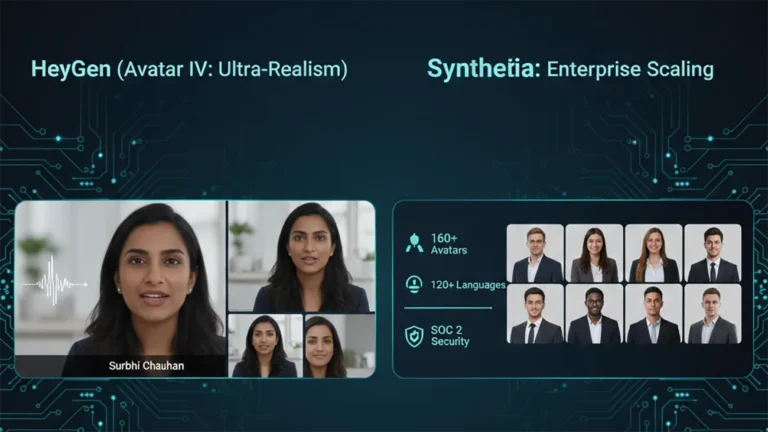
    HeyGen’s latest iteration, Avatar IV, is pushing the boundaries of what’s possible in AI avatar realism. Its “Digital Twin” feature allows businesses to create incredibly lifelike avatars of actual employees or spokespersons from minimal video footage. The subtlety of facial expressions and natural-sounding voice clones are truly impressive.

    • The Aesthetic: Aimed squarely at hyper-realism. If you want your AI presenter to be indistinguishable from a real human, HeyGen is currently leading the pack. It masters the minute details, making it ideal for maintaining a personal touch at scale.
    • The Director’s Take: “HeyGen is for when ‘authentic’ means ‘looks like you.’ It’s unparalleled for personalized sales videos, founder messages, or any content where the presenter’s unique identity is key. It allows a boutique agency to maintain its human brand persona without physically being in every video.”

    2. Synthesia: The Enterprise Powerhouse

    Synthesia has been the long-standing leader in the corporate AI video space, and for good reason. It boasts an extensive library of over 160 diverse stock avatars and 120+ languages, coupled with robust SOC 2 compliance for data security. Its platform is built for scalable, professional use cases across large organizations.

    • The Aesthetic: Polished, professional, and consistent. While its stock avatars are highly realistic, they aim for broad appeal rather than individual uniqueness.
    • The Director’s Take: “Synthesia is the workhorse of the enterprise. If you need to produce hundreds of consistent training modules, international onboarding videos, or routine explainers, its sheer volume of customizable options and security features make it the undisputed choice. It ensures your corporate communication is slick and reliable across the board.”

    The Verdict: Which Digital Double is Right for You?

    • Choose HeyGen if your priority is Personalization and Ultra-Realism. If you need your AI presenter to look and sound exactly like a specific person to build trust or enhance a unique brand identity.
    • Choose Synthesia if your priority is Scalability and Corporate Readiness. If you require a vast library of diverse avatars, multi-language support, and enterprise-grade security for consistent, high-volume video production.

    Our Recommendation for 2026

    For many agencies, the ideal setup might involve a blend: HeyGen for high-impact, personalized, and client-facing content, and Synthesia for internal training, broad-reach explainers, or situations requiring a diverse range of stock avatars. Both tools excel at making video production accessible, but they serve different strategic objectives.

  • ·

    Character Consistency: Midjourney vs. Flux

    If you have ever tried to make an AI comic book or a storyboard, you know the pain.

    You generate a stunning protagonist in Scene 1. Let’s call her “Maya, a cyberpunk hacker with a neon blue undercut.” She looks perfect.

    Then you write the prompt for Scene 2: “Maya sitting in a cafe drinking coffee.”

    Suddenly, Maya has a bob cut. Her jacket changed from leather to denim. Her face structure looks like she aged ten years or turned into her own cousin. The immersion is broken.

    For years, this “Shapeshifter Problem” was the wall that separated “cool AI art” from “actual storytelling.” But in 2026, the wall is crumbling. We now have specific tools designed to lock in a character’s identity.

    We put the two heavyweights—Midjourney and Flux—to the test. Here is who wins the Consistency Battle.

    The Contender: Midjourney (The --cref King)

    Midjourney remains the king of aesthetics, but its “Character Reference” (--cref) feature is what storytellers rely on.

    • How it works: You generate your “Master Image” of Maya. You copy the URL. Then, in your next prompt, you add --cref [url].
    • The Experience: It is shockingly good at capturing the vibe and facial features. In our test, Midjourney kept Maya’s neon hair and facial structure consistent about 85% of the time.
    • The Downside: Midjourney is stubborn. It loves to “prettify” things. If you try to put Maya in a gritty, ugly situation, the AI fights you to make it look cinematic. It also struggles with specific clothing consistency. Maya’s face stays the same, but her outfit tends to hallucinate new zippers and pockets in every frame.

    The Challenger: Flux (The Control Freak)

    Flux (specifically the specialized fine-tunes available in 2026) has taken the open-source world by storm.

    • How it works: Flux relies on “LoRAs” (Low-Rank Adaptation). Think of it as a mini-brain training. You upload 10 photos of a character, and the model learns who they are.
    • The Experience: This is the professional’s choice. Once Flux “knows” Maya, it doesn’t just guess; it understands her geometry. You can rotate her, change the lighting, or put her in a spacesuit, and the face remains identical.
    • The Downside: The learning curve is steep. You aren’t just typing a prompt; you are managing a workflow. You need a decent GPU or a cloud host like Fal.ai or Replicate to run it efficiently.

    The Verdict: Which One Do You Need?

    Choose Midjourney if: You are making a mood board, a pitch deck, or a children’s book where “close enough” is okay. It is fast, easy, and the lighting is always beautiful. The --cref tag is enough to fool the casual eye.

    Choose Flux if: You are building a graphic novel or a recurring brand mascot. If you need the character to wear the exact same logo on their shirt in panel 1 and panel 50, Flux is the only tool that offers that level of rigid consistency.

    The days of the shapeshifter are over. Pick your weapon and start telling your story.

  • ·

    Predictive AI Marketing Software: Stop Churn Before It Happens

    For solo entrepreneurs and boutique agency owners, there’s a silent killer that’s far more damaging than a bad month of sales: churn. You spend countless hours and thousands of dollars acquiring a new high-value client in the US or UK, only to have them quietly slip away through the back door six months later. It’s the classic leaky bucket problem.

    Historically, fixing churn was a reactive game. You’d conduct an exit interview after the client had already left to find out what went wrong. At AI Growth Gear, a division of Enoxx News Private Limited, we believe true digital growth comes from securing your backend financial stability first. That means moving from reactive firefighting to proactive prediction.

    Thanks to a new wave of accessible AI tools, you no longer need a team of data scientists to predict the future. You can now use the data you already have to flag at-risk clients before they cancel. Here are the top predictive AI marketing software platforms that are helping lean businesses turn retention into a science in 2026.

    Pecan AI: The Democratization of Predictive Modeling

    Until recently, building a predictive churn model required a PhD in data science. Pecan AI has changed that by building a low-code platform designed for business users, not just data engineers.

    • The Retention Play: As a solo operator, you are sitting on a goldmine of historical data in your CRM and billing systems. Pecan connects directly to these sources and uses automated machine learning to build custom models specifically for your business. Within days, it can generate a list of your current clients with a “churn probability score.” This allows you to focus your limited time and energy on the 10% of clients who are actually at risk, rather than spray-and-praying generic retention emails to everyone.

    Mixpanel: Behavioral Analytics as a Crystal Ball

    While many tools tell you what happened, Mixpanel specializes in telling you why. It’s a powerful product analytics platform that helps you understand user behavior at a granular, event-based level.

    • The Retention Play: Churn rarely happens overnight; there are almost always leading indicators. Perhaps a client stopped logging into your project management portal, or their usage of a key feature dropped by 30% last month. Mixpanel’s deep behavioral cohort analysis helps you identify these specific patterns of “pre-churn” behavior. By setting up alerts for these leading indicators, you can intervene with a personalized check-in call or a targeted helpful resource at the exact moment a client’s engagement begins to wobble.

    Optimove: The AI Orchestrator for Retention Actions

    Knowing who is going to churn is only half the battle. You also need to know what action will prevent it. Optimove sits at the intersection of predictive data and marketing execution. It’s a Customer-Led Marketing Hub that uses AI to determine the next best action for every individual client.

    • The Retention Play: Optimove’s AI builds dynamic micro-segments of your client base based on their predicted future value and churn risk. Instead of sending a generic monthly newsletter, you can set up autonomous workflows. For a high-value client showing moderate churn risk, Optimove might automatically trigger an exclusive offer for a free strategy session via email. For a lower-tier client, it might trigger a series of educational in-app messages. It ensures that every retention effort is hyper-personalized and delivered at the optimal time to change the outcome.

    The Bottom Line

    In the high-stakes world of B2B services, client retention is your most sustainable growth strategy. By integrating predictive AI tools like Pecan AI, Mixpanel, and Optimove into your backend operations, you can stop guessing about who might leave and start proactively securing your business’s future revenue.

  • ·

    The “Faceless” YouTube Affiliate Empire

    Let’s be honest. The thought of setting up a ring light, staring down a camera lens, and trying to act excessively energetic for ten minutes sounds exhausting to most of us.

    For years, the advice was: “If you want YouTube affiliate money, you have to be a personality.” You had to be the brand.

    In 2026, that advice is obsolete.

    We have entered the golden age of the “Faceless Channel.” These aren’t the janky, slideshow videos with robotic voices from five years ago. Today’s faceless channels use AI tools so sophisticated that viewers often don’t realize they are watching synthetic media. They are slick, professional, and incredibly profitable assets that run almost on autopilot.

    If you are an introverted solo-preneur looking for a high-leverage side hustle, this is your playbook.

    1. Stop Picking “Penny Niches”

    The biggest mistake beginners make is choosing niches with low payouts. Forget “Top 10 Amazon Kitchen Gadgets Under $20.” The margins are too thin to sustain a real business.

    In 2026, the faceless goldmine is in high-ticket digital products and services. You want niches where a single affiliate commission lands you $50 to $500.

    • B2B SaaS Reviews: Deep dives into CRM software, AI marketing tools, or project management platforms. Businesses spend big money here.
    • Financial Tech: Comparing premium credit cards, investment platforms, or crypto security devices.
    • High-End Education: Reviewing expensive certification courses or bootcamps.

    You need fewer views to make real money in these spaces. A channel with 5,000 targeted views on “Best Enterprise AI Sales Tools” will out-earn a channel with 100,000 views on “Funny Cat Toys.”

    2. The 2026 “Invisible Stack”

    The technology has matured. You no longer need to hire an editor or a voice actor to compete with the big channels. You just need to be a good director of AI agents.

    • The Brain (Scripting): Don’t just ask ChatGPT to “write a script.” Use models like Claude or Gemini Pro to analyze top-performing competitor videos and analyze their structure. Then, prompt the AI to write a script that focuses on information density—giving the viewer pure value without the fluff.
    • The Voice (Audio): The robotic monotone is dead. Tools like ElevenLabs or OpenAI’s Voice Engine now offer hyper-realistic voices with breath, inflection, and emotion. You can even clone your own voice once and never speak into a mic again.
    • The Visuals (Video): This is the game-changer of 2026. We have moved beyond simple stock footage mixing. New text-to-video models allow you to generate specific B-roll scenes, animate diagrams, or create slick motion graphics just by describing them.

    3. Bridging the “Trust Gap”

    Here is the catch: audiences in the US and UK are savvy. If your video feels too synthetic—like it was purely churned out by a machine with no human oversight—they will click away.

    The secret to a successful faceless empire is being a “Cyborg.” You use AI for the heavy lifting, but you inject undeniable human proof.

    If you are reviewing software, don’t just show generic stock footage of people typing. Use screen recording software to show the actual dashboard of the tool you are reviewing. Show the mouse moving. Show the actual results.

    The AI provides the polish; you provide the evidence.

    The Bottom Line

    The barrier to entry for YouTube has never been lower, but the bar for quality has never been higher. The winners won’t be the loudest personalities; they will be the smartest operators who know how to leverage AI to build digital real estate that earns money while they sleep.