
|

AI Workflow Automation for Small Businesses (2026 Guide)

AI workflow automation dashboard connecting business apps

Running a small business means handling dozens of repetitive tasks every day—emails, invoices, customer responses, lead management, and social media updates. These tasks consume valuable time that could be spent growing the business.

This is where AI workflow automation comes in.

By using automation platforms like Zapier and Make, small businesses can automate repetitive workflows, connect multiple apps, and reduce manual work dramatically.

In this guide, you will learn:

  • What AI workflow automation is
  • Why small businesses should use it
  • The best automation tools available
  • Real examples of automated workflows
  • How to start automation in your business today

What is AI Workflow Automation?

AI workflow automation is the process of using automation tools and artificial intelligence to perform repetitive business tasks automatically.

Instead of manually transferring data between apps, sending emails, or updating spreadsheets, automation platforms create trigger-based workflows.

Example workflow:

Customer fills website form →
Lead added to CRM →
Welcome email sent →
Sales team notified →
Task created in project management tool.

All of this happens automatically without human intervention.
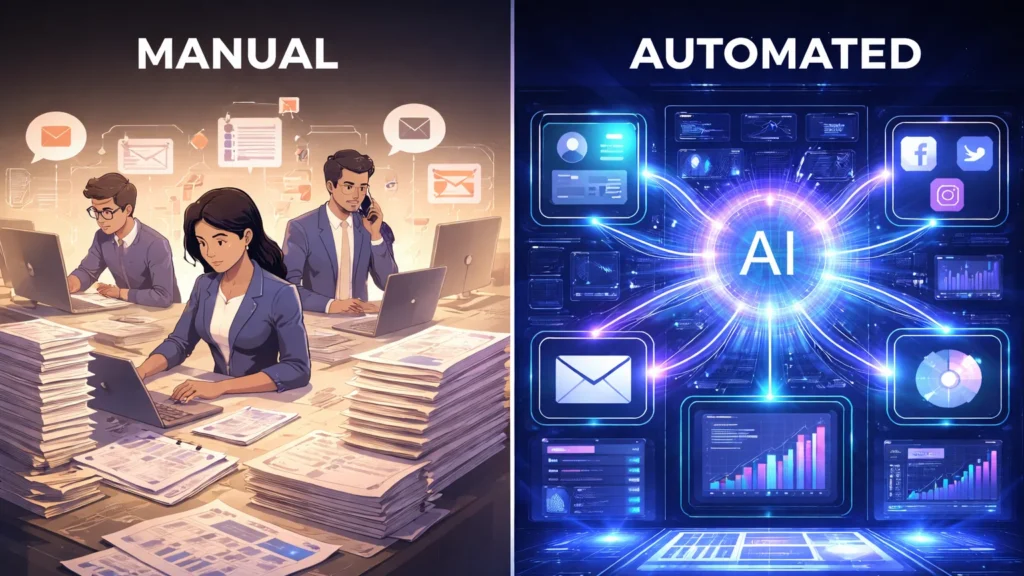
Manual business workflow compared with AI automated workflow
Comparison of manual business processes and AI automated workflows that eliminate repetitive tasks.

Why Small Businesses Need Workflow Automation

Small businesses usually operate with limited staff and resources. Automation allows teams to do more work with fewer people.

1. Save Time

Automation removes repetitive tasks such as:

  • Email responses
  • Data entry
  • Report generation
  • File organization

2. Reduce Human Errors

Manual data entry often leads to mistakes. Automation ensures accurate data transfer across systems.

3. Increase Productivity

Employees can focus on high-value activities like sales, strategy, and customer relationships.

4. Scale Operations Faster

As business grows, automation ensures workflows remain efficient without hiring additional staff.


Best AI Workflow Automation Tools

Zapier is one of the most popular automation platforms used by millions of businesses worldwide.

It allows users to connect 6,000+ apps and automate tasks without coding.

Key Features

  • No-code workflow builder
  • Thousands of app integrations
  • AI automation suggestions
  • Conditional workflows
  • Multi-step automation

Example Automation

When a customer purchases from Shopify →
Automatically add customer to email marketing list →
Send onboarding email →
Create invoice.

Zapier is ideal for small businesses, freelancers, and startups.
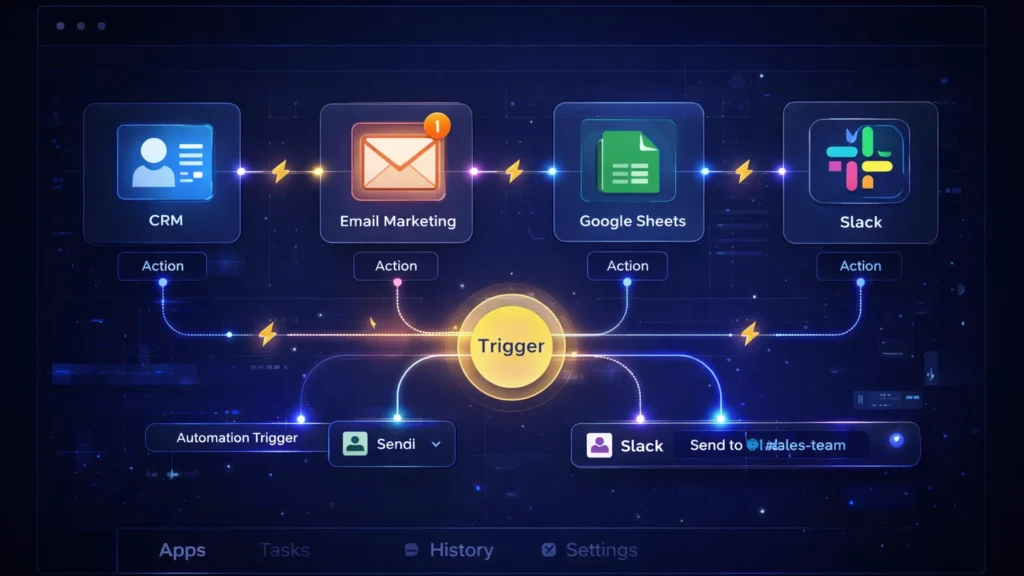
workflow automation diagram connecting CRM email marketing Google Sheets and Slack
Workflow automation tools connect apps like CRM, email marketing, Google Sheets, and Slack through automation triggers.

Make (formerly Integromat) is a powerful visual automation platform designed for complex workflows.

Unlike Zapier, Make uses a visual scenario builder where users can see how data flows between apps.

Key Features

  • Visual automation builder
  • Advanced conditional logic
  • Data transformation tools
  • Real-time automation execution
  • Powerful integrations

Example Automation

New lead from Facebook Ads →
Filter high-quality leads →
Add to CRM →
Send SMS notification to sales team.

Make is perfect for businesses that require advanced automation and detailed control.
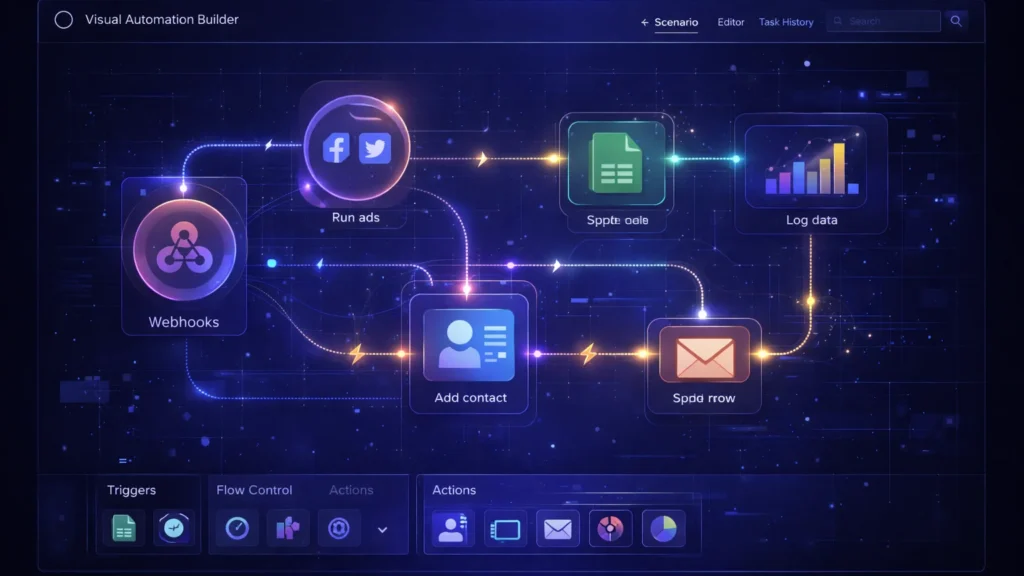
visual automation builder interface connecting marketing apps CRM and analytics
Visual workflow builders allow businesses to design complex automation scenarios using connected nodes and triggers.

Real AI Workflow Automation Examples

Here are practical automation workflows small businesses can implement immediately.

Website contact form →
Add lead to CRM →
Send welcome email →
Notify sales team on Slack.

Customer email received →
AI categorizes issue →
Ticket created in helpdesk →
Auto response sent to customer.

New blog post published →
Automatically share on:

  • Facebook
  • LinkedIn
  • Twitter
  • Pinterest

Customer order placed →
Inventory updated →
Invoice generated →
Shipping notification sent.
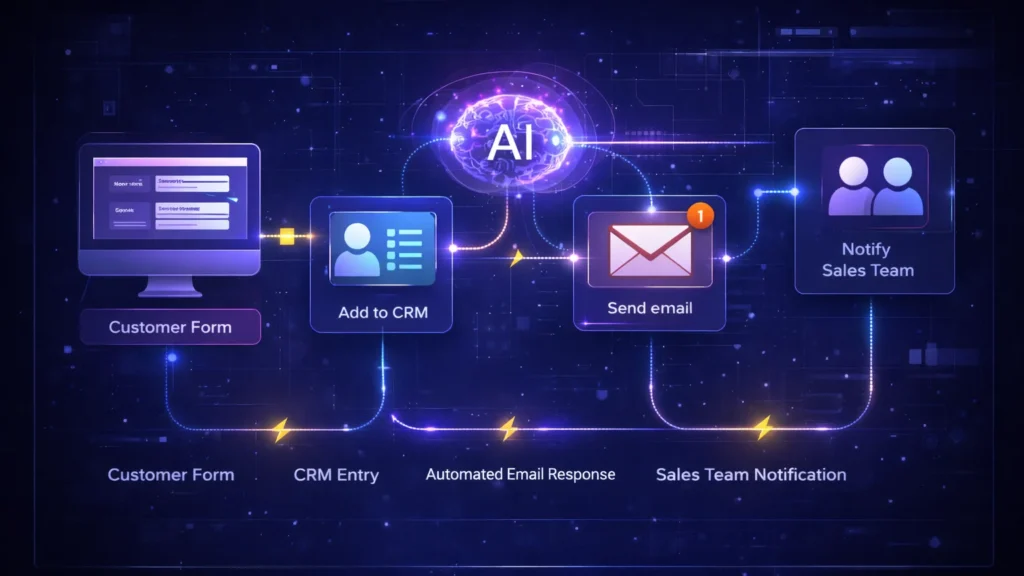
AI business automation flowchart showing customer form CRM email and sales notification
Example of an automated business workflow from customer form submission to CRM entry, email response, and sales team notification.

AI + Workflow Automation: The Future of Business

AI is rapidly transforming automation.

Modern tools now include:

  • AI-powered workflow suggestions
  • Smart data extraction
  • Automated decision making
  • AI customer support bots

This means businesses can automate not just tasks—but entire decision processes.

For example:

AI analyzes customer behavior →
Predicts churn →
Triggers retention email automatically.
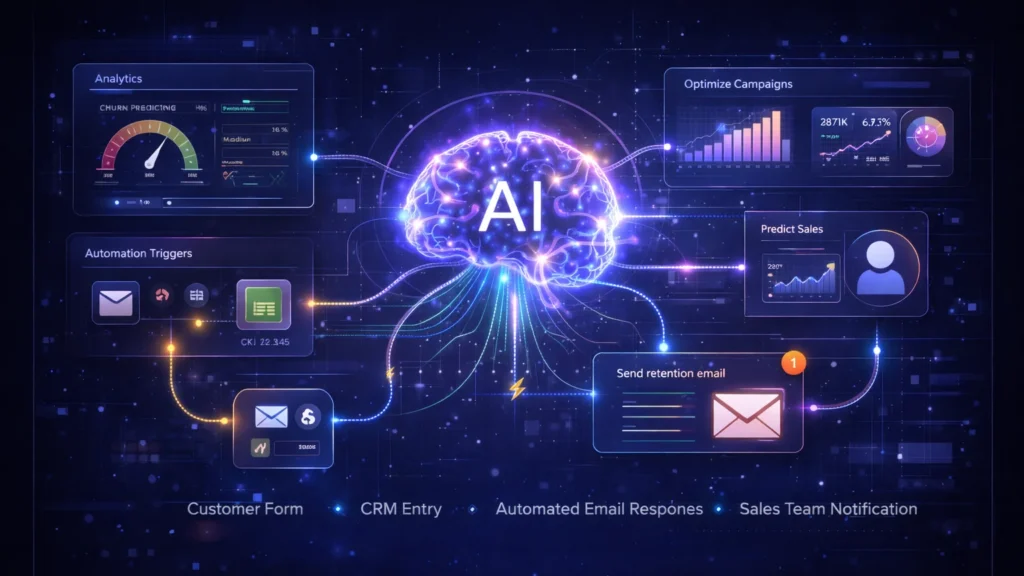
artificial intelligence analyzing business dashboards and predictive analytics automation
Advanced AI systems analyze business data and trigger automated decisions using predictive analytics.

How to Start AI Workflow Automation

Follow these simple steps:

Look for tasks that happen frequently such as:

  • Email responses
  • Data entry
  • Lead management
  • Reporting

Beginners usually start with:

  • Zapier for simplicity
  • Make for advanced workflows

Most businesses integrate:

  • CRM
  • Email marketing tools
  • Google Sheets
  • Payment gateways
  • Customer support tools

Create a trigger → action system.

Example:

New customer →
Send welcome email.


Common Automation Mistakes to Avoid

Automation should improve workflows—not automate inefficient ones.

Too many automations can create complexity and confusion.

Always test and monitor automations regularly to ensure they function correctly.


small business owner using AI automation dashboard for CRM email and marketing tasks
Small businesses can automate emails, CRM updates, and marketing tasks using AI workflow automation tools.

Final Thoughts

AI workflow automation is no longer just for large companies. Today, even small businesses can automate operations using tools like Zapier and Make.

By automating repetitive tasks, businesses can:

  • Save time
  • Reduce costs
  • Increase efficiency
  • Scale faster

If you’re running a small business in 2026, workflow automation is one of the most powerful tools you can adopt to stay competitive.

Similar Posts

  • ·

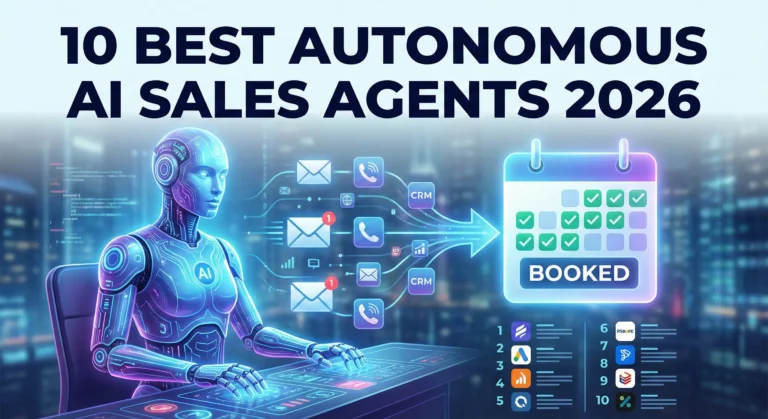
    10 Best Autonomous AI Sales Agents in 2026 (That Actually Book Meetings)

    Let’s rip the band-aid off: The traditional SDR model is broken. Burning out young graduates by making them send 100 generic emails a day isn’t just cruel; in 2026, it’s bad business. Response rates are plummeting, and CAC (Customer Acquisition Cost) is skyrocketing.

    The solution isn’t “better templates.” It’s Digital Workers.

    We aren’t talking about chatbots that sit on your website waiting for visitors. We are talking about Autonomous Outbound Agents—AI that wakes up, logs into your CRM, finds leads, researches them, and sends hyper-personalized emails (or even makes calls) without you lifting a finger.

    I’ve tested the top contenders. Here are the 10 best AI Sales Agents that are actually worth your budget this year.

    1. 11x.ai (Alice)

    Best For: Pure autonomous outbound. If you’ve been on LinkedIn lately, you’ve heard of Alice. She is the closest thing to a “set it and forget it” AI SDR.

    • What she does: Alice finds leads, researches their LinkedIn activity, and drafts emails that sound frighteningly human.
    • The Killer Feature: She doesn’t just “blast.” She waits. She understands timing and follow-up cadence better than most junior reps.

    2. Artisan (Ava)

    Best For: Teams who want an “All-in-One” AI Employee. Artisan positions its agent, Ava, not as a tool but as a hire.

    • What she does: Ava automates the entire outbound stack. She has a built-in database of 300M+ B2B contacts (so you don’t need ZoomInfo) and handles the email warming and sending herself.
    • The Killer Feature: The “Waterfall” personalization. Ava stitches together data from news, funding rounds, and hiring posts to write emails that actually make sense.

    3. Salesforce Agentforce (SDR Agent)

    Best For: Enterprise teams living in Salesforce. For years, Salesforce AI was just “Einstein” giving you scores. Agentforce is different. It uses the new “Atlas” reasoning engine to actually do the work.

    • What it does: It lives inside your Sales Cloud. It qualifies inbound leads 24/7 and can autonomously nurture them until they are ready to buy.
    • The Killer Feature: Security. It respects your enterprise data governance. It won’t hallucinate your Q4 targets to a competitor.

    4. HubSpot Breeze (Prospecting Agent)

    Best For: Mid-market companies using HubSpot. If Salesforce is the tank, HubSpot Breeze is the sports car. It’s fast to deploy and lives natively in your CRM.

    • What it does: It researches companies in your target market and adds them to your CRM with “enriched” data, then drafts the outreach for you.
    • The Killer Feature: Ease of use. You don’t need a systems integrator to set this up. You turn it on, and it works.

    5. Clay (Claygent)

    Best For: Deep research and data enrichment. Clay isn’t a traditional “sender,” but its agent, Claygent, is the secret weapon of the world’s best growth hackers.

    • What it does: You give it a task like “Find me every VP of Sales in London who is hiring and loves golf.” Claygent scrapes the web, checks job boards, reads LinkedIn posts, and builds you a list that is 99% accurate.
    • The Killer Feature: It replaces your research team. It can visit 1,000 websites in minutes to verify if they use your competitor’s software.

    6. Regie.ai

    Best For: Enterprise-grade personalization and “Auto-Pilot.” Regie started as a writing assistant but has evolved into a full-blown agent.

    • What it does: It uses “Auto-Pilot” to continuously scan for triggers (like a funding announcement) and instantly enrolls that prospect into a sequence.
    • The Killer Feature: It solves the “blank page” problem. It dynamically builds campaigns based on who the prospect is, not just what template you picked.

    7. SalesCloser.ai

    Best For: Voice and Video demos. Most agents just write text. SalesCloser can talk.

    • What it does: It can join a Zoom call, give a product demo, and handle objections in real-time using voice.
    • The Killer Feature: It can handle the “discovery call” for smaller accounts that your human AEs don’t have time for.

    8. Reply.io (Jason AI)

    Best For: High-volume agencies. If you are an agency running outreach for 50 clients, Jason AI is your workhorse.

    • What it does: It handles the back-and-forth. When a lead replies “Not interested,” Jason handles it. When they say “Call me Tuesday,” Jason books it.
    • The Killer Feature: It integrates with everything, making it a great “layer” on top of your existing messy stack.

    9. Lindy.ai

    Best For: Custom workflows. Lindy is flexible. You can build a “Sales Lindy,” a “Support Lindy,” or a “Recruiting Lindy.”

    • What it does: It’s great for tasks that require jumping between apps—like “Check my email, update the CRM, then Slack the AE.”
    • The Killer Feature: You can “teach” it new skills just by recording your screen.

    10. AiSDR

    Best For: Budget-conscious teams. If 11x and Artisan are too pricey, AiSDR is the solid challenger.

    • What it does: It automates the email loop—drafting, sending, and qualifying—at a fraction of the cost of a full-time hire.
    • The Killer Feature: It reacts to objections. If a lead says “too expensive,” AiSDR knows how to pivot to a “budget-friendly” value prop.

    The Bottom Line

    If you are an Enterprise shop, go with Agentforce. If you are a startup or growth team, look at 11x or Artisan.

    But whatever you do, stop hiring humans to do a robot’s job. Your competitors already have.

  • ·

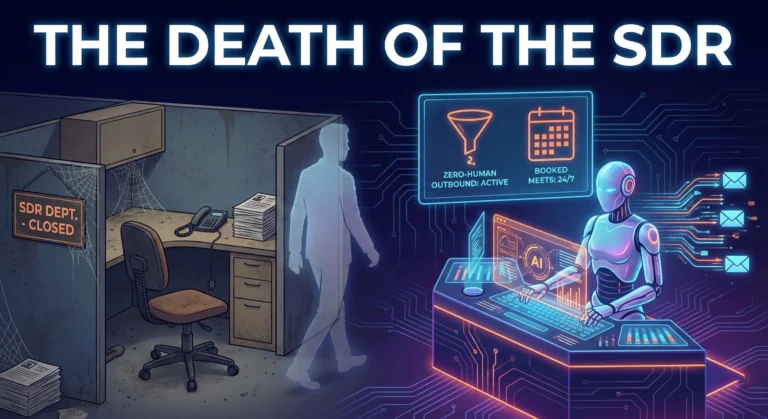
    The Death of the SDR: Building a “Zero-Human” Outbound Team

    Let’s be brutally honest for a moment. The “SDR Sweatshop” model is finally dead.

    We all knew it was broken back in 2023. But here in February 2026, continuing to run it is financial negligence. Taking bright, ambitious 22-year-olds and forcing them to act like spam-bots—sending 150 generic emails a day just to get a 0.5% reply rate—isn’t a strategy anymore. It’s insanity.

    The fundamental shift of the last two years isn’t just that AI got better at writing. It’s that AI got “agency.”

    We have moved past needing humans in the loop for low-value tasks. The future of high-growth B2B sales is the “Zero-Human” Outbound Team.

    The Math Just Doesn’t Work Anymore

    The demise of the Sales Development Representative (SDR) role comes down to cold, hard economics.

    An entry-level SDR in San Francisco, London, or New York costs anywhere from $80,000 to $120,000 fully loaded (salary, commission, tools, benefits). They work roughly 8 hours a day, they burn out in 14 months, and they spend 40% of their time just screwing around in Salesforce.

    In 2026, an autonomous AI agent—like 11x’s Alice, Artisan’s Ava, or a custom-built Agentforce flow—costs a fraction of that. It works 24/7/365. It never gets demoralized by rejection. It never forgets to follow up. It researches 1,000 leads in the time it takes a human to research ten.

    The ROI gap is now too wide for any CFO to ignore. If your competitor is using agents to book meetings at $50 a pop, and you’re using humans to book them at $500 a pop, you have already lost.

    Autonomy vs. Assistance

    The mistake most VPs of Sales are making right now is confusing “AI Co-pilots” with “AI Agents.”

    • A Co-pilot helps a human write an email faster. The human is still the bottleneck.
    • An Agent does the whole job. It finds the lead on LinkedIn, reads their recent posts to find a hook, drafts the email, sends it, reads the reply, handles basic objections, and books time on the Account Executive’s calendar. No human touches the process until the prospect says, “Sure, let’s talk.”

    We are now building outbound engines where the only human input is defining the Ideal Customer Profile (ICP), and the only human output is a booked Zoom call.

    The New Sales Org Chart

    So, do we fire everyone? No. But the pyramid is inverting.

    The bottom layer of the sales stack—the brute-force prospecting layer—is being automated away. The role of the “SDR Manager” is rapidly evolving into an “AI Ops Manager.” This person doesn’t motivate 20-somethings; they manage prompt libraries, monitor agent hallucination rates, and ensure data hygiene.

    This is liberation, not destruction. Humans are terrible at repetitive, robotic tasks. We are fantastic at empathy, complex negotiation, and relationship building.

    By outsourcing the grunt work to agents, your Account Executives (AEs) stop chasing ghosts and start spending their time actually selling to qualified buyers.

    The Final Pivot

    The transition is painful. It requires tearing down playbooks that have worked for a decade. But the companies that win in 2027 won’t be the ones with the biggest army of SDRs making cold calls. They will be the ones with the smartest swarms of autonomous agents.

    Stop hiring people for a job that no longer exists. It’s time to build the machine.

  • Scaling the Boutique Agency: How AI Multiplies Your Billable Hours

    In the professional services world—whether you are a consultant in London or a creative director in New York—you eventually hit a “ceiling.” This ceiling is defined by the number of hours in a day. Since your revenue is tied to your time, your growth is capped by your own physical limits.

    At AI Growth Gear, we call this the Expert’s Dilemma. You want to grow, but you don’t want to hire a massive team that dilutes your brand’s “soul” or increases your overhead to stressful levels.

    The secret to breaking this ceiling in 2026 isn’t working harder; it’s building a Digital Twin for your operations.

    The Math of Growth

    Most boutique owners spend 60% of their time on “Administrative Friction”—invoicing, lead qualification, meeting prep, and basic research. These are $20/hour tasks being performed by a $200/hour expert.

    By implementing specific AI Gears, we help our clients flip that ratio.

    • The Lead Filter: An AI Agent that qualifies leads before they ever reach your calendar.
    • The Briefing Engine: A system that researches a client and prepares a 1-page strategic brief while you sleep.
    • The Content Multiplier: Taking one 10-minute video of you speaking and turning it into a month’s worth of high-end social posts.

    When you remove the friction, you don’t just save time—यू (you) multiply your billable capacity.

    Quality Over Headcount

    The old way to scale was to hire junior staff. But junior staff require training, management, and a high salary. In 2026, the leanest agencies are the most profitable.

    By using Aesthetic Automation, a founder can maintain a “Boutique” feel—giving every client that high-end, personal touch—while the AI handles the data-heavy lifting in the background. Surbhi’s background at NIFT taught us that luxury is often about what you don’t see. The client sees a seamless, high-end experience; they don’t need to see the gears that made it happen so quickly.

    The 10x Consultant

    Imagine being able to take on three times the number of clients without adding a single minute to your work week. That is the power of a well-oiled AI strategy. It allows you to move from being a “worker” in your business to being the “Architect” of it.

    Is Your Business Gear-Ready?

    Scaling isn’t about doing more; it’s about being more efficient with what you already have. If you are ready to stop trading your life for billable hours, it’s time to look at your operational gears.

  • ·

    Top Agentic AI Tools for Boutique Agencies

    For boutique agencies and solo entrepreneurs scaling in the US and UK markets, the bottleneck isn’t usually a lack of ideas—it’s headcount. You want enterprise-level marketing output without the enterprise-level payroll. Enter agentic AI.

    Unlike traditional “if-this-then-that” marketing automation, agentic AI tools don’t just follow static, rigid rules. They perceive data, make decisions, and execute multi-step workflows autonomously based on context. They act less like software and more like digital team members.

    Here is a breakdown of the top agentic AI marketing tools that are changing how lean agencies handle B2B lead generation, CRM management, and digital growth in 2026.

    Gumloop: The No-Code Operations Architect

    If you need to build custom AI workflows without writing a single line of code, Gumloop is your sandbox. It’s a drag-and-drop platform designed to automate heavy, logic-based marketing and sales tasks.

    • The Agency Play: Use Gumloop to build an autonomous lead-scraping agent. You can set it up to monitor specific industry triggers (like companies that just raised Series A funding), scrape their executive data, and automatically categorize the leads based on your specific Ideal Customer Profile (ICP). It handles the tedious, top-of-funnel research that normally eats up hours of a junior marketer’s week, passing only the most qualified data into your CRM.

    Artisan AI (Ava): Your Autonomous BDR

    Artisan AI built “Ava,” an AI-driven Business Development Representative (BDR). Instead of buying a fragmented tech stack for data sourcing, email warm-up, and sequence scheduling, Artisan bundles the entire outbound motion into one autonomous platform.

    • The Agency Play: Ava taps into a built-in database of over 300 million B2B contacts. You give her your target parameters, and she handles the rest. She researches the prospects, writes hyper-personalized cold outreach emails based on real-time data (such as a recent LinkedIn post or company news), and dynamically manages the follow-ups based on recipient behavior. For boutique agencies selling high-ticket B2B services, Ava keeps the outbound pipeline full while you focus entirely on closing the deal.

    HubSpot Breeze: The Enterprise CRM Brain

    HubSpot has heavily integrated agentic AI directly into its ecosystem with Breeze. It features specific agents for content, social media, and prospecting, all tied directly to your core CRM data so it never loses context.

    • The Agency Play: Breeze Intelligence automatically enriches your inbound leads with critical B2B data points (industry, headcount, tech stack). Meanwhile, the Prospecting Agent tracks buyer intent. If a prospect from a UK-based enterprise visits your pricing page, Breeze can auto-add them to the CRM, score the lead, and draft a context-aware outreach email for you to approve. It bridges the gap between marketing activity and sales execution seamlessly, ensuring no high-value lead slips through the cracks.

    Make: The Ultimate Workflow Orchestrator

    Make (formerly Integromat) isn’t strictly a standalone AI agent, but it is the visual infrastructure that makes complex agentic workflows possible. It allows you to connect thousands of different apps and inject AI decision-making (via LLMs like OpenAI or Anthropic) at any step of the journey.

    • The Agency Play: You can use Make to tie your entire marketing stack together into one autonomous loop. For example, when a high-value lead fills out a form, Make can route the data to an LLM to analyze the lead’s intent, ping your team’s Slack channel with a summary, and automatically generate a personalized proposal draft in Google Docs. It allows solo operators to build a bespoke, highly automated backend that rivals massive agencies.

    The Bottom Line

    Scaling a boutique agency no longer requires a massive hiring sprint. By integrating these agentic AI platforms into your B2B marketing strategies, you can automate the heavy lifting, keep your CRM spotless, and focus your human capital on high-value digital growth and strategy.

  • ·

    Best AI Tools for Content Creation in 2026

    Content creation in 2026 is faster, smarter, and more competitive than ever. Whether you’re a blogger, marketer, or entrepreneur, producing high-quality content consistently is one of the biggest challenges today.

    AI tools are transforming how we write blogs, create ads, and manage content workflows. Instead of spending hours writing manually, creators now use AI to generate ideas, draft content, and optimize for SEO in minutes.

    If you’re looking to scale your content output and grow your online business, choosing the right AI tools can make all the difference.

    AI writing tool dashboard generating blog content with templates and editor interface
    AI writing tool dashboard helping creators generate and edit content efficiently

    • AI tools can reduce content creation time by up to 70%
    • They help generate blog posts, ads, and social media content
    • Great for beginners and professionals alike
    • Can significantly boost income through content scaling
    • Tools like Jasper AI and Copy.ai dominate the market


    Creating content consistently is hard.

    Most creators struggle with:
    • Writer’s block
    • Time constraints
    • Lack of SEO knowledge
    • Scaling content production

    This leads to missed opportunities in traffic, revenue, and audience growth.


    AI tools automate content creation by:
    • Generating blog drafts instantly
    • Creating ad copies and captions
    • Providing SEO optimization
    • Repurposing content

    This allows creators to focus on strategy instead of writing everything manually.


    Description: Premium AI writing assistant for high-quality content

    Key Features:
    • Long-form content generation
    • SEO integration
    • Brand voice customization

    Pros:
    • High-quality output
    • Great for professionals

    Cons:
    • Expensive

    Best For: Agencies, marketers

    Verdict: Best overall tool for scaling content


    Description: Affordable AI writing tool with multiple templates

    Key Features:
    • Blog generator
    • Ad copy tools
    • Chatbot integration

    Pros:
    • Budget-friendly
    • Fast output

    Cons:
    • Quality varies

    Best For: Beginners

    Split screen showing multiple AI writing tools like Jasper, Writesonic and Copy.ai generating content
    Comparison view of popular AI writing tools used for content creation and marketing

    Description: Easy-to-use AI content generator

    Key Features:
    • Social media content
    • Email writing
    • Blog ideas

    Pros:
    • Simple interface
    • Great for quick content

    Cons:
    • Limited advanced features

    Best For: Beginners and freelancers


    Description: Lightweight AI writing tool

    Key Features:
    • Multiple tones
    • Fast generation

    Pros:
    • Very affordable

    Cons:
    • Limited long-form capabilities

    Best For: Small creators

    👉 Start using Rytr


    Description: AI + SEO content optimization tool

    Key Features:
    • SERP analysis
    • Content briefs

    Pros:
    • SEO-focused

    Cons:
    • Learning curve

    Best For: SEO writers


    ToolBest ForKey FeaturePricing
    Jasper AIProfessionalsLong-form writingPremium
    WritesonicBudget usersFast generationAffordable
    Copy.aiBeginnersEase of useModerate
    RytrSmall creatorsLow costCheap
    FraseSEO writersOptimizationModerate

    ToolProsCons
    Jasper AIHigh qualityExpensive
    WritesonicAffordableInconsistent output
    Copy.aiEasy to useLimited depth
    RytrCheapBasic features
    FraseSEO focusedComplex

    A blogger can:

    1. Use Jasper AI to generate blog draft
    2. Use Frase for SEO optimization
    3. Use Copy.ai for social posts

    Total time saved: 3–5 hours per article

    Step-by-step workflow showing how AI writing tools generate, edit, and publish content
    Step-by-step process of creating content using AI writing tools for faster and scalable results

    Blog writing
    Affiliate marketing
    • YouTube scripts
    Social media posts
    • Email marketing


    With AI tools, creators can:
    • Publish more content
    • Rank faster on Google
    • Earn via ads + affiliates

    Many bloggers scale to $1000–$5000/month using AI-assisted workflows.


    Benefits:
    • Speed
    • Scalability
    • Cost-effective

    Limitations:
    • Requires editing
    • May lack originality without guidance


    • Always edit AI content
    • Combine multiple tools
    • Focus on SEO keywords
    • Use AI for ideas, not just writing


    Are AI tools good for SEO?
    Yes, if used correctly with optimization.

    Which AI tool is best?
    Jasper AI is best overall.

    Can beginners use AI tools?
    Yes, tools like Copy.ai are beginner-friendly.


    If you want the best results, go with Jasper AI.

    It offers the best quality, scalability, and SEO integration.


    Start with one tool, create your first AI-generated article, and scale your content strategy from there.


    AI tools are no longer optional—they are essential.

    If you want to grow faster, earn more, and stay competitive, using AI for content creation is the smartest move you can make in 2026.

  • ·

    Agentic Automation: The Future of Workflow Automation

    The Shift From Task Automation to Autonomous Systems

    For years, workflow automation meant one thing: automate repetitive tasks.

    Businesses deployed RPA bots to click buttons, copy data between systems, and follow predefined rules. It worked — to a point. Costs dropped. Manual errors decreased. Efficiency improved.

    But in 2026, the conversation has shifted.

    Companies are no longer asking, “How do we automate this task?”
    They’re asking, “How do we automate outcomes?”

    That shift is where agentic automation enters the picture.


    What Is Agentic Automation?

    Agentic automation refers to AI systems designed to act like autonomous agents rather than scripted bots.

    Instead of following rigid instructions, these AI agents:

    • Understand objectives
    • Plan multi-step workflows
    • Adjust decisions based on changing inputs
    • Optimize performance over time
    • Execute tasks across multiple systems

    In simple terms:

    Traditional automation executes instructions.
    Agentic automation pursues goals.

    If RPA is a digital worker following a checklist, agentic automation is a digital project manager figuring out the best way to get the job done.


    Why 2026 Is the Turning Point

    Several factors are converging to make 2026 a breakthrough year for agentic automation:

    1. Mature AI Models

    Large language models and reasoning engines are now capable of multi-step thinking, contextual understanding, and strategic decision-making.

    2. Better Workflow Orchestration Tools

    Modern orchestration platforms allow AI agents to interact with CRMs, ERPs, marketing systems, analytics dashboards, and internal databases seamlessly.

    3. Business Pressure for Agility

    US and UK enterprises face increasing pressure to reduce operational overhead while scaling faster. Static bots cannot keep up with dynamic markets.

    4. Data Explosion

    Companies generate massive amounts of data daily. Agentic systems can analyze and act on that data continuously — something rule-based bots struggle with.

    The result? Businesses are moving from automation scripts to intelligent orchestration layers.


    What Is Workflow Orchestration in This Context?

    Workflow orchestration is the coordination of multiple automated processes into one intelligent, goal-driven system.

    Instead of separate bots for:

    • Lead qualification
    • CRM updates
    • Email nurturing
    • Reporting

    An agentic system oversees the entire pipeline. It monitors performance, adjusts messaging, escalates exceptions, and reallocates resources when needed.

    It doesn’t just execute — it manages.


    Agentic Automation vs RPA: What Businesses Should Know

    To understand the future, we need to compare it with the present.

    1. Decision-Making Capability

    RPA:
    Follows predefined rules. If X happens, do Y.

    Agentic Automation:
    Analyzes context and decides the best action based on objectives.

    Example:
    An RPA bot sends a standard follow-up email.
    An AI agent decides whether to follow up, change tone, escalate to sales, or pause outreach based on engagement data.


    2. Adaptability

    RPA:
    Breaks when systems change or workflows evolve.

    Agentic Automation:
    Adapts to new inputs, system updates, and unexpected scenarios.

    This flexibility significantly reduces maintenance costs.


    3. Scope of Automation

    RPA:
    Automates tasks.

    Agentic Automation:
    Automates entire processes and optimizes them continuously.

    Instead of automating invoice entry, an AI agent can oversee the entire accounts payable workflow — from invoice detection to fraud checks and payment timing.


    4. Human Involvement

    RPA:
    Requires ongoing human supervision and frequent updates.

    Agentic Automation:
    Operates with minimal supervision, escalating only when judgment or compliance decisions are required.

    It augments humans instead of replacing them.


    5. ROI Potential

    RPA typically delivers incremental efficiency gains — often 20–40% improvement in specific tasks.

    Agentic automation can deliver transformational gains by:

    • Reducing operational headcount pressure
    • Improving decision speed
    • Increasing revenue conversion rates
    • Minimizing error-based losses
    • Enabling 24/7 optimization

    For enterprises, this moves automation from a cost-saving initiative to a growth strategy.


    Where Agentic Automation Delivers the Most Value

    In 2026, we’re seeing the strongest impact in:

    • Sales workflow automation
    • Marketing orchestration
    • Customer support triaging
    • Financial process management
    • Supply chain coordination
    • Enterprise IT operations

    Particularly in high-income markets like the US and UK, businesses are adopting agentic systems to remain competitive against leaner, AI-native startups.


    Should Businesses Replace RPA?

    Not immediately.

    RPA still has value for simple, stable, repetitive tasks. It’s reliable and cost-effective.

    However, forward-thinking organizations are layering agentic automation on top of existing RPA infrastructure — using RPA for execution and AI agents for orchestration.

    This hybrid approach offers the best of both worlds.


    The Bigger Picture: Automation as Strategy

    The most important takeaway isn’t technological — it’s strategic.

    Workflow automation is no longer just about saving time.

    It’s about building systems that:

    • Learn
    • Adapt
    • Scale
    • Optimize themselves

    Agentic automation represents the next evolution in business automation — moving from static scripts to intelligent operational ecosystems.

    In 2026 and beyond, the companies that win will not be the ones with the most bots.

    They’ll be the ones with the smartest orchestration layers.


    Final Thoughts

    Agentic automation is not hype — it’s a structural shift in how businesses think about workflows.

    RPA automated the past.
    Agentic systems are shaping the future.

    For organizations in the US, UK, and other advanced markets, the question is no longer if AI will manage workflows — but how quickly they can adopt it strategically.

    The future of workflow automation is autonomous, adaptive, and outcome-driven.

    And that future has already begun.