Agentic AI

  • ·

    Top Agentic AI Tools for Boutique Agencies

    For boutique agencies and solo entrepreneurs scaling in the US and UK markets, the bottleneck isn’t usually a lack of ideas—it’s headcount. You want enterprise-level marketing output without the enterprise-level payroll. Enter agentic AI.

    Unlike traditional “if-this-then-that” marketing automation, agentic AI tools don’t just follow static, rigid rules. They perceive data, make decisions, and execute multi-step workflows autonomously based on context. They act less like software and more like digital team members.

    Here is a breakdown of the top agentic AI marketing tools that are changing how lean agencies handle B2B lead generation, CRM management, and digital growth in 2026.

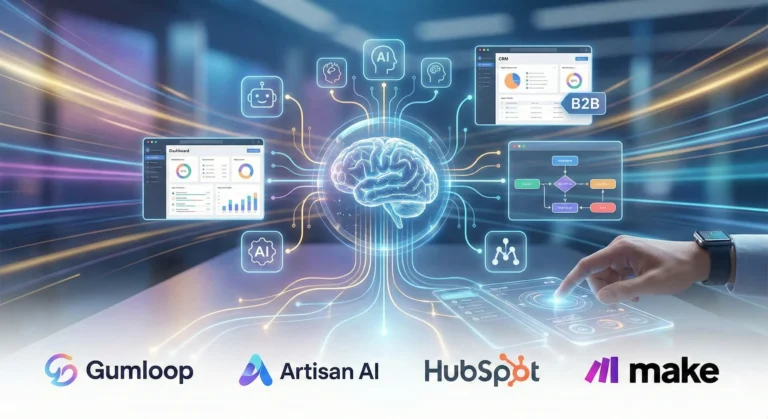
    Gumloop: The No-Code Operations Architect

    If you need to build custom AI workflows without writing a single line of code, Gumloop is your sandbox. It’s a drag-and-drop platform designed to automate heavy, logic-based marketing and sales tasks.

    • The Agency Play: Use Gumloop to build an autonomous lead-scraping agent. You can set it up to monitor specific industry triggers (like companies that just raised Series A funding), scrape their executive data, and automatically categorize the leads based on your specific Ideal Customer Profile (ICP). It handles the tedious, top-of-funnel research that normally eats up hours of a junior marketer’s week, passing only the most qualified data into your CRM.

    Artisan AI (Ava): Your Autonomous BDR

    Artisan AI built “Ava,” an AI-driven Business Development Representative (BDR). Instead of buying a fragmented tech stack for data sourcing, email warm-up, and sequence scheduling, Artisan bundles the entire outbound motion into one autonomous platform.

    • The Agency Play: Ava taps into a built-in database of over 300 million B2B contacts. You give her your target parameters, and she handles the rest. She researches the prospects, writes hyper-personalized cold outreach emails based on real-time data (such as a recent LinkedIn post or company news), and dynamically manages the follow-ups based on recipient behavior. For boutique agencies selling high-ticket B2B services, Ava keeps the outbound pipeline full while you focus entirely on closing the deal.

    HubSpot Breeze: The Enterprise CRM Brain

    HubSpot has heavily integrated agentic AI directly into its ecosystem with Breeze. It features specific agents for content, social media, and prospecting, all tied directly to your core CRM data so it never loses context.

    • The Agency Play: Breeze Intelligence automatically enriches your inbound leads with critical B2B data points (industry, headcount, tech stack). Meanwhile, the Prospecting Agent tracks buyer intent. If a prospect from a UK-based enterprise visits your pricing page, Breeze can auto-add them to the CRM, score the lead, and draft a context-aware outreach email for you to approve. It bridges the gap between marketing activity and sales execution seamlessly, ensuring no high-value lead slips through the cracks.

    Make: The Ultimate Workflow Orchestrator

    Make (formerly Integromat) isn’t strictly a standalone AI agent, but it is the visual infrastructure that makes complex agentic workflows possible. It allows you to connect thousands of different apps and inject AI decision-making (via LLMs like OpenAI or Anthropic) at any step of the journey.

    • The Agency Play: You can use Make to tie your entire marketing stack together into one autonomous loop. For example, when a high-value lead fills out a form, Make can route the data to an LLM to analyze the lead’s intent, ping your team’s Slack channel with a summary, and automatically generate a personalized proposal draft in Google Docs. It allows solo operators to build a bespoke, highly automated backend that rivals massive agencies.

    The Bottom Line

    Scaling a boutique agency no longer requires a massive hiring sprint. By integrating these agentic AI platforms into your B2B marketing strategies, you can automate the heavy lifting, keep your CRM spotless, and focus your human capital on high-value digital growth and strategy.
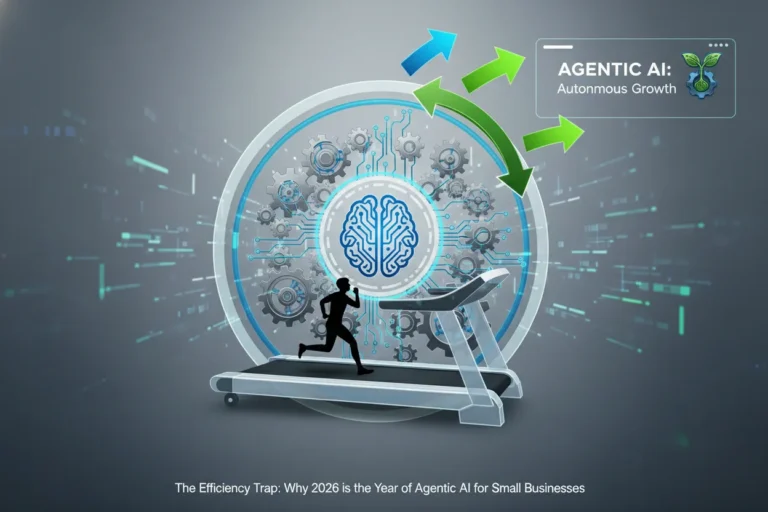
  • The Efficiency Trap: Why 2026 is the Year of Agentic AI for Small Businesses

    There is a specific kind of exhaustion that every small business owner in the US and UK knows all too well. It’s that feeling of being a “professional firefighter.” You start your Monday with a grand vision for growth, but by 10:00 AM, you are buried in the weeds—answering basic customer service emails, manually updating your CRM, and trying to figure out why your latest social post didn’t hit the mark.

    This is the Efficiency Trap. It’s the paradox of the modern digital age: we have more tools than ever, yet we’ve never been busier with low-value tasks. We are running on a digital treadmill, exhausted by the “noise” of the business, with zero time left to actually steer the ship.

    As we move through 2026, the solution isn’t just “more AI.” We’ve moved past the novelty phase of basic chatbots. The real escape route is Agentic AI.

    From Tools to Teammates

    For the last few years, most of us have used AI reactively. You give a prompt to ChatGPT, and it gives you a response. It’s helpful, but it’s still a “manual” tool. You are the one who has to remember to ask the question, verify the data, and move the output to where it needs to go.

    Agentic AI changes the fundamental nature of this relationship. Instead of a tool that waits for your command, an AI Agent is a digital teammate that understands a specific objective.

    If you tell an agent, “Nurture this lead until they are ready for a call,” it doesn’t just write a draft. It monitors your inbox, follows up at the right intervals based on the lead’s behavior, checks your real-time availability on Calendly, and sends the invite. It manages the entire workflow autonomously. In 2026, the competitive edge belongs to those who stop “prompting” and start “delegating.”

    The “Gear” Philosophy: Why Operations are the New Moat

    At AI Growth Gear, we look at business through a lens of high-end operations. My co-founder, Surbhi Chauhan, brings a unique perspective from the worlds of fashion communication (NIFT) and film production. In those industries, a brilliant creative vision is worth nothing if the “gears” of production fail.

    Most small businesses are currently suffering from a “production” problem. They have a great product, but their backend is a patchwork of manual processes. Agentic AI acts as the mechanical heart of your business. It allows a lean team of three people to have the operational output of a mid-sized corporation.

    Three Pillars for the 2026 Business Owner

    To break out of the Efficiency Trap this year, your strategy must sit on three pillars:

    1. Aesthetic Automation: In a market flooded with generic, “robotic” content, design matters more than ever. Your AI-driven communication must feel human and high-end. If it looks like a machine made it, your customers will tune out.
    2. Strategic Oversight: We don’t believe in “set it and forget it.” The most successful 2026 businesses use agents to handle the 80% of repetitive, data-heavy work, leaving the final 20%—the high-value, emotional, and strategic decisions—to the human experts.
    3. Seamless Orchestration: Your AI needs to be an “orchestrator,” not a silo. It needs to live inside your email, your project management tools (like Monday.com or Asana), and your website.

    Owning the Gears

    The reality of 2026 is that the barrier to entry for starting a business has never been lower, but the barrier to scaling one has never been higher. The digital noise is deafening.

    You can choose to keep fighting the treadmill yourself, or you can build the digital infrastructure that does the heavy lifting for you. Agentic AI isn’t a futuristic luxury anymore; it’s the only way to ensure that you, the founder, can finally step out of the daily grind and back into the vision that started it all.

    It’s time to stop being a part of the machine and start owning the gears.