Character Consistency: Midjourney vs. Flux

If you have ever tried to make an AI comic book or a storyboard, you know the pain.
You generate a stunning protagonist in Scene 1. Let’s call her “Maya, a cyberpunk hacker with a neon blue undercut.” She looks perfect.
Then you write the prompt for Scene 2: “Maya sitting in a cafe drinking coffee.”
Suddenly, Maya has a bob cut. Her jacket changed from leather to denim. Her face structure looks like she aged ten years or turned into her own cousin. The immersion is broken.
For years, this “Shapeshifter Problem” was the wall that separated “cool AI art” from “actual storytelling.” But in 2026, the wall is crumbling. We now have specific tools designed to lock in a character’s identity.
We put the two heavyweights—Midjourney and Flux—to the test. Here is who wins the Consistency Battle.
The Contender: Midjourney (The --cref King)
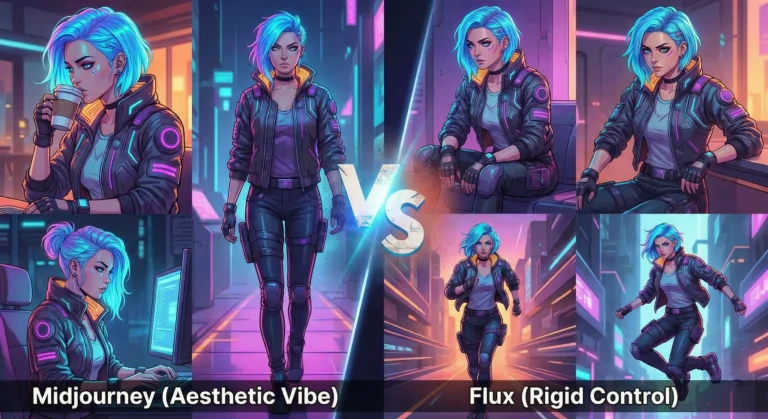
Midjourney remains the king of aesthetics, but its “Character Reference” (--cref) feature is what storytellers rely on.
- How it works: You generate your “Master Image” of Maya. You copy the URL. Then, in your next prompt, you add
--cref [url]. - The Experience: It is shockingly good at capturing the vibe and facial features. In our test, Midjourney kept Maya’s neon hair and facial structure consistent about 85% of the time.
- The Downside: Midjourney is stubborn. It loves to “prettify” things. If you try to put Maya in a gritty, ugly situation, the AI fights you to make it look cinematic. It also struggles with specific clothing consistency. Maya’s face stays the same, but her outfit tends to hallucinate new zippers and pockets in every frame.
The Challenger: Flux (The Control Freak)
Flux (specifically the specialized fine-tunes available in 2026) has taken the open-source world by storm.
- How it works: Flux relies on “LoRAs” (Low-Rank Adaptation). Think of it as a mini-brain training. You upload 10 photos of a character, and the model learns who they are.
- The Experience: This is the professional’s choice. Once Flux “knows” Maya, it doesn’t just guess; it understands her geometry. You can rotate her, change the lighting, or put her in a spacesuit, and the face remains identical.
- The Downside: The learning curve is steep. You aren’t just typing a prompt; you are managing a workflow. You need a decent GPU or a cloud host like Fal.ai or Replicate to run it efficiently.
The Verdict: Which One Do You Need?
Choose Midjourney if: You are making a mood board, a pitch deck, or a children’s book where “close enough” is okay. It is fast, easy, and the lighting is always beautiful. The --cref tag is enough to fool the casual eye.
Choose Flux if: You are building a graphic novel or a recurring brand mascot. If you need the character to wear the exact same logo on their shirt in panel 1 and panel 50, Flux is the only tool that offers that level of rigid consistency.
The days of the shapeshifter are over. Pick your weapon and start telling your story.