Grok AI vs ChatGPT: Features and Real Use Cases

Understanding Grok AI: Why It’s Getting Attention
Artificial intelligence tools are evolving rapidly, but most of them follow a similar pattern: static training data, controlled outputs, and limited real-time awareness. That model works well for structured tasks like coding assistance or writing help. However, it struggles when users want current insights, cultural context, or social trends.
That gap is where Grok, developed by xAI, enters the picture.
Unlike many AI assistants that rely primarily on training datasets, Grok was designed to connect directly with X (formerly Twitter). This integration allows the model to analyze public conversations, trending topics, and real-time discussions.
For professionals working in marketing, research, or online business, that difference can significantly change how AI is used in daily workflows.
What Grok AI Actually Does
At its core, Grok functions as a conversational AI assistant similar to ChatGPT or Claude. Users can ask questions, generate text, analyze ideas, or explore technical topics.
But Grok was intentionally designed with a different philosophy: context awareness from live data.
Key capabilities include:
⚡ Real-time information access
Grok can interpret current discussions happening on X, making it useful for trend monitoring and sentiment analysis.
📊 Social conversation insights
It can summarize how people are reacting to a topic rather than just describing the topic itself.
🧠 Conversational reasoning
Grok aims to produce more informal and context-aware answers compared with some traditional AI assistants.
🔎 Idea exploration and brainstorming
Because it pulls from real discussions, it can surface unexpected perspectives that static datasets might miss.
For example, a digital marketer researching a product launch could ask Grok:
“What are people complaining about in the latest smartphone release?”
Instead of returning a generic answer, the AI can analyze current posts and highlight common concerns.
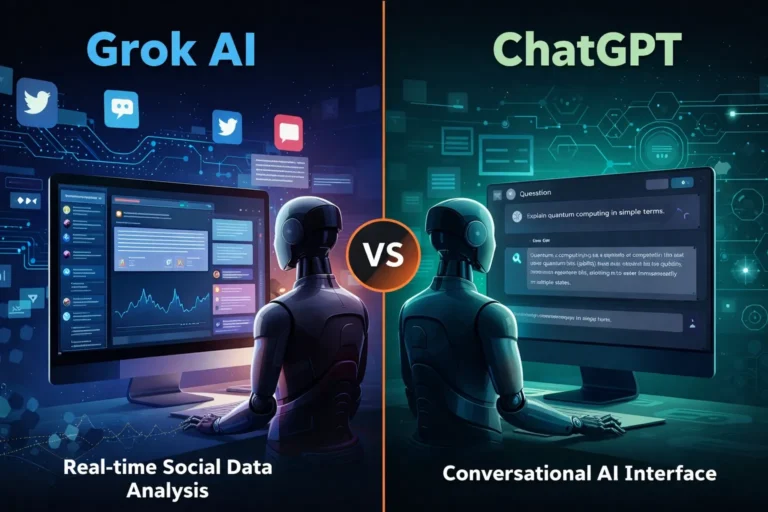
Grok AI vs ChatGPT: Where They Differ
While both systems function as AI assistants, their strengths are slightly different.
🔹 Data Sources
Grok
- Strong connection to real-time social data
- Useful for trend discovery and sentiment analysis
ChatGPT
- Primarily trained on large datasets and structured knowledge
- Strong for reasoning, coding, and documentation
🔹 Content Tone
Grok often responds with a more conversational tone, reflecting its connection to social platforms.
ChatGPT generally produces more structured, formal responses, which can be useful for professional documentation.
🔹 Business Applications
ChatGPT remains stronger in areas like:
- code generation
- structured writing
- workflow automation
- technical problem solving
Grok shows promise in areas such as:
- social trend monitoring
- public sentiment analysis
- cultural context research
For professionals, the tools may complement rather than replace each other.
Real-World Use Cases for Grok AI
Here are practical scenarios where Grok can be particularly useful.
📈 Marketing trend research
Marketers can analyze what audiences are discussing about a brand or industry.
Example:
A SaaS founder launching a productivity app could analyze conversations around productivity tools to identify common complaints.
🧩 Product feedback discovery
Companies can quickly identify how users feel about competing products.
This type of insight traditionally required expensive social listening tools.
📰 News and narrative monitoring
Journalists, analysts, and researchers can track how a story evolves across social media conversations.
💡 Content brainstorming
Creators and writers can explore trending topics that resonate with real audiences.
Instead of guessing what people want to read, Grok can surface ideas based on live discussion patterns.
Benefits and Limitations
Like any AI system, Grok has strengths and trade-offs.
✔ Benefits
• Access to real-time conversations
• Useful for trend discovery
• Insight into public sentiment
• Unique perspective compared to traditional AI tools
⚠ Limitations
• Social data may contain noise or misinformation
• Real-time data can introduce bias or emotional reactions
• Not always ideal for technical or academic analysis
Professionals should treat Grok as a research assistant rather than a final authority.
How Professionals Can Use Grok Strategically
If you’re running an online business or digital project, Grok works best when integrated into a broader workflow.
Practical workflow example
1️⃣ Trend discovery using Grok
2️⃣ Content research and structure using ChatGPT
3️⃣ Publishing strategy based on validated audience interests
This layered approach combines real-time insight with structured AI reasoning.
Who Should Use Grok AI
Grok may be especially valuable for:
• digital marketers
• startup founders
• journalists and analysts
• social media strategists
• creators researching audience interests
Who may not benefit as much
• developers needing deep coding assistance
• academic researchers needing highly verified sources
• enterprises requiring strict moderation controls
Final Thoughts
AI tools are gradually moving from static knowledge systems toward dynamic intelligence connected to real-world conversations. Grok represents an early experiment in that direction.
While it may not replace traditional AI assistants like ChatGPT, its ability to interpret live social discussions creates new possibilities for research, marketing, and trend discovery.
For professionals exploring AI workflows, Grok is less about replacing existing tools and more about adding a new layer of real-time insight to decision making.