Business Automation

  • ·

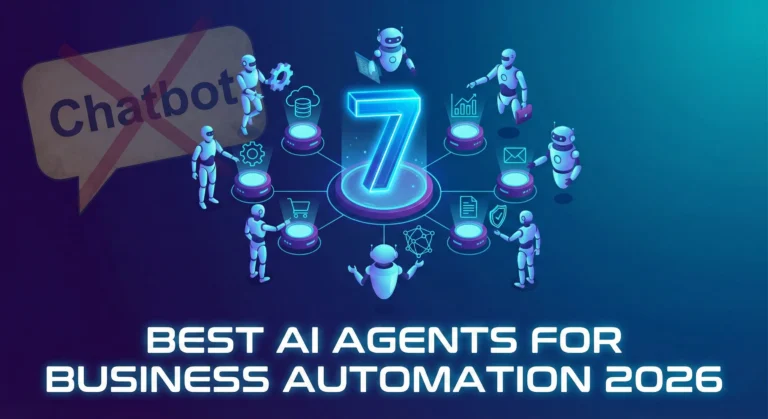
    7 Best AI Agents for Business Automation in 2026

    If 2024 was the year of the Chatbot, 2026 is undeniably the year of the Agent.

    The difference is profound. A chatbot answers your questions; an agent does your work. For business leaders in London, New York, and San Francisco, the novelty of “chatting” with AI has worn off. The focus has shifted entirely to ROI and autonomous workflows.

    We are looking for tools that don’t just generate text but can open a browser, click buttons, query databases, and send Slack messages without human hand-holding.

    After testing dozens of platforms, here are the 7 best AI Agents for business automation in 2026.

    1. Zapier Central (The “Gateway” Agent)

    Best For: Connecting your existing SaaS stack.

    If you already use Zapier, this is the easiest entry point. Zapier Central isn’t just a prettier interface for their automation tools; it’s a logic layer that sits on top of them.

    • What it does: Instead of building rigid “If This, Then That” workflows, you give Central a goal: “Check my email for invoices, match them to Xero, and slack me if the amount is over $1,000.”
    • The Killer Feature: It has access to 6,000+ apps immediately. You don’t need to wait for integrations; they are already there.

    2. Microsoft Copilot Studio (The Enterprise Standard)

    Best For: Corporations living in the Office 365 ecosystem.

    For large enterprises, security is the bottleneck. Microsoft Copilot Studio (formerly Power Virtual Agents) allows you to build agents that live safely inside your corporate tenant.

    • What it does: You can build an agent that accesses your internal SharePoint, reads your Outlook calendar, and updates Excel sheets.
    • The Killer Feature: It respects your organization’s data governance. It won’t hallucinate confidential data to the wrong employee.

    3. Lindy.ai (The “Digital Employee”)

    Best For: Specific roles like Medical Scribes, HR Assistants, or Executive Assistants.

    Lindy positions itself not as a tool, but as an employee. You don’t “configure” Lindy; you “hire” her for a specific job.

    • What it does: Lindy comes pre-trained for specific verticals. An “HR Lindy” already knows how to handle onboarding documents; a “Medical Lindy” knows how to transcribe patient notes into EMR formats.
    • The Killer Feature: “Proactive” behavior. Lindy doesn’t always wait for a command; she can monitor your inbox and draft replies for you to approve.

    4. Salesforce Agentforce (The CRM Specialist)

    Best For: Sales and Customer Support teams.

    If your business lives or dies by your CRM data, Agentforce is the heavy hitter. Salesforce realized that generic AI struggles with specific customer data, so they built agents that live inside the data layer.

    • What it does: An Agentforce service agent can autonomously resolve customer tickets by looking up order history, processing a refund, and updating the case status—all without a human agent opening the file.
    • The Killer Feature: The “Atlas” reasoning engine, which is surprisingly good at handling complex customer queries that usually confuse standard bots.

    5. Relevance AI (The No-Code Builder)

    Best For: Building custom “AI Workforce” teams without code.

    Relevance AI is for the power user who wants to build a custom agent team but doesn’t want to write Python.

    • What it does: It allows you to build multi-agent chains. You can have a “Researcher Agent” that scrapes the web, passes the data to a “Writer Agent” that drafts a report, and a “Manager Agent” that critiques it.
    • The Killer Feature: The visual builder is intuitive, making it easy to visualize how your “digital team” is passing data back and forth.

    6. CrewAI (The Developer’s Choice)

    Best For: Technical teams building complex, code-heavy workflows.

    If you have a dev team, skip the no-code tools and go straight to CrewAI. It’s an open-source framework that orchestrates role-playing agents.

    • What it does: You define specific roles (e.g., “Senior Python Engineer,” “QA Tester”) and assign them goals. The agents collaborate, delegate tasks to each other, and solve problems iteratively.
    • The Killer Feature: It handles “delegation” better than almost anything else. If one agent gets stuck, it can ask another agent for help.

    7. MultiOn (The Browser Navigator)

    Best For: Tasks that require using a web browser like a human.

    Most APIs are limited. MultiOn solves this by giving the AI a web browser.

    • What it does: It can log into websites, click buttons, fill out forms, and navigate complex UIs just like a human user would.
    • The Killer Feature: It can handle “real world” tasks like booking a flight on a site that doesn’t have an API, or ordering lunch from a delivery service.

    The Bottom Line

    In 2026, the question isn’t “Which AI model is the smartest?”—it’s “Which Agent has the best access to my tools?”

    If you want a safe bet, start with Zapier Central. If you want to build a digital workforce, look at Relevance AI or CrewAI. Just stop waiting for the chatbot to do the work for you.
  • ·

    Chatbots Are Dead. Long Live AI Agents: A 2026 Guide

    Let’s be honest for a second. We all spent 2023 and 2024 being amazed that ChatGPT could write a haiku or summarize a PDF. It was cool, it was novel, but let’s face it: it was passive. You had to show up, type a prompt, wait for the text, copy it, and then paste it somewhere else to actually do something with it.

    In 2026, that workflow is already obsolete.

    If your business is still treating AI like a smart encyclopedia, you are leaving money on the table. The shift happening right now—in Silicon Valley, London, and Berlin—is the move from Chatbots to AI Agents.

    The Difference: “Talk” vs. “Action”

    The distinction is simple but critical.

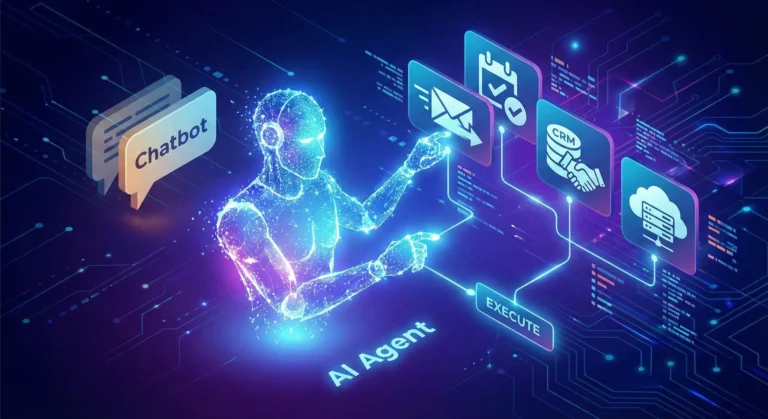
    • A Chatbot is like a library. You ask a question; it gives you an answer. It waits for you.
    • An AI Agent is like an intern. You give it a goal (“Plan my travel”), and it goes off, checks flights, compares hotels, books the tickets, and puts them on your calendar. It has agency.

    For business automation, this is the holy grail. We are no longer using AI to write the email; we are using AI to send the email, update the CRM, and notify the sales team on Slack—without you touching the keyboard.

    The Anatomy of an Agent

    You don’t need a computer science degree to build one. You just need to understand the three parts of an “Agentic Workflow”:

    1. The Brain (The LLM): This is GPT-4o, Claude 3.5, or Gemini. Its job isn’t to generate text, but to make decisions. It decides which tool to use based on your instructions.
    2. The Hands (The Tools): This is where the magic happens. You give the “Brain” access to your apps—Gmail, Salesforce, Excel, Slack—via APIs.
    3. The Rails (The Rules): Agents can hallucinate. You need guardrails to ensure it doesn’t accidentally email your entire database.

    How to Build Your First “Loop” (Without Code)

    You don’t need to hire a Python developer to start. Platforms like Zapier Central, Make.com, or Microsoft Copilot Studio have democratized this.

    Here is a simple “Lead Qualification” agent you can build this afternoon:

    Step 1: The Trigger Don’t start with “I want AI.” Start with a pain point. Let’s say: “I spend too much time reading contact forms.”

    • Trigger: A new entry lands in your Typeform or website contact form.

    Step 2: The Agent Analysis Instead of just forwarding that email to you, the AI Agent intercepts it.

    • Instruction: “Read the message. If the budget mentioned is under $5,000, label it ‘Low Priority.’ If it’s over $5,000, label it ‘High Priority’ and draft a personalized meeting invite.”

    Step 3: The Action This is the part that feels like magic.

    • If Low Priority: The Agent adds the row to a Google Sheet for later review.
    • If High Priority: The Agent pings you on Slack with a summary (“Hot lead from London, budget $10k”) and drafts the email in your Drafts folder, waiting for one click to send.

    The “Human-in-the-Loop” Rule

    The biggest mistake I see businesses make is trusting the Agent too much too soon. In 2026, the best workflow is “AI Drafts, Human Approves.”

    Let the Agent do the grunt work—the searching, the sorting, the drafting. But keep your finger on the “Approve” button for the final mile. As these agents get smarter, you can slowly remove the training wheels, but for now, trust is good; control is better.

    The Bottom Line

    The businesses that win in the next decade won’t be the ones with the smartest prompt engineers. They will be the ones who successfully outsource their repetitive, low-value cognitive loops to digital agents.

    Stop asking your AI questions. Start giving it a job description.

  • The Efficiency Trap: Why 2026 is the Year of Agentic AI for Small Businesses

    There is a specific kind of exhaustion that every small business owner in the US and UK knows all too well. It’s that feeling of being a “professional firefighter.” You start your Monday with a grand vision for growth, but by 10:00 AM, you are buried in the weeds—answering basic customer service emails, manually updating your CRM, and trying to figure out why your latest social post didn’t hit the mark.

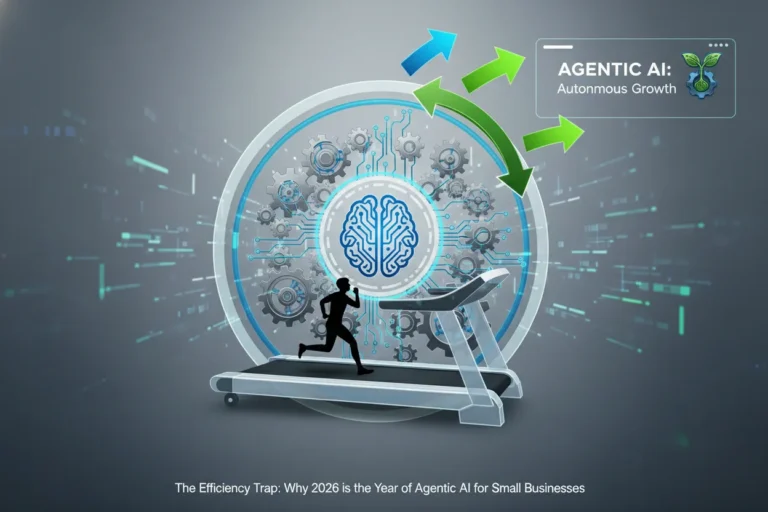
    This is the Efficiency Trap. It’s the paradox of the modern digital age: we have more tools than ever, yet we’ve never been busier with low-value tasks. We are running on a digital treadmill, exhausted by the “noise” of the business, with zero time left to actually steer the ship.

    As we move through 2026, the solution isn’t just “more AI.” We’ve moved past the novelty phase of basic chatbots. The real escape route is Agentic AI.

    From Tools to Teammates

    For the last few years, most of us have used AI reactively. You give a prompt to ChatGPT, and it gives you a response. It’s helpful, but it’s still a “manual” tool. You are the one who has to remember to ask the question, verify the data, and move the output to where it needs to go.

    Agentic AI changes the fundamental nature of this relationship. Instead of a tool that waits for your command, an AI Agent is a digital teammate that understands a specific objective.

    If you tell an agent, “Nurture this lead until they are ready for a call,” it doesn’t just write a draft. It monitors your inbox, follows up at the right intervals based on the lead’s behavior, checks your real-time availability on Calendly, and sends the invite. It manages the entire workflow autonomously. In 2026, the competitive edge belongs to those who stop “prompting” and start “delegating.”

    The “Gear” Philosophy: Why Operations are the New Moat

    At AI Growth Gear, we look at business through a lens of high-end operations. My co-founder, Surbhi Chauhan, brings a unique perspective from the worlds of fashion communication (NIFT) and film production. In those industries, a brilliant creative vision is worth nothing if the “gears” of production fail.

    Most small businesses are currently suffering from a “production” problem. They have a great product, but their backend is a patchwork of manual processes. Agentic AI acts as the mechanical heart of your business. It allows a lean team of three people to have the operational output of a mid-sized corporation.

    Three Pillars for the 2026 Business Owner

    To break out of the Efficiency Trap this year, your strategy must sit on three pillars:

    1. Aesthetic Automation: In a market flooded with generic, “robotic” content, design matters more than ever. Your AI-driven communication must feel human and high-end. If it looks like a machine made it, your customers will tune out.
    2. Strategic Oversight: We don’t believe in “set it and forget it.” The most successful 2026 businesses use agents to handle the 80% of repetitive, data-heavy work, leaving the final 20%—the high-value, emotional, and strategic decisions—to the human experts.
    3. Seamless Orchestration: Your AI needs to be an “orchestrator,” not a silo. It needs to live inside your email, your project management tools (like Monday.com or Asana), and your website.

    Owning the Gears

    The reality of 2026 is that the barrier to entry for starting a business has never been lower, but the barrier to scaling one has never been higher. The digital noise is deafening.

    You can choose to keep fighting the treadmill yourself, or you can build the digital infrastructure that does the heavy lifting for you. Agentic AI isn’t a futuristic luxury anymore; it’s the only way to ensure that you, the founder, can finally step out of the daily grind and back into the vision that started it all.

    It’s time to stop being a part of the machine and start owning the gears.