Content Scaling

  • ·

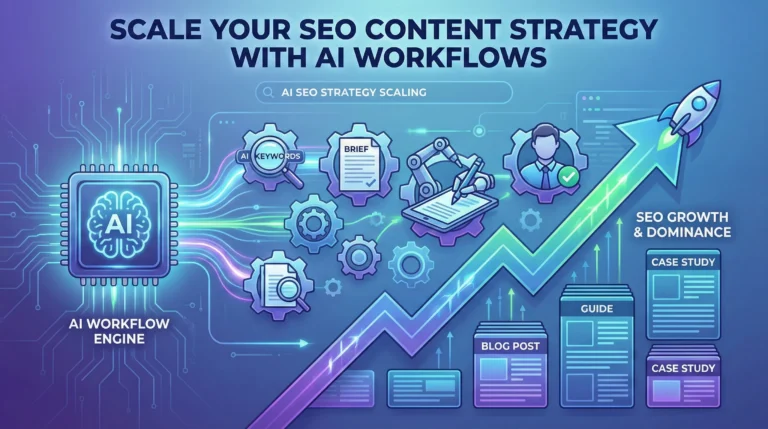
    Scale Your Content Strategy: A Blueprint for AI SEO Workflows

    If you are a content manager or niche site builder, you know the current reality: the SERPs are hungrier than ever. The old playbook of manually researching keywords, crafting individual briefs, and managing a dozen freelance writers on Trello is becoming unsustainable. It’s too slow and too expensive to compete with competitors who have figured out velocity.

    To win at search today, you cannot just “use AI to write.” You need to build an AI SEO strategy that turns manual bottlenecks into automated workflows.

    Scaling isn’t about asking ChatGPT to write 50 articles in one giant prompt—that’s a recipe for generic, low-ranking “slop.” True scale comes from deconstructing the SEO process and using AI to handle the repetitive heavy lifting, leaving the high-value strategic thinking to humans.

    Here is how to graduate from basic prompting to building an enterprise-grade programmatic SEO engine.

    Phase 1: Intelligent Keyword Clustering at Scale

    The biggest mistake SEOs make with AI is starting with the writing phase. Scale starts with structure. You cannot dominate a niche by picking keywords one by one.

    Instead of manually grouping keywords in spreadsheets, dump thousands of raw keyword ideas from tools like Ahrefs or Semrush into a CSV. Then, use ChatGPT’s Advanced Data Analysis feature to perform semantic clustering.

    The Goal: Ask ChatGPT to group keywords not just by similar words, but by identical search intent. This turns a messy list of 5,000 keywords into a clean map of 300 distinct article topics, ensuring you don’t cannibalize your own rankings.

    Phase 2: The Automated Content Brief Factory

    Before you generate a single paragraph of draft copy, you must generate the instructions. The quality of your ChatGPT for SEO content output is directly tied to the quality of the input brief.

    Don’t ask ChatGPT to “write an article about X.” Instead, create a workflow (perhaps using a tool like Make.com or Zapier chained to OpenAI’s API) that takes a target keyword and generates a comprehensive brief based on live SERP data.

    Your automated brief should include:

    • The primary search intent (informational vs. commercial).
    • A suggested H2/H3 structure based on top-ranking competitors.
    • A list of semantic entities and NLP terms that must be included.
    • The specific questions the article needs to answer to win Featured Snippets.

    Phase 3: The “Chain-of-Thought” Drafting Engine

    Once you have a rock-solid brief, you can begin drafting. But don’t try to generate a 2,000-word guide in one shot. AI loses the thread on long outputs.

    Build a workflow that chains prompts together. Step one generates the introduction based on the brief’s hook. Step two takes the introduction and the brief’s first H2 to write the next section, and so on. By breaking the task into modular chunks, you maintain context and improve factual accuracy.

    Phase 4: The Human-in-the-Loop (E-E-A-T Layer)

    This is where the elite SEOs separate themselves from the spammers. You cannot auto-publish raw AI output and expect long-term gains.

    Your workflow must end in a human review queue. The AI is the architect and the bricklayer, but you are the site inspector. The human job is no longer drafting; it’s injecting Experience, Expertise, Authoritativeness, and Trustworthiness (E-E-A-T). Add unique data, personal anecdotes, expert quotes, and ensure the tone matches your brand.

    By automating the research, briefing, and drafting phases, your team spends 80% of their time improving content quality, rather than staring at a blank page.
  • ·

    Digital Doubles: HeyGen vs. Synthesia – Choosing Your AI Presenter for 2026

    In business, communication is everything. Whether it’s training your global sales force, delivering personalized video messages to thousands of leads, or creating consistent brand explainers, the demand for engaging video is immense. The traditional approach—hiring presenters, booking studios, shooting, editing—is a bottleneck for even the most agile teams.

    This is where AI Avatar & Business Presenters step in. These aren’t just text-to-speech tools; they create convincing digital humans who can speak your message in multiple languages, with realistic expressions and lip-sync. For businesses in the US and UK looking to scale their video output without scaling their production budget, these platforms are a game-changer.

    At AI Growth Gear, we’ve evaluated the leading platforms with our “Director’s Lens,” focusing on realism, brand integration, and operational efficiency. Here’s how the top two—HeyGen (Avatar IV) and Synthesia—compare for your business.

    The Contenders at a Glance

    FeatureHeyGen (Avatar IV)Synthesia
    Primary StrengthUltra-Realistic Digital TwinsEnterprise-Grade Library & Compliance
    Best ForPersonalized Sales, UGCCorporate Training, Explainers
    WeaknessCustom avatars require more inputStock avatars can feel less unique

    1. HeyGen (Avatar IV): The Ultra-Realist

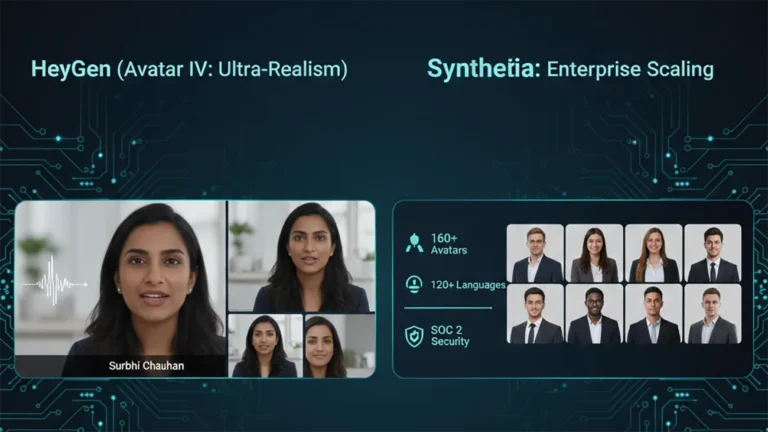
    HeyGen’s latest iteration, Avatar IV, is pushing the boundaries of what’s possible in AI avatar realism. Its “Digital Twin” feature allows businesses to create incredibly lifelike avatars of actual employees or spokespersons from minimal video footage. The subtlety of facial expressions and natural-sounding voice clones are truly impressive.

    • The Aesthetic: Aimed squarely at hyper-realism. If you want your AI presenter to be indistinguishable from a real human, HeyGen is currently leading the pack. It masters the minute details, making it ideal for maintaining a personal touch at scale.
    • The Director’s Take: “HeyGen is for when ‘authentic’ means ‘looks like you.’ It’s unparalleled for personalized sales videos, founder messages, or any content where the presenter’s unique identity is key. It allows a boutique agency to maintain its human brand persona without physically being in every video.”

    2. Synthesia: The Enterprise Powerhouse

    Synthesia has been the long-standing leader in the corporate AI video space, and for good reason. It boasts an extensive library of over 160 diverse stock avatars and 120+ languages, coupled with robust SOC 2 compliance for data security. Its platform is built for scalable, professional use cases across large organizations.

    • The Aesthetic: Polished, professional, and consistent. While its stock avatars are highly realistic, they aim for broad appeal rather than individual uniqueness.
    • The Director’s Take: “Synthesia is the workhorse of the enterprise. If you need to produce hundreds of consistent training modules, international onboarding videos, or routine explainers, its sheer volume of customizable options and security features make it the undisputed choice. It ensures your corporate communication is slick and reliable across the board.”

    The Verdict: Which Digital Double is Right for You?

    • Choose HeyGen if your priority is Personalization and Ultra-Realism. If you need your AI presenter to look and sound exactly like a specific person to build trust or enhance a unique brand identity.
    • Choose Synthesia if your priority is Scalability and Corporate Readiness. If you require a vast library of diverse avatars, multi-language support, and enterprise-grade security for consistent, high-volume video production.

    Our Recommendation for 2026

    For many agencies, the ideal setup might involve a blend: HeyGen for high-impact, personalized, and client-facing content, and Synthesia for internal training, broad-reach explainers, or situations requiring a diverse range of stock avatars. Both tools excel at making video production accessible, but they serve different strategic objectives.