
Solo Entrepreneur

  • ·

    Predictive AI Marketing Software: Stop Churn Before It Happens

    For solo entrepreneurs and boutique agency owners, there’s a silent killer that’s far more damaging than a bad month of sales: churn. You spend countless hours and thousands of dollars acquiring a new high-value client in the US or UK, only to have them quietly slip away through the back door six months later. It’s the classic leaky bucket problem.

    Historically, fixing churn was a reactive game. You’d conduct an exit interview after the client had already left to find out what went wrong. At AI Growth Gear, a division of Enoxx News Private Limited, we believe true digital growth comes from securing your backend financial stability first. That means moving from reactive firefighting to proactive prediction.

    Thanks to a new wave of accessible AI tools, you no longer need a team of data scientists to predict the future. You can now use the data you already have to flag at-risk clients before they cancel. Here are the top predictive AI marketing software platforms that are helping lean businesses turn retention into a science in 2026.

    Pecan AI: The Democratization of Predictive Modeling

    Until recently, building a predictive churn model required a PhD in data science. Pecan AI has changed that by building a low-code platform designed for business users, not just data engineers.

    • The Retention Play: As a solo operator, you are sitting on a goldmine of historical data in your CRM and billing systems. Pecan connects directly to these sources and uses automated machine learning to build custom models specifically for your business. Within days, it can generate a list of your current clients with a “churn probability score.” This allows you to focus your limited time and energy on the 10% of clients who are actually at risk, rather than spray-and-praying generic retention emails to everyone.

    Mixpanel: Behavioral Analytics as a Crystal Ball

    While many tools tell you what happened, Mixpanel specializes in telling you why. It’s a powerful product analytics platform that helps you understand user behavior at a granular, event-based level.

    • The Retention Play: Churn rarely happens overnight; there are almost always leading indicators. Perhaps a client stopped logging into your project management portal, or their usage of a key feature dropped by 30% last month. Mixpanel’s deep behavioral cohort analysis helps you identify these specific patterns of “pre-churn” behavior. By setting up alerts for these leading indicators, you can intervene with a personalized check-in call or a targeted helpful resource at the exact moment a client’s engagement begins to wobble.

    Optimove: The AI Orchestrator for Retention Actions

    Knowing who is going to churn is only half the battle. You also need to know what action will prevent it. Optimove sits at the intersection of predictive data and marketing execution. It’s a Customer-Led Marketing Hub that uses AI to determine the next best action for every individual client.

    • The Retention Play: Optimove’s AI builds dynamic micro-segments of your client base based on their predicted future value and churn risk. Instead of sending a generic monthly newsletter, you can set up autonomous workflows. For a high-value client showing moderate churn risk, Optimove might automatically trigger an exclusive offer for a free strategy session via email. For a lower-tier client, it might trigger a series of educational in-app messages. It ensures that every retention effort is hyper-personalized and delivered at the optimal time to change the outcome.

    The Bottom Line

    In the high-stakes world of B2B services, client retention is your most sustainable growth strategy. By integrating predictive AI tools like Pecan AI, Mixpanel, and Optimove into your backend operations, you can stop guessing about who might leave and start proactively securing your business’s future revenue.
  • ·

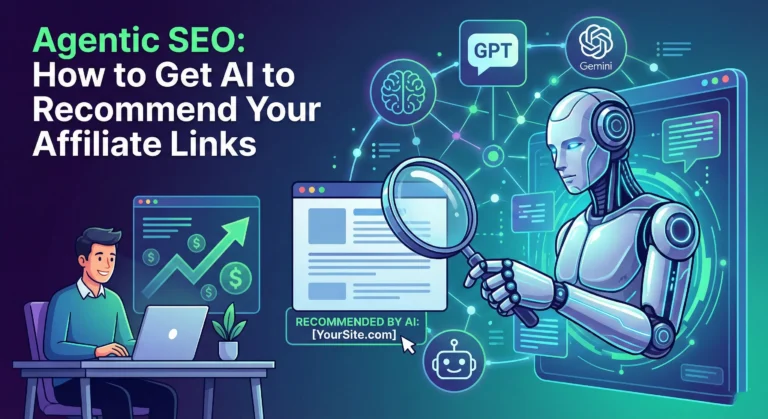
    Agentic SEO: How to Get AI to Recommend Your Affiliate Links

    Let’s be real for a second: when was the last time you scrolled past the AI summary to click on a random blog link?

    If you’re like most users in 2026, the answer is “rarely.”

    For solo entrepreneurs and affiliate marketers, this is terrifying. We spent years worshiping the Google algorithm, learning to structure our H1s and stuff keywords into alt tags. But the game has changed. We aren’t just optimizing for a search engine anymore; we are optimizing for agents—AI models like Gemini, ChatGPT, and Claude that don’t just give users a list of options, but give them an answer.

    This is Agentic SEO (sometimes called GEO or AEO). And if you want your affiliate links to survive, you need to stop writing for clicks and start writing for citations.

    Here is the straightforward, no-fluff guide on how to get AI agents to recommend your products.

    1. The “Answer Capsule” Strategy

    AI models are impatient readers. When they scan your content, they are looking for a direct, factual answer to a specific question. If you bury your affiliate recommendation in paragraph four after a long-winded intro about “the history of running shoes,” the AI will ignore you.

    You need to use Answer Capsules.

    This is a specific formatting trick where you place a direct, 40-60 word answer immediately after an H2 question.

    • Bad: There are many factors to consider when buying a microphone…
    • Good: The best budget microphone for podcasting in 2026 is the Rode PodMic. It offers broadcast-quality sound for under $100 and rejects background noise better than the Blue Yeti.

    By front-loading the facts, you make it easy for the AI to “grab” that snippet and serve it to the user—usually with a citation link back to your site.

    2. Data is the New Keyword

    In the old days, we competed on keyword density. Today, we compete on Information Gain.

    LLMs (Large Language Models) are trained to prioritize unique data. If your review of a software tool just rewrites the features list from the company’s homepage, the AI has no reason to cite you. It already knows that info.

    To win, you need to create new data points that the AI doesn’t have.

    • Don’t just say “The battery lasts a long time.”
    • Say: “In our stress test, the battery lasted 14 hours and 12 minutes.”

    When you provide specific, hard numbers, AI agents flag your content as a primary source. This dramatically increases the chance that when a user asks, “Which laptop has the best validated battery life?”, the AI will pull your stat and your link.

    3. The “Reddit” Factor

    Here is a weird twist: to rank your website, you might need to spend more time off of it.

    AI models like Perplexity and Google’s Gemini rely heavily on “human consensus” to verify facts. They look at platforms like Reddit, Quora, and G2 to see what actual humans are saying.

    If you are a solo affiliate, you can’t just be a ghost. You need to build a brand “entity.” If people on Reddit are discussing your blog post as a good resource, or if you are mentioned in forum discussions as a trustworthy reviewer, the AI picks up on that signal. It treats your site as a verified authority.

    The Action Step: Don’t just spam links. Engage in communities. Be the expert who answers questions. When the AI sees your brand name associated with “helpful answers” across the web, it starts trusting your site’s content too.

    4. Structure for Machines (Schema is King)

    Finally, you have to speak the robot’s language. In 2026, “Schema Markup” isn’t optional technical mumbo-jumbo; it’s mandatory.

    You need to use JSON-LD schema to explicitly tell the AI what your page is about. Are you reviewing a product? Use Product schema. Are you writing a tutorial? Use HowTo schema.

    This gives the AI a structured map of your content, making it effortless for it to extract your price comparisons, pros/cons, and ratings. The easier you make it for the AI to understand your data, the more likely it is to use it.

    The Bottom Line

    The “generic” affiliate site is dead. The “AI-Recommended” expert is the new king. Stop writing generic fluff and start building a library of hard data, direct answers, and structured facts. That is how you win the trust of the machines—and the clicks of the humans.