Beyond the Hype: Our Top 5 AI Gear for Driving Growth in 2026

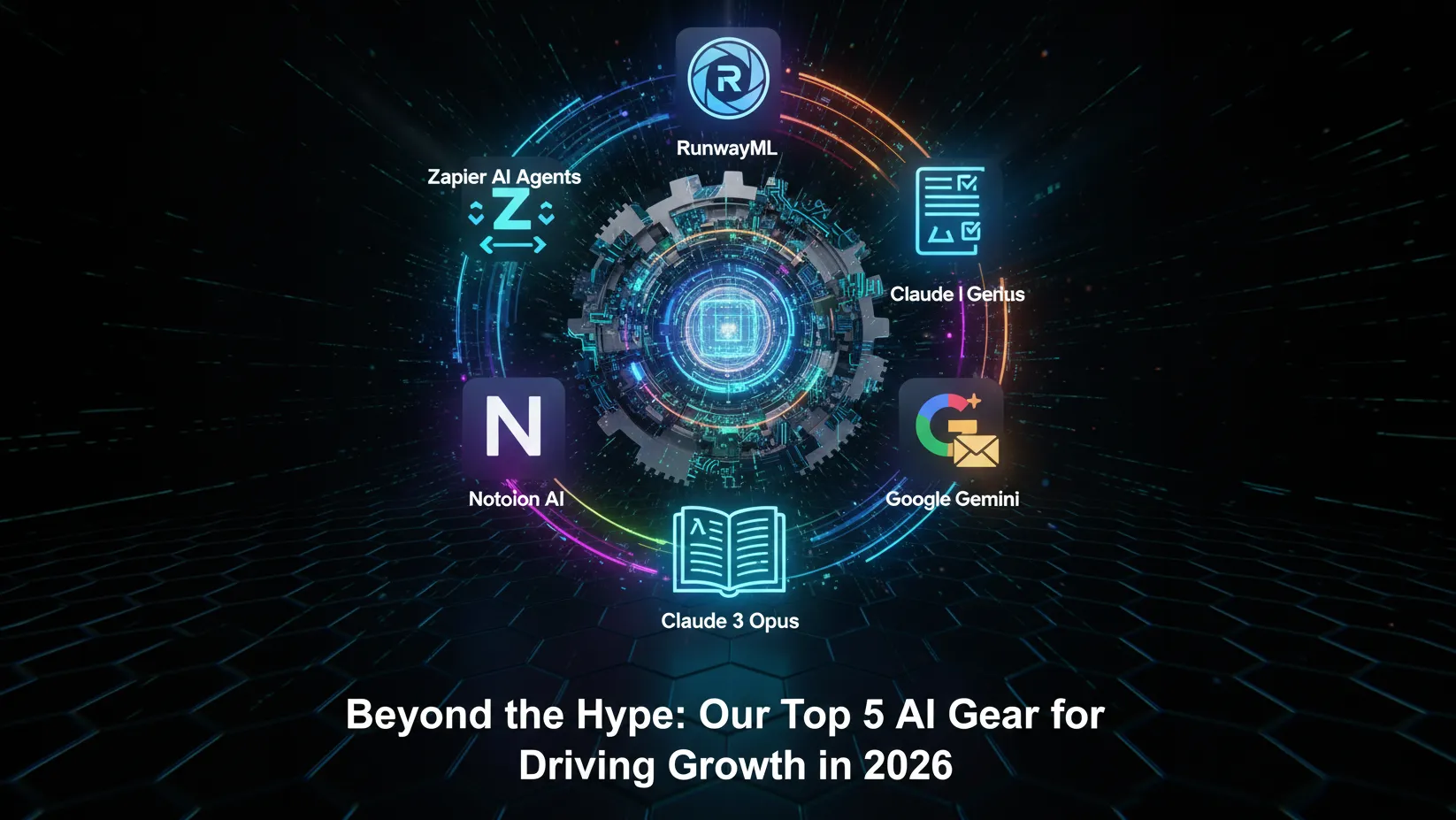
Beyond the Hype: Our Top 5 AI Gear for Driving Growth in 2026

Every week, it feels like a hundred new AI tools launch. The promises are grand, the demos are dazzling, but for the busy business owner, it’s just another layer of confusion. Which ones actually work? Which ones are built for growth, not just novelty?

At AI Growth Gear, our philosophy is simple: Don’t chase every shiny object; invest in the right gears. With my background managing the fast-paced operations at Enoxx News, and Surbhi’s eye for seamless integration from NIFT and film, we don’t recommend a tool unless it truly elevates an existing workflow. We’ve put countless hours into testing, integrating, and often, breaking these tools so you don’t have to.

So, as we navigate 2026, here are our top 5 battle-tested AI “Gears” that are truly driving growth for businesses in the US and UK.

1. The Orchestrator: Zapier AI Agents (for Seamless Workflow Automation)

Think of Zapier as the central nervous system of your digital operations. Now, imagine giving it a brain. Zapier AI Agents aren’t just about connecting apps; they’re about giving an AI an objective and letting it execute multi-step tasks across your entire tech stack.

  • Why it’s essential: Instead of manually moving data from your CRM to your email marketing, or updating your project management tool based on a customer query, an Agent handles it. It’s perfect for streamlining lead nurturing, customer onboarding, and even internal reporting. It truly embodies the “Agentic AI” we champion.

2. The Visual Storyteller: RunwayML (for Dynamic Video & Visuals)

The demand for video content is relentless. Traditional video production is slow and expensive. Enter RunwayML. While still evolving, its capabilities in generating short video clips from text, transforming existing footage, and even isolating elements are game-changing.

  • Why it’s essential: For brands needing to create quick, high-quality social media clips, product explainers, or animated graphics, RunwayML democratizes video creation. It allows you to maintain aesthetic quality without a full production team, resonating deeply with Surbhi’s visual-first approach.

3. The Intelligent Copywriter: Claude 3 Opus (for High-Quality Content Creation)

While ChatGPT got all the headlines, Claude 3 Opus (and its siblings Haiku and Sonnet) has quietly become our go-to for sophisticated long-form content and nuanced brand voice. Its ability to handle complex prompts and produce less “AI-sounding” text is remarkable.

  • Why it’s essential: From drafting compelling blog posts and email sequences to generating detailed market analyses, Claude 3 Opus consistently delivers. It helps maintain the “Aesthetic Automation” principle by producing copy that feels genuinely human and on-brand, freeing up your team for strategic refinement.

4. The Knowledge Manager: Notion AI (for Organized Operations & Idea Generation)

If your business lives in Notion (and many successful ones do), then Notion AI is a non-negotiable. It’s an integrated AI assistant that lives directly within your workspaces, databases, and documents.

  • Why it’s essential: Instantly summarize lengthy meeting notes, draft marketing copy based on project briefs, automate task generation, and even brainstorm content ideas directly within your existing knowledge base. It transforms Notion from a powerful workspace into an intelligent operational hub, drastically improving team productivity.

5. The Data Whisperer: Google Gemini for Workspace (for Smart Insights & Efficiency)

We live in our inboxes and spreadsheets. Google Gemini for Workspace integrates AI directly into Gmail, Docs, Sheets, and Slides. This means AI can draft emails, summarize lengthy document threads, analyze data in Sheets, and even create presentations with simple prompts.

  • Why it’s essential: It’s about leveraging the tools you already use daily. Gemini streamlines communication, automates data analysis, and assists with content creation right where you work. It’s subtle, powerful, and an absolute game-changer for internal efficiency and external communication, ensuring every interaction is precise and purposeful.

Equip Your Growth

Choosing the right AI “gear” isn’t about having the most tools; it’s about having the most effective ones. These five solutions, when integrated strategically, can transform your business from being trapped in the “Efficiency Trap” to being a nimble, growth-driven machine.

Don’t just automate; orchestrate. Let’s equip your business with the intelligence it needs to thrive in 2026.
Similar Posts

  • Aesthetic Automation: Why Your Brand’s Human Soul Matters in an AI World

    In the world of high fashion and cinema, there is a term we often use: Texture. It’s the subtle imperfection in a fabric, the specific grain of a 35mm film, or the slight tremor in a voice that tells the audience something is real.

    As we move through 2026, we are witnessing a digital crisis. The internet is being flooded with “perfect” content. We see AI-generated images that are too glossy, AI-written captions that are too enthusiastic, and AI videos that feel just a bit too… hollow. In the US and UK markets, consumers are developing a sixth sense for this. They are tuning out.

    This is where the concept of Aesthetic Automation comes in.

    The NIFT Lens: Design is a Language, Not a Tool

    My journey at the National Institute of Fashion Technology (NIFT) wasn’t just about learning how things look; it was about learning how they communicate. When I moved into film production and eventually co-founded Enoxx News, that lesson stayed with me.

    AI is a powerful engine, but it is “taste-blind.” It can generate a thousand logos in a minute, but it doesn’t know which one carries the weight of a legacy brand or the edge of a modern startup.

    At AI Growth Gear, we believe that automation without aesthetics is just noise. If you are using AI to scale your business but losing your brand’s unique “texture” in the process, you aren’t growing—you’re diluting.

    The 2026 Shift: From “Perfect” to “Authentic”

    A few years ago, the goal was to make AI look as polished as possible. Today, the trend is shifting toward Authentic Automation. Top-tier brands in London and New York are no longer looking for the most “advanced” AI; they are looking for the most “human” AI. They want automation that understands subtext, irony, and minimalist design. They want the “gears” to stay hidden behind a beautiful, human-centric interface.

    To achieve this, we apply three core design principles to every AI workflow:

    1. Curation Over Creation: The role of the human has shifted from being the one who draws the line to the one who chooses the best line. We use our background in film and fashion to curate AI outputs so they feel intentional, not accidental.
    2. The “Imperfect” Prompt: We don’t ask AI for “perfect” results. We prompt for character, for specific lighting styles (like Chiaroscuro), and for a tone of voice that sounds like a person, not a marketing brochure.
    3. Visual Cohesion: One of the biggest mistakes small businesses make is using five different AI tools that create five different “looks.” We build unified “Aesthetic Sets” so your brand remains recognizable across every automated touchpoint.

    Gearing Up Your Brand

    Automation should be your brand’s silent partner, not its replacement. Whether we are automating your social media presence or building an AI-driven video workflow, the goal is always the same: Efficiency that looks and feels like Art.

    The “Gear” in our name represents the mechanics of your business, but the “Growth” represents the life and soul of your brand. In 2026, the most successful companies will be those that use technology to become more human, not less.

    Don’t let your brand become a victim of the “uncanny valley.” Let’s build a system that honors your vision while leveraging the speed of tomorrow.

  • ·

    Chatbots Are Dead. Long Live AI Agents: A 2026 Guide

    Let’s be honest for a second. We all spent 2023 and 2024 being amazed that ChatGPT could write a haiku or summarize a PDF. It was cool, it was novel, but let’s face it: it was passive. You had to show up, type a prompt, wait for the text, copy it, and then paste it somewhere else to actually do something with it.

    In 2026, that workflow is already obsolete.

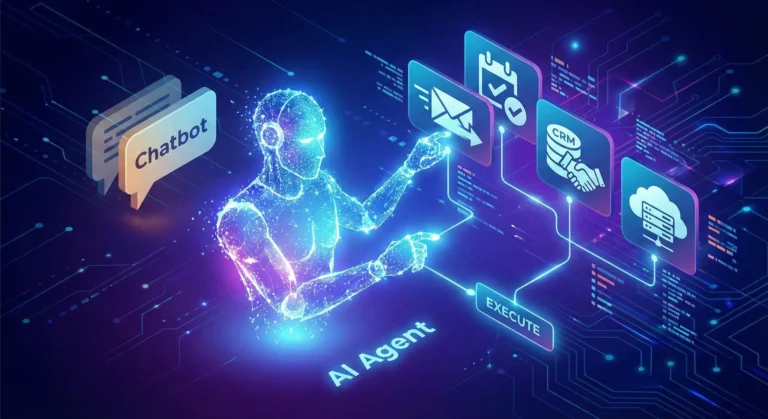
    If your business is still treating AI like a smart encyclopedia, you are leaving money on the table. The shift happening right now—in Silicon Valley, London, and Berlin—is the move from Chatbots to AI Agents.

    The Difference: “Talk” vs. “Action”

    The distinction is simple but critical.

    • A Chatbot is like a library. You ask a question; it gives you an answer. It waits for you.
    • An AI Agent is like an intern. You give it a goal (“Plan my travel”), and it goes off, checks flights, compares hotels, books the tickets, and puts them on your calendar. It has agency.

    For business automation, this is the holy grail. We are no longer using AI to write the email; we are using AI to send the email, update the CRM, and notify the sales team on Slack—without you touching the keyboard.

    The Anatomy of an Agent

    You don’t need a computer science degree to build one. You just need to understand the three parts of an “Agentic Workflow”:

    1. The Brain (The LLM): This is GPT-4o, Claude 3.5, or Gemini. Its job isn’t to generate text, but to make decisions. It decides which tool to use based on your instructions.
    2. The Hands (The Tools): This is where the magic happens. You give the “Brain” access to your apps—Gmail, Salesforce, Excel, Slack—via APIs.
    3. The Rails (The Rules): Agents can hallucinate. You need guardrails to ensure it doesn’t accidentally email your entire database.

    How to Build Your First “Loop” (Without Code)

    You don’t need to hire a Python developer to start. Platforms like Zapier Central, Make.com, or Microsoft Copilot Studio have democratized this.

    Here is a simple “Lead Qualification” agent you can build this afternoon:

    Step 1: The Trigger Don’t start with “I want AI.” Start with a pain point. Let’s say: “I spend too much time reading contact forms.”

    • Trigger: A new entry lands in your Typeform or website contact form.

    Step 2: The Agent Analysis Instead of just forwarding that email to you, the AI Agent intercepts it.

    • Instruction: “Read the message. If the budget mentioned is under $5,000, label it ‘Low Priority.’ If it’s over $5,000, label it ‘High Priority’ and draft a personalized meeting invite.”

    Step 3: The Action This is the part that feels like magic.

    • If Low Priority: The Agent adds the row to a Google Sheet for later review.
    • If High Priority: The Agent pings you on Slack with a summary (“Hot lead from London, budget $10k”) and drafts the email in your Drafts folder, waiting for one click to send.

    The “Human-in-the-Loop” Rule

    The biggest mistake I see businesses make is trusting the Agent too much too soon. In 2026, the best workflow is “AI Drafts, Human Approves.”

    Let the Agent do the grunt work—the searching, the sorting, the drafting. But keep your finger on the “Approve” button for the final mile. As these agents get smarter, you can slowly remove the training wheels, but for now, trust is good; control is better.

    The Bottom Line

    The businesses that win in the next decade won’t be the ones with the smartest prompt engineers. They will be the ones who successfully outsource their repetitive, low-value cognitive loops to digital agents.

    Stop asking your AI questions. Start giving it a job description.

  • ·

    Agentic Automation: The Future of Workflow Automation

    The Shift From Task Automation to Autonomous Systems

    For years, workflow automation meant one thing: automate repetitive tasks.

    Businesses deployed RPA bots to click buttons, copy data between systems, and follow predefined rules. It worked — to a point. Costs dropped. Manual errors decreased. Efficiency improved.

    But in 2026, the conversation has shifted.

    Companies are no longer asking, “How do we automate this task?”
    They’re asking, “How do we automate outcomes?”

    That shift is where agentic automation enters the picture.


    What Is Agentic Automation?

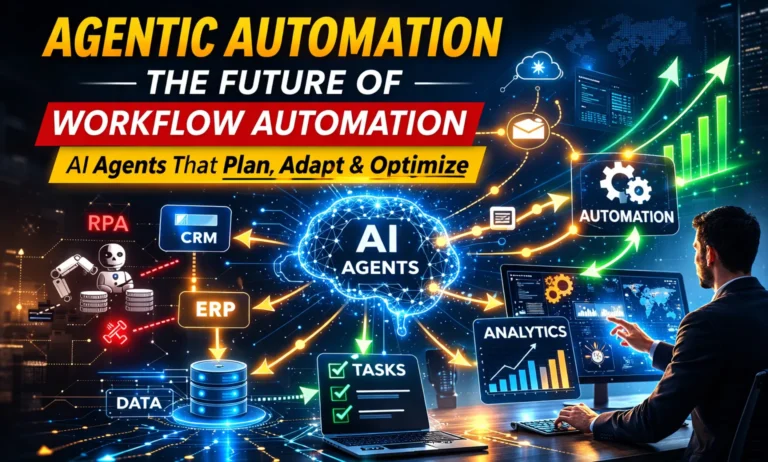
    Agentic automation refers to AI systems designed to act like autonomous agents rather than scripted bots.

    Instead of following rigid instructions, these AI agents:

    • Understand objectives
    • Plan multi-step workflows
    • Adjust decisions based on changing inputs
    • Optimize performance over time
    • Execute tasks across multiple systems

    In simple terms:

    Traditional automation executes instructions.
    Agentic automation pursues goals.

    If RPA is a digital worker following a checklist, agentic automation is a digital project manager figuring out the best way to get the job done.


    Why 2026 Is the Turning Point

    Several factors are converging to make 2026 a breakthrough year for agentic automation:

    1. Mature AI Models

    Large language models and reasoning engines are now capable of multi-step thinking, contextual understanding, and strategic decision-making.

    2. Better Workflow Orchestration Tools

    Modern orchestration platforms allow AI agents to interact with CRMs, ERPs, marketing systems, analytics dashboards, and internal databases seamlessly.

    3. Business Pressure for Agility

    US and UK enterprises face increasing pressure to reduce operational overhead while scaling faster. Static bots cannot keep up with dynamic markets.

    4. Data Explosion

    Companies generate massive amounts of data daily. Agentic systems can analyze and act on that data continuously — something rule-based bots struggle with.

    The result? Businesses are moving from automation scripts to intelligent orchestration layers.


    What Is Workflow Orchestration in This Context?

    Workflow orchestration is the coordination of multiple automated processes into one intelligent, goal-driven system.

    Instead of separate bots for:

    • Lead qualification
    • CRM updates
    • Email nurturing
    • Reporting

    An agentic system oversees the entire pipeline. It monitors performance, adjusts messaging, escalates exceptions, and reallocates resources when needed.

    It doesn’t just execute — it manages.


    Agentic Automation vs RPA: What Businesses Should Know

    To understand the future, we need to compare it with the present.

    1. Decision-Making Capability

    RPA:
    Follows predefined rules. If X happens, do Y.

    Agentic Automation:
    Analyzes context and decides the best action based on objectives.

    Example:
    An RPA bot sends a standard follow-up email.
    An AI agent decides whether to follow up, change tone, escalate to sales, or pause outreach based on engagement data.


    2. Adaptability

    RPA:
    Breaks when systems change or workflows evolve.

    Agentic Automation:
    Adapts to new inputs, system updates, and unexpected scenarios.

    This flexibility significantly reduces maintenance costs.


    3. Scope of Automation

    RPA:
    Automates tasks.

    Agentic Automation:
    Automates entire processes and optimizes them continuously.

    Instead of automating invoice entry, an AI agent can oversee the entire accounts payable workflow — from invoice detection to fraud checks and payment timing.


    4. Human Involvement

    RPA:
    Requires ongoing human supervision and frequent updates.

    Agentic Automation:
    Operates with minimal supervision, escalating only when judgment or compliance decisions are required.

    It augments humans instead of replacing them.


    5. ROI Potential

    RPA typically delivers incremental efficiency gains — often 20–40% improvement in specific tasks.

    Agentic automation can deliver transformational gains by:

    • Reducing operational headcount pressure
    • Improving decision speed
    • Increasing revenue conversion rates
    • Minimizing error-based losses
    • Enabling 24/7 optimization

    For enterprises, this moves automation from a cost-saving initiative to a growth strategy.


    Where Agentic Automation Delivers the Most Value

    In 2026, we’re seeing the strongest impact in:

    • Sales workflow automation
    • Marketing orchestration
    • Customer support triaging
    • Financial process management
    • Supply chain coordination
    • Enterprise IT operations

    Particularly in high-income markets like the US and UK, businesses are adopting agentic systems to remain competitive against leaner, AI-native startups.


    Should Businesses Replace RPA?

    Not immediately.

    RPA still has value for simple, stable, repetitive tasks. It’s reliable and cost-effective.

    However, forward-thinking organizations are layering agentic automation on top of existing RPA infrastructure — using RPA for execution and AI agents for orchestration.

    This hybrid approach offers the best of both worlds.


    The Bigger Picture: Automation as Strategy

    The most important takeaway isn’t technological — it’s strategic.

    Workflow automation is no longer just about saving time.

    It’s about building systems that:

    • Learn
    • Adapt
    • Scale
    • Optimize themselves

    Agentic automation represents the next evolution in business automation — moving from static scripts to intelligent operational ecosystems.

    In 2026 and beyond, the companies that win will not be the ones with the most bots.

    They’ll be the ones with the smartest orchestration layers.


    Final Thoughts

    Agentic automation is not hype — it’s a structural shift in how businesses think about workflows.

    RPA automated the past.
    Agentic systems are shaping the future.

    For organizations in the US, UK, and other advanced markets, the question is no longer if AI will manage workflows — but how quickly they can adopt it strategically.

    The future of workflow automation is autonomous, adaptive, and outcome-driven.

    And that future has already begun.

  • The Human-in-the-Loop: Why AI Strategy Requires a Director’s Touch

    In film production, there is a reason why a movie doesn’t just consist of actors and a script. It needs a Director. The director ensures that every shot, every line, and every edit serves the larger vision. Without that oversight, even the most expensive production falls apart into a series of disconnected scenes.

    As we consult with businesses across the UK and US, we see a recurring fear: “If I automate my business, will I lose the soul of my brand?” The answer is only “Yes” if you treat AI like a replacement. At AI Growth Gear, we treat AI as a high-performing crew that requires a skilled Director. This is what we call the Human-in-the-Loop (HITL) philosophy.

    The Myth of “Set it and Forget it”

    The biggest mistake a business can make in 2026 is believing that AI is a magic wand. You cannot simply “plug in” an agent and expect it to understand your brand’s nuances, your customers’ emotional needs, or your ethical boundaries.

    True “Gear-driven” growth requires a feedback loop. AI handles the heavy lifting—the data crunching, the first drafts, the scheduling—while the human handles the judgment.

    Why My Film Background Matters to Your ROI

    During my time in film production, I learned that a great story is told in the edits. AI is fantastic at generating volume, but humans are essential for selection.

    When we build an AI workflow for a client, we don’t just hand over a tool. We build “Director Checkpoints.” These are stages in the automation where the system pauses for human approval or refinement. This ensures that:

    • The Tone stays consistent: Your AI shouldn’t sound like a different person every time it sends an email.
    • The Ethics remain sound: AI doesn’t inherently understand the cultural nuances of a London-based client versus a New York-based one.
    • The Strategy evolves: Data tells you what happened; humans tell you why it matters.

    Building Your Digital Crew

    Imagine your business as a production. Your AI agents are your camera operators, your lighting crew, and your editors. They work fast, they don’t get tired, and they follow instructions perfectly. But you are the Director.

    The HITL approach allows you to scale your output by 10x without losing 1% of your quality. It’s about leveraging the machine to give the human more time to be creative, strategic, and—most importantly—present.

    Gearing Up for Authenticity

    In a world that is becoming increasingly automated, authenticity is the new gold standard. By keeping a human in the loop, you aren’t slowing down your growth; you are protecting your brand’s most valuable asset: its identity.

    At AI Growth Gear, we don’t just give you the tech; we give you the script and the direction to ensure your business’s story is told exactly how you intended.

  • ·

    Top No-Code AI Agent Builders for Agencies

    Scaling an agency in the US or UK used to mean one thing: hiring more people. Every new client meant adding more project managers, more data entry clerks, and more administrative bloat. But operations managers are waking up to a new reality. You don’t need a bigger team to handle enterprise-level capacity; you need better internal infrastructure.

    The secret to maximizing agency margins right now is replacing repetitive administrative headcount with custom AI agents. By leveraging no-code enterprise automation, you can build digital employees that handle your backend operations 24/7. Here at AI Growth Gear, we prioritize software that directly impacts the bottom line. If you want to deploy sophisticated business intelligence and workflow software without writing a line of code, these are the platforms you need.

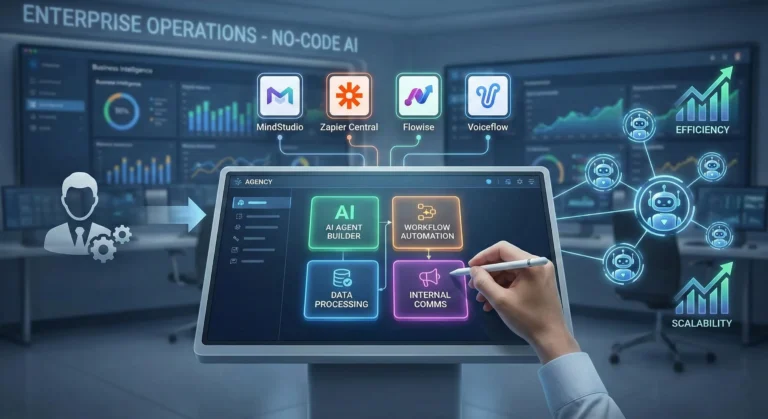
    MindStudio: The AI Employee Factory

    MindStudio is arguably the most robust platform right now for building highly specialized, multi-step AI agents. It allows you to build custom interfaces and connect different foundation models (like Claude 3 or GPT-4) depending on the specific task.

    • The Operations Play: Stop paying junior staff to summarize endless client discovery calls and format them into briefs. With MindStudio, you can build an internal “Strategy Agent.” You upload the raw call transcript, and the agent automatically extracts the core business objectives, cross-references them with your agency’s standard operating procedures (SOPs), and outputs a polished, ready-to-execute project brief. It turns hours of manual administrative work into a three-second automated workflow.

    Zapier Central: The Action-Oriented Assistant

    You likely already use Zapier to connect your apps, but Zapier Central transforms those passive connections into an active, conversational AI workspace. It allows you to build bots that sit directly on top of your live data.

    • The Operations Play: Zapier Central excels at data triage. Imagine a custom agent monitoring your high-value lead inbox. When a new enterprise inquiry comes in, the agent reads the context, automatically queries your CRM to see if they are an existing contact, drafts a personalized response based on their industry, and pings the correct account executive in Slack with a summary. It acts as an autonomous executive assistant that never drops the ball, perfectly optimizing your agency’s lead response times.

    Flowise: Visual LLM Orchestration

    For agencies handling vast amounts of proprietary data or complex technical documentation, Flowise is a game-changer. It provides a drag-and-drop visual interface for LangChain, meaning you can build highly complex AI logic flows without needing a Python developer.

    • The Operations Play: Build a secure, internal “Knowledge Retrieval Agent” for your team. By connecting Flowise to your agency’s internal Google Drive or Notion workspace, your team can simply ask the agent questions like, “What were the exact deliverables we promised in the Q3 contract for Client X?” The agent searches the secure internal database and retrieves the exact clause in seconds. This eliminates the endless back-and-forth messaging between departments and streamlines overall business intelligence.

    Voiceflow: Conversational Process Management

    While typically known for building customer-facing chatbots, smart operations managers are using Voiceflow to build robust internal conversational interfaces.

    • The Operations Play: Employee onboarding is a massive drain on operational resources. With Voiceflow, you can build an interactive “HR & Onboarding Agent.” Instead of handing new hires a static 50-page PDF of company policies, they interact with the Voiceflow agent. It can guide them through setting up their software stack, answer specific questions about payroll schedules, and train them on agency methodologies. It guarantees a consistent, scalable onboarding experience without tying up your senior staff.

    The Bottom Line

    B2B margins are won and lost in the backend. By investing in no-code workflow software like MindStudio, Zapier Central, Flowise, and Voiceflow, you aren’t just buying tools—you are building a scalable, automated workforce. This allows you to take on larger enterprise contracts without proportionately increasing your overhead.

  • ·

    ChatGPT vs. Claude vs. Jasper: Which AI Writing Assistant Actually Rules in 2026?

    Let’s be honest. Back in 2023, we were all just happy the magic trick worked. You typed a prompt, and a robot wrote a poem. Mind blown.

    But we are in 2026 now. The novelty has worn off. Now, we just need the work done.

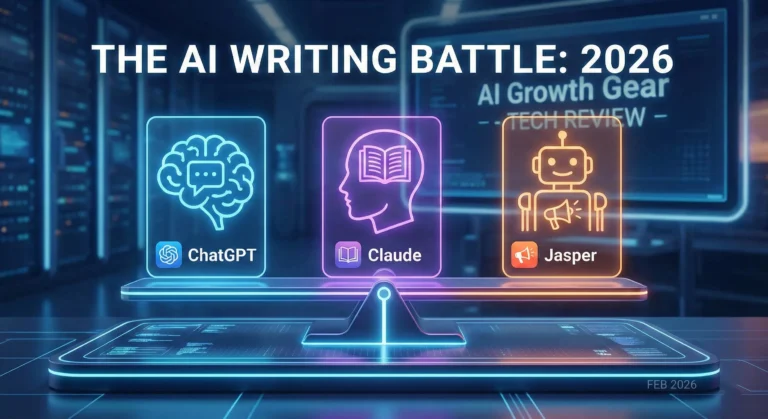
    My team and I have spent the last month putting the internet’s three heavyweights into the ring: ChatGPT (OpenAI), Claude (Anthropic), and Jasper.

    If you are confused about where to spend your monthly subscription budget this year, this battle post is for you. We tested them on marketing copy, creative nuance, and the ultimate test: Does it sound like a human?

    The Contenders

    1. ChatGPT (The Swiss Army Knife): With the GPT-5 / 4o updates, this isn’t just a chatbot anymore. It’s an ecosystem. It sees, it hears, it codes. But can it write a blog post without sounding like a corporate press release?
    2. Claude (The Writer’s Muse): Anthropic’s model (specifically Claude 3.5 Sonnet & Opus) has quietly become the cult favorite among professional writers in New York and London. The claim? It understands “nuance” better than anyone.
    3. Jasper (The Marketing Machine): Jasper stopped trying to be a “chatbot” years ago. In 2026, it’s a full-blown enterprise marketing platform. It doesn’t just write; it manages brands.

    Round 1: The “Human” Test (Writing Quality)

    The Challenge: Who writes text that doesn’t make readers roll their eyes and say, “AI wrote this”?

    ChatGPT: Look, GPT-4o is incredibly smart. It’s a genius. But it writes like a genius who is trying too hard to impress his boss. It loves words like “unleash,” “digital landscape,” and “delve.” It plays it safe. If you ask it for a LinkedIn post, you get a generic, emoji-filled wall of text that screams “AI.” It’s unbeatable for brainstorming, but for a final draft? It usually needs a heavy human edit.

    Claude: This is where Claude steals the show. The ‘Sonnet’ model understands rhythm. It varies sentence length. It uses metaphors that actually make sense. Most importantly, it doesn’t sound like it swallowed a thesaurus. If you are writing long-form blogs, newsletters, or even fiction, Claude’s flow is significantly more natural than ChatGPT. It feels like a creative partner, not a text generator.

    Jasper: Jasper isn’t trying to be Shakespeare; it’s trying to be your Brand Manager. It might not have the soulful prose of Claude, but its “Brand Voice” feature is elite. If your brand tone is “witty and punchy,” Jasper locks onto that and never lets go. ChatGPT often drifts back into “robot mode” after a few paragraphs; Jasper stays in character.

    🏆 Winner: Claude (For pure writing quality)


    Round 2: The “Workflow” Test (Features & Utility)

    ChatGPT: Its superpower is Multimodality. You’re writing an article and need a custom image? DALL-E generates it instantly. Need to analyze a CSV file for data to put in that article? It does that too. With ‘Custom GPTs’, you can build mini-tools for specific tasks. It is the ultimate “Generalist.”

    Claude: Two words: Artifacts and Projects. Claude’s ‘Projects’ feature is a game-changer for writers. You can upload your entire library of previous work, style guides, and research papers into a “Project.” Claude then writes from that knowledge base without you needing to re-upload files every chat. It remembers context better than any other tool right now.

    Jasper: If you run a team, Jasper is the winner. In 2026, their “AI Agents” are impressive. You don’t just ask it to write a blog; you tell it to “Create a Campaign.” It writes the blog, turns that blog into five social posts, writes the email newsletter to promote it, and creates the Google Ad copy—all in one workflow. It’s not just an editor; it’s a Project Manager.

    🏆 Winner: Jasper (For Teams/Agencies) / ChatGPT (For Multitasking)


    Round 3: The “Value” Test (Bang for Your Buck)

    • ChatGPT Plus ($20/mo): You get image generation, web browsing, data analysis, and voice mode. It’s the best value if you want one tool that does a little bit of everything.
    • Claude Pro ($20/mo): If you are strictly a writer or coder, this is the best money you can spend. But remember, no image generation.
    • Jasper (Starts ~$39-49/mo): It’s pricey. For a solo freelancer, it might be overkill unless you are churning out massive amounts of client work. But for a marketing agency? It pays for itself in one day.

    The Verdict: What Should You Buy in 2026?

    Here is my no-nonsense take:

    1. You are a Solopreneur / Blogger / Novelist: 👉 Get Claude. The writing is simply better. You will spend less time editing and more time creating.
    2. You are a “Jack of All Trades” (You code, design, and write): 👉 Stick with ChatGPT. It is the Swiss Army Knife you need in your pocket.
    3. You run a Marketing Agency or Business Team: 👉 Invest in Jasper. The Brand Voice control and collaborative workflows will save your team hundreds of hours. It’s not a tool; it’s a teammate.

    So, which corner of the ring are you in? Are you Team Human (Claude) or Team Powerhouse (ChatGPT)? Let me know in the comments below.