|

Build a Custom GPT to Automate Client Onboarding

Build a Custom GPT to Automate Client Onboarding

If you run an agency or consulting business, you already know the onboarding paradox. Landing a new client is the best feeling in the world, but the administrative hangover that immediately follows—sending welcome packets, chasing down brand assets, and setting up project management boards—is a massive drain on your time.

What if you could bottle up your exact onboarding process and hand it over to an AI?

Building a custom ChatGPT agent to handle your new client intake isn’t just a fun tech experiment; it is a scalable business asset. By combining OpenAI’s custom GPT capabilities with AI workflow automation, you can create an assistant that guides your clients, answers their initial questions, and drafts their strategy documents while you focus on the actual billable work.

Here is a step-by-step custom GPT tutorial to help you automate client onboarding and win back your week.

Step 1: Map the Workflow (Don’t Skip This)

A custom GPT is only as smart as the system you anchor it to. Before you even log into OpenAI, you need to document exactly what happens when a prospect says “yes.”

Grab a piece of paper and outline your current bottlenecks. What do you do on repeat?

  • Do you send the same welcome email with slightly tweaked variables?
  • Do you manually review intake forms to pull out key goals?
  • Do you spend an hour writing a project kickoff brief?

Pick one specific, repetitive phase of your onboarding process to automate first. A GPT built to “draft a custom project kickoff brief based on a client intake form” will perform ten times better than a GPT told to “handle my new clients.”

Step 2: Configure Your Custom GPT

Once your workflow is locked in, head over to ChatGPT. Note: You will need a paid Plus, Team, or Enterprise account to create and save custom GPTs.

  1. Click on Explore GPTs in the left sidebar, then hit Create.
  2. You will see a split screen. While it is tempting to use the “Create” tab to chat with the builder, switch over to the Configure tab. This gives you manual, granular control over how your agent behaves.
  3. Give your assistant a name (e.g., Onboarding Co-Pilot) and a brief description.

Step 3: Write the System Prompt (The Brain)

The “Instructions” box is where the magic happens. A standard prompt like “write welcome emails for my clients” will give you generic, robotic outputs.

To make this tool an extension of your business, give it a strict persona, clear rules, and an expected output format. Try using this structure:

  • Role: You are the Senior Client Success Manager for [Your Agency Name]. Your job is to facilitate a seamless onboarding experience for new B2B clients.
  • Tone: Warm, professional, and concise. Avoid marketing jargon.
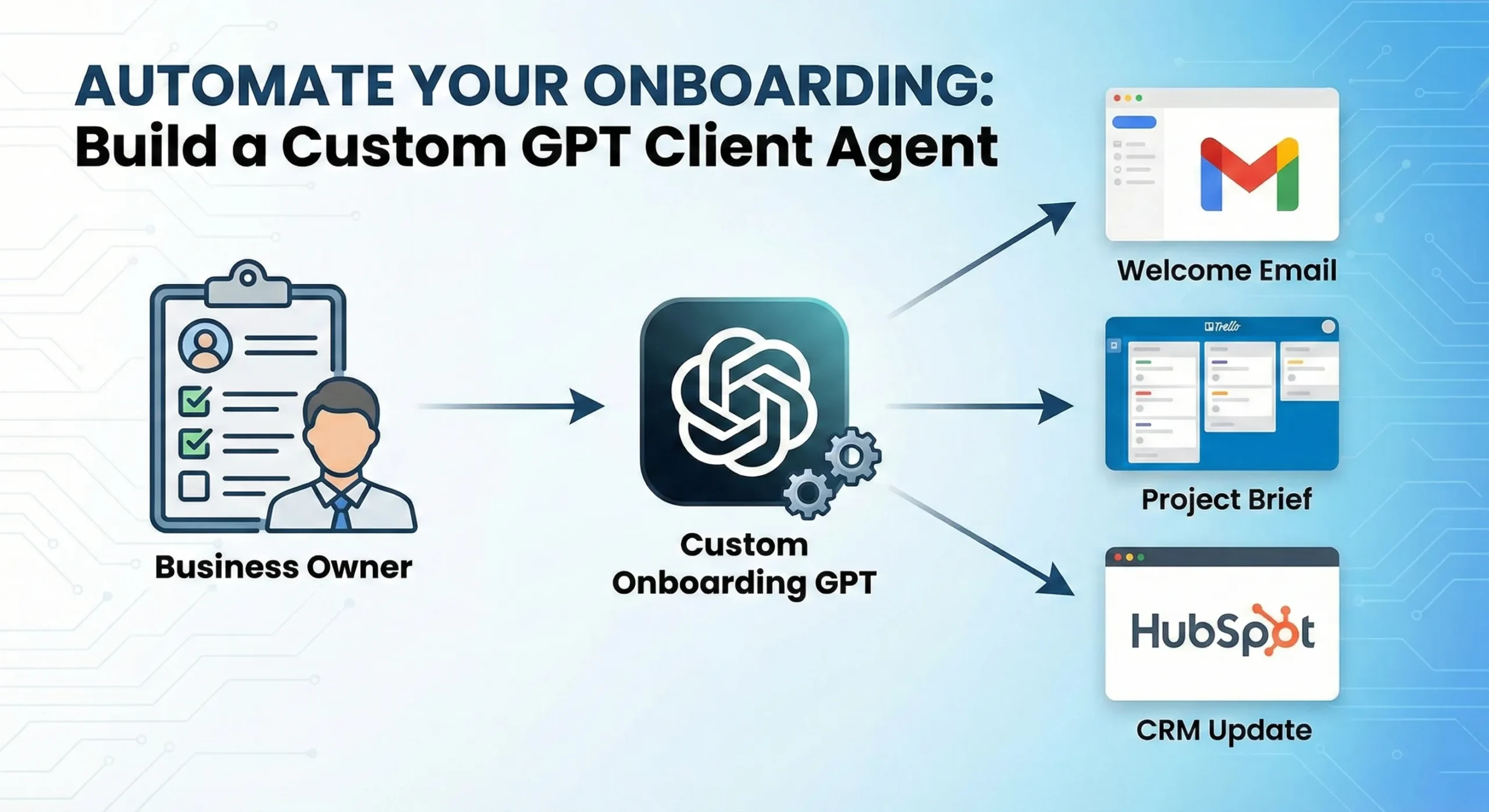
  • Task: When I upload a completed client intake form, you will generate three things: 1) A personalized welcome email. 2) A bulleted list of missing assets we need from the client. 3) An internal project brief for my team.
  • Boundaries: Never invent services we do not offer. If the intake form is missing critical budget data, explicitly flag it for my review.

Step 4: Upload Your Knowledge Base

This is what separates using ChatGPT for business from using it for parlor tricks. In the Knowledge section, upload the proprietary documents that make your agency unique.

Upload your standard operating procedures (SOPs), your service pricing tiers, past examples of excellent project briefs, and your brand tone guidelines. When the GPT generates an onboarding plan, it will actively reference these files so the output actually sounds like it came from your desk.

Pro Tip: Keep your knowledge files clean. Break large, messy PDFs into smaller, clearly titled text documents (e.g., Welcome_Email_Templates.pdf, Service_Tiers.pdf). This helps the AI pull the exact information it needs without hallucinating.

Step 5: Connect to AI Workflow Automation

Once your GPT is reliably analyzing intake forms and drafting emails, it is time to connect it to the rest of your tech stack.

Under the “Capabilities” section, you can set up Custom Actions. By connecting your GPT to tools like Zapier or Make, your agent can move from just writing text to actually executing tasks. You can configure it so that once the GPT generates the onboarding brief, it automatically pushes that data into a new Trello card, updates the client’s status in HubSpot or Salesforce, and drafts the welcome email directly in your Gmail drafts folder.

Final Thoughts

Treat your new custom GPT like a new hire. It will make a few mistakes in its first week. When it gives you an output you don’t like, don’t just fix the output manually—go back into the Configure tab and update the instructions so it learns for next time. Within a few weeks, you will have a rock-solid, automated client onboarding system that scales as fast as your agency does.
Similar Posts

  • ·

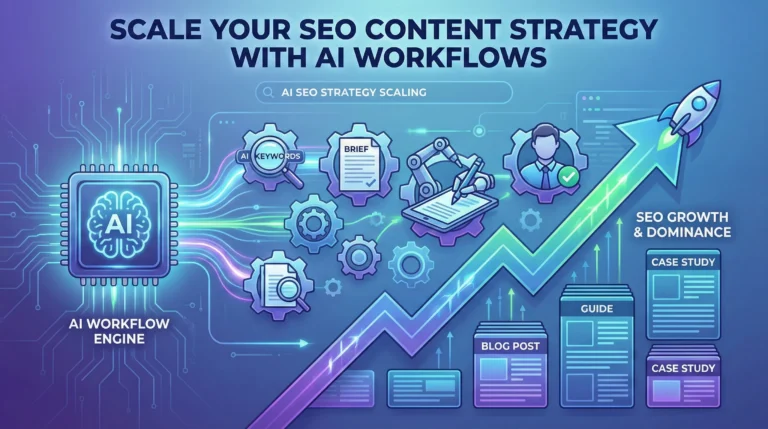
    Scale Your Content Strategy: A Blueprint for AI SEO Workflows

    If you are a content manager or niche site builder, you know the current reality: the SERPs are hungrier than ever. The old playbook of manually researching keywords, crafting individual briefs, and managing a dozen freelance writers on Trello is becoming unsustainable. It’s too slow and too expensive to compete with competitors who have figured out velocity.

    To win at search today, you cannot just “use AI to write.” You need to build an AI SEO strategy that turns manual bottlenecks into automated workflows.

    Scaling isn’t about asking ChatGPT to write 50 articles in one giant prompt—that’s a recipe for generic, low-ranking “slop.” True scale comes from deconstructing the SEO process and using AI to handle the repetitive heavy lifting, leaving the high-value strategic thinking to humans.

    Here is how to graduate from basic prompting to building an enterprise-grade programmatic SEO engine.

    Phase 1: Intelligent Keyword Clustering at Scale

    The biggest mistake SEOs make with AI is starting with the writing phase. Scale starts with structure. You cannot dominate a niche by picking keywords one by one.

    Instead of manually grouping keywords in spreadsheets, dump thousands of raw keyword ideas from tools like Ahrefs or Semrush into a CSV. Then, use ChatGPT’s Advanced Data Analysis feature to perform semantic clustering.

    The Goal: Ask ChatGPT to group keywords not just by similar words, but by identical search intent. This turns a messy list of 5,000 keywords into a clean map of 300 distinct article topics, ensuring you don’t cannibalize your own rankings.

    Phase 2: The Automated Content Brief Factory

    Before you generate a single paragraph of draft copy, you must generate the instructions. The quality of your ChatGPT for SEO content output is directly tied to the quality of the input brief.

    Don’t ask ChatGPT to “write an article about X.” Instead, create a workflow (perhaps using a tool like Make.com or Zapier chained to OpenAI’s API) that takes a target keyword and generates a comprehensive brief based on live SERP data.

    Your automated brief should include:

    • The primary search intent (informational vs. commercial).
    • A suggested H2/H3 structure based on top-ranking competitors.
    • A list of semantic entities and NLP terms that must be included.
    • The specific questions the article needs to answer to win Featured Snippets.

    Phase 3: The “Chain-of-Thought” Drafting Engine

    Once you have a rock-solid brief, you can begin drafting. But don’t try to generate a 2,000-word guide in one shot. AI loses the thread on long outputs.

    Build a workflow that chains prompts together. Step one generates the introduction based on the brief’s hook. Step two takes the introduction and the brief’s first H2 to write the next section, and so on. By breaking the task into modular chunks, you maintain context and improve factual accuracy.

    Phase 4: The Human-in-the-Loop (E-E-A-T Layer)

    This is where the elite SEOs separate themselves from the spammers. You cannot auto-publish raw AI output and expect long-term gains.

    Your workflow must end in a human review queue. The AI is the architect and the bricklayer, but you are the site inspector. The human job is no longer drafting; it’s injecting Experience, Expertise, Authoritativeness, and Trustworthiness (E-E-A-T). Add unique data, personal anecdotes, expert quotes, and ensure the tone matches your brand.

    By automating the research, briefing, and drafting phases, your team spends 80% of their time improving content quality, rather than staring at a blank page.

  • ·

    How to Use Grok AI for Research and Productivity

    Most AI assistants are extremely good at structured tasks like writing emails, summarizing documents, or explaining technical concepts. But when professionals want live insights, public sentiment, or emerging trends, traditional AI tools can fall short.

    A marketer researching product feedback, for example, might ask an AI assistant about a trending app only to receive generic background information. What they actually need is current conversation analysis.

    This is where Grok, developed by xAI, offers something slightly different. Because it integrates with X, Grok can interpret ongoing public discussions.

    Used correctly, Grok becomes less of a chatbot and more of a real-time research assistant.

    This guide walks through how professionals can use Grok effectively without relying on guesswork or hype.


    Before diving into the tutorial, it helps to understand Grok’s strengths.

    Unlike many AI systems trained primarily on static datasets, Grok focuses heavily on social conversation analysis. That means it can detect patterns in how people are discussing topics online.

    This capability makes it useful for:

    Trend monitoring
    📊 Public sentiment analysis
    💡 Content ideation
    🔍 Market research

    However, Grok should not be treated as a perfect source of truth. Social media data can contain noise, misinformation, and emotional reactions.

    The key is learning how to ask the right questions.


    Currently, Grok is integrated directly into the X platform interface.

    To access it:

    • Log into your X account
    • Navigate to the Grok interface
    • Open a conversation window

    Once inside the chat environment, you can begin asking questions similar to other AI assistants.


    One mistake beginners make is asking overly generic prompts.

    Instead of:

    “Tell me about electric vehicles.”

    Ask:

    “What are people currently complaining about with electric vehicles?”

    Grok works best when you ask questions related to opinions, reactions, or discussions.

    Examples of effective prompts:

    • “What are users saying about the latest iPhone release?”
    • “What concerns are developers discussing about AI regulation?”
    • “What are common complaints about popular productivity apps?”

    These questions trigger Grok’s strength: conversation pattern analysis.


    Grok is particularly useful for spotting patterns early.

    Example scenario:

    A SaaS founder researching customer needs might ask:

    • “What productivity problems do remote workers complain about most?”

    Grok may highlight recurring frustrations such as:

    • meeting overload
    • task management fragmentation
    • collaboration tool fatigue

    Those insights can help shape product features or marketing messaging.


    Content creators often struggle with topic selection.

    Grok can help surface ideas based on real audience interest.

    Example workflow:

    1️⃣ Ask Grok what people are discussing about a topic
    2️⃣ Identify common frustrations or questions
    3️⃣ Turn those insights into article ideas

    Example output:

    • “Why remote workers dislike traditional productivity apps”
    • “Top complaints about AI writing tools”
    • “What freelancers actually want from automation tools”

    This process grounds content in real conversations rather than assumptions.


    Here are some practical ways professionals can integrate Grok into their workflow.

    📈 Digital Marketing Research

    Marketers can analyze how audiences react to competitors.

    Example prompt:

    “What are people criticizing about popular email marketing tools?”

    The results may reveal usability complaints or pricing concerns.


    🧩 Product Development Feedback

    Startup founders can monitor how users talk about competing products.

    Instead of conducting expensive research studies, Grok can reveal informal but valuable insights.


    📰 News and Trend Monitoring

    Analysts and journalists can track how narratives evolve around major events.

    This helps identify:

    • emerging opinions
    • misinformation patterns
    • shifts in public sentiment


    ✔ Advantages

    • Access to real-time discussion trends
    • Useful for audience research
    • Helps discover unexpected perspectives
    • Faster than manual social monitoring

    ⚠ Limitations

    • Social media data can be noisy
    • Trends may be temporary or exaggerated
    • Not ideal for academic-level research

    The most effective approach is using Grok alongside other AI tools, not replacing them.


    Grok works best for professionals who rely on audience insight and trend awareness.

    Ideal users include:

    • digital marketers
    • startup founders
    • content strategists
    • journalists
    • social media analysts

    Who may not benefit as much

    • developers needing coding support
    • academic researchers requiring verified sources
    • enterprises needing strict data validation


    Grok AI introduces an interesting shift in how AI assistants gather knowledge. Instead of relying solely on training data, it interprets ongoing conversations happening online.

    For professionals in marketing, research, and digital business, that capability offers a valuable advantage: real-time awareness of what people are actually discussing.

    Used thoughtfully, Grok becomes less of a chatbot and more of a social intelligence tool that helps guide better decisions.

  • ·

    Midjourney Branding: A Guide to Style Consistency

    We have all been there. You are playing around in Midjourney, and suddenly, you generate the perfect concept for a client’s logo. It’s the right vibe, the right colors, the right aesthetic. The client loves it.

    Then they ask the inevitable follow-up question: “This is great. Can we get a matching icon set for the website and a header image in the same style?”

    You go back to Midjourney, paste in the original prompt, hit enter, and… you get something completely different. Panic sets in.

    Midjourney is incredible at generating beautiful, singular images, but out of the box, it is terrible at consistency. And in branding, consistency isn’t just nice to have; it’s the whole ballgame. A brand identity is defined by repetition and cohesiveness.

    If you want to transition from using AI as a toy to using AI graphic design for business, you have to stop treating it like a slot machine and start treating it like a junior designer that needs very specific instructions.

    Here is a tutorial on how to force Midjourney style consistency to build a usable brand identity system.

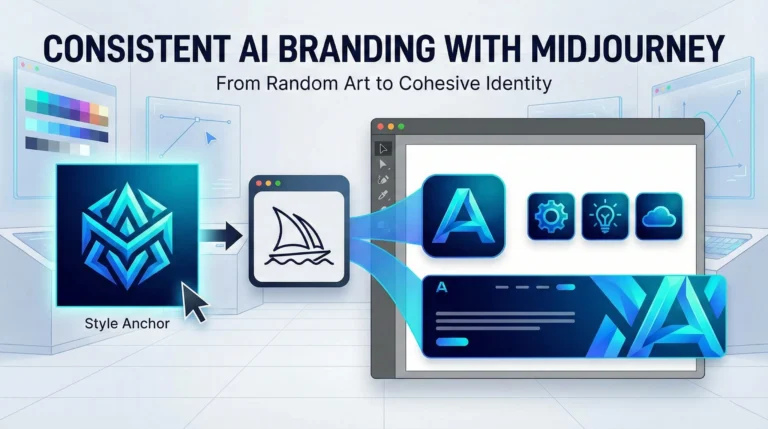
    Phase 1: Defining the “Style Anchor”

    You cannot build a consistent brand until you define what “consistent” looks like. You need one image that perfectly encapsulates the visual DNA of the brand—the color palette, the rendering technique (e.g., flat vector, 3D isometric, watercolor), and the mood.

    Don’t try to generate the final logo yet. Just generate the style.

    Example Prompt for a Tech Startup Style: /imagine prompt: A futuristic, minimalist geometric emblem, gradients of electric blue and cyan, clean lines, abstract data flow concept, white background, vector art style --v 6.0

    Reroll this prompt until you get one image that makes you say, “Yes, that is the look.” Upscale it. This image is now your “Style Anchor.” Right-click it and copy the image URL.

    Phase 2: The Secret Weapon (Style References)

    For a long time, maintaining consistency meant endlessly tweaking prompt text and praying. Then, Midjourney introduced the Style Reference parameter (--sref). This changed everything for professional designers.

    --sref tells Midjourney: “Don’t just look at the words I’m typing; look at this image and copy its vibe.”

    This is how we move from a single cool image to an AI logo design tutorial that actually works for business.

    Phase 3: Building the Asset Suite

    Now we are going to generate different assets, but we will force them all to match our Style Anchor from Phase 1 using the URL we copied.

    1. The Primary Logo Icon: Now we ask for the specific subject matter, but apply the anchor style.

    Prompt: /imagine prompt: A stylized letter 'A' icon, geometric, tech company logo --sref [INSERT YOUR STYLE ANCHOR URL HERE] --v 6.0

    2. Matching Website Icons: You need a set of three icons (a gear, a lightbulb, a cloud) for the services section of a website. They need to look like siblings to the logo.

    Prompt: /imagine prompt: A set of three UI icons: a gear, a lightbulb, and a cloud. Clean geometric style, minimalist --sref [INSERT YOUR STYLE ANCHOR URL HERE] --v 6.0

    Because you used the --sref link, Midjourney will render these new objects using the exact same electric blue gradients and clean line work as your anchor image.

    3. The Hero Background: You need a wide banner for the website header that feels connected to the brand but isn’t just a giant logo.

    Prompt: /imagine prompt: A wide website banner background, abstract data flowing, futuristic network patterns, subtle gradients --ar 16:9 --sref [INSERT YOUR STYLE ANCHOR URL HERE] --v 6.0

    Phase 4: The Professional Reality Check (Vectorizing)

    If you are an agency owner or freelancer, you know you cannot deliver a Midjourney PNG to a client as a final logo file. Midjourney creates raster images (pixels); professional brands need vectors (math).

    Midjourney is for ideation and consistency creation. Once you have the approved assets, your workflow must move off-platform. Take your finalized, consistent Midjourney outputs and use tools like Adobe Illustrator’s “Image Trace” or specialized AI vectorizers like Vectorizer.ai to convert them into scalable SVGs or EPS files.

    Final Thoughts

    Using Midjourney brand assets doesn’t replace the designer’s eye. It just speeds up the iteration process exponentially. By mastering tools like style referencing, you stop fighting the AI’s randomness and start harnessing it to build cohesive, sellable brand identities.

  • ·

    Automate Ecommerce Descriptions & Pricing with AI

    If you are a Shopify store owner or an Amazon FBA seller, you know that scaling your catalog comes with a massive administrative hangover. Every new SKU you add requires SEO-optimized copy, feature extraction, and competitive pricing strategies. Doing this manually for ten products is annoying; doing it for ten thousand is impossible.

    The smartest e-commerce managers are no longer throwing human hours at these repetitive tasks. Instead, they are leveraging artificial intelligence to build automated systems that write high-converting copy and adjust prices in real-time.

    Here is your tutorial on how to use AI for ecommerce to automate your product descriptions and supercharge your pricing strategy.

    Part 1: Automating Product Descriptions at Scale

    Writing generic product descriptions is a surefire way to kill your conversion rate. Shoppers want to know the benefits, but search engines need the features and keywords. Trying to balance both across thousands of products is where AI shines.

    Moving Beyond the “One-by-One” Prompt If you are opening ChatGPT, pasting in a manufacturer’s spec sheet, and asking it to write a description one by one, you aren’t really automating. True automation requires bulk generation.

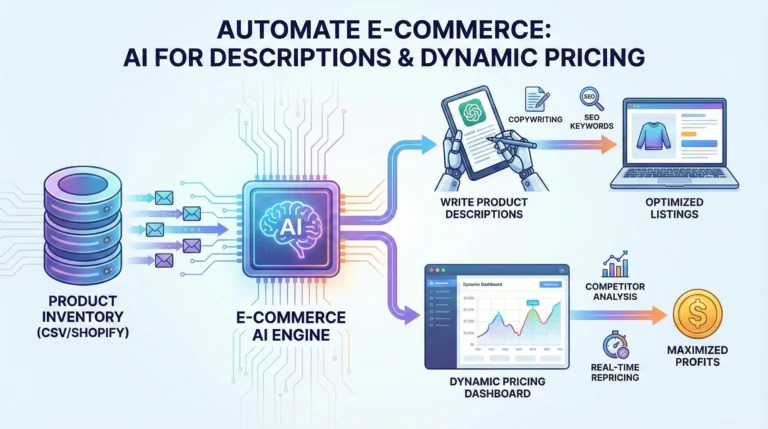
    To build an automated content factory, you need to connect your product database (like a Google Sheet or CSV export of your Shopify inventory) directly to an AI language model using tools like Zapier, Make.com, or specialized apps like Copy.ai and Hypotenuse AI.

    The Workflow:

    1. The Trigger: A new product is added to your store database with basic attributes (Name, Color, Material, Dimensions).
    2. The Prompt Template: Your automation tool sends these attributes to OpenAI with a strict prompt: “Act as an expert e-commerce copywriter. Using the provided specs, write a 100-word product description. Start with an emotional hook, follow with three bulleted benefits, and naturally weave in these SEO keywords. Tone: Premium and minimalist.”
    3. The Output: The AI generates the description and instantly updates your Shopify or WooCommerce listing via API.

    What used to take a copywriter a full week can now be executed across 5,000 SKUs while you grab a coffee.

    Part 2: Winning the Buy Box with Dynamic Pricing AI

    Having great product copy gets customers to your page, but pricing gets them to click “Add to Cart.” In the past, repricing meant setting basic rules (e.g., “always price my product $1 cheaper than Competitor X”). Today, rule-based pricing is obsolete.

    Enter dynamic pricing AI.

    Major players like Amazon make millions of repricing decisions every single day, evaluating relative market value without relying on manual input. Now, thanks to tools like Prisync, Intelis, and DynamicPricing AI, independent store owners have access to that exact same enterprise-level technology.

    How AI Pricing Works: Instead of just scraping a competitor’s website, modern AI pricing tools ingest dozens of variables simultaneously. They analyze:

    • Real-time competitor stock levels (If your competitor sells out, the AI automatically raises your price to capture a higher margin).
    • Historical sales velocity and seasonal demand trends.
    • Your specific procurement costs and target profit margins.
    • Customer price elasticity (how sensitive your specific audience is to a $2 price hike).

    Setting the Guardrails: The beauty of an ecommerce automation tutorial focused on pricing is that you remain in control. You never have to worry about the AI accidentally pricing a $100 jacket for $5. You set the absolute minimum margin floor (the “guardrails”), and the AI constantly tests price points above that floor to find the exact dollar amount that maximizes your total profit, not just your revenue.

    Final Thoughts

    The divide in e-commerce is no longer about who has the best product; it is about who has the best operational velocity. By automating your ChatGPT product descriptions and integrating dynamic pricing AI, you remove the human bottleneck from your catalog management. This frees you up to focus on what actually grows a business: sourcing better products, building a brand identity, and acquiring new customers.

  • ·

    Automate Real Estate Market Analysis with ChatGPT

    If you are a real estate investor or realtor, your most valuable asset isn’t capital—it’s time. The traditional method of property analysis involves mind-numbing hours spent exporting MLS data, building complex spreadsheet models, and reading through hundred-page HOA disclosures just to see if a deal pencils out.

    But what if you could outsource the heavy lifting to an AI?

    Using ChatGPT for data analysis is no longer a futuristic concept; it is a baseline requirement for staying competitive in today’s fast-moving housing market. By combining ChatGPT’s advanced capabilities with purpose-built real estate AI tools, you can automate your property analysis, spot off-market trends, and calculate your ROI in seconds.

    Here is your complete tutorial on how to automate real estate market analysis using AI.

    Step 1: Export Your Raw Market Data

    ChatGPT cannot analyze what it cannot see. To get started, you need raw data. Go to your local MLS, Redfin, or Zillow, and run a search for your target criteria (e.g., multi-family homes in a specific ZIP code sold in the last 6 months). Export this data as a .csv or .xlsx file.

    Pro Tip: Make sure your spreadsheet has clear column headers like “List Price,” “Days on Market,” “Square Footage,” and “HOA Fees.” Clean data leads to accurate AI insights.

    Step 2: Upload and Prompt ChatGPT

    You will need a ChatGPT Plus, Team, or Enterprise account to use the Advanced Data Analysis feature. Open a new chat, click the paperclip icon to upload your CSV file, and use a highly specific command.

    Do not ask vague questions like, “Is this a good market?” Instead, use a strict analytical prompt:

    • The Prompt: “Act as an expert real estate investment analyst. I have uploaded recent sales data for [ZIP Code/Neighborhood]. Please analyze this dataset and provide a comprehensive market report. Include: 1) The median price per square foot. 2) The average Days on Market (DOM) for properties over $500k versus under $500k. 3) Identify any pricing outliers or anomalies. Present your findings in a clean, bulleted format and generate a bar chart showing the sales price trends over the last six months.”

    Within seconds, ChatGPT will write and execute the Python code necessary to parse your spreadsheet, giving you a digestible report and visual charts you can instantly drop into a client presentation or investor memo.

    Step 3: Automate Cash Flow and Cap Rate Modeling

    Analyzing the broader market is only half the battle; you also need to underwrite the specific property. You can use ChatGPT to instantly build custom cash flow models.

    Upload a property’s financials (taxes, insurance quotes, estimated rent) and use this prompt:

    • The Prompt: “Calculate the projected cap rate and cash-on-cash return for this property. Assume a 20% down payment, a 6.5% interest rate on a 30-year fixed mortgage, and a 5% vacancy rate. Factor in the provided property taxes and maintenance estimates. Output the results in a month-by-month financial table.”

    Step 4: Rapid Due Diligence on Long Documents

    One of the most tedious parts of real estate investing is the due diligence phase. Reading through thick HOA packets, seller disclosures, zoning laws, and inspection reports can take days.

    Instead of reading line-by-line, upload the PDF directly into ChatGPT and command it to find the red flags:

    • The Prompt: “Read this HOA disclosure packet. Extract any buyer-impacting details and summarize them in clear, plain language. Specifically highlight: rental restrictions (like short-term/Airbnb bans), special assessments, pet limitations, and any unusual fees. Format this for easy scanning.”

    This turns a two-hour reading session into a two-minute review.

    Step 5: Level Up with Dedicated Real Estate AI Tools

    While ChatGPT is an incredible general-purpose assistant, scaling a massive portfolio sometimes requires specialized firepower. If you want to automate property analysis at an enterprise level, consider integrating dedicated AI in real estate platforms:

    • HouseCanary: Excellent for automated valuation models (AVMs) and predictive forecasting for residential properties. It uses thousands of data points to predict price movements with institutional-grade accuracy.
    • Reonomy: The go-to platform for commercial real estate. It uses AI to discover off-market deals and analyze debt maturity profiles, helping you find motivated sellers months before they list.
    • Explo & Domo: Great for brokerages that want to build custom, AI-driven analytics dashboards that plug directly into their existing CRM systems.

    Final Thoughts

    Integrating AI in real estate doesn’t mean replacing your local market expertise or your gut instinct for a good deal. It means eliminating the friction between finding a property and making a data-driven offer. By mastering ChatGPT data analysis, you buy back your time—allowing you to focus on negotiating deals, building relationships, and scaling your portfolio.