AI Agents

  • ·

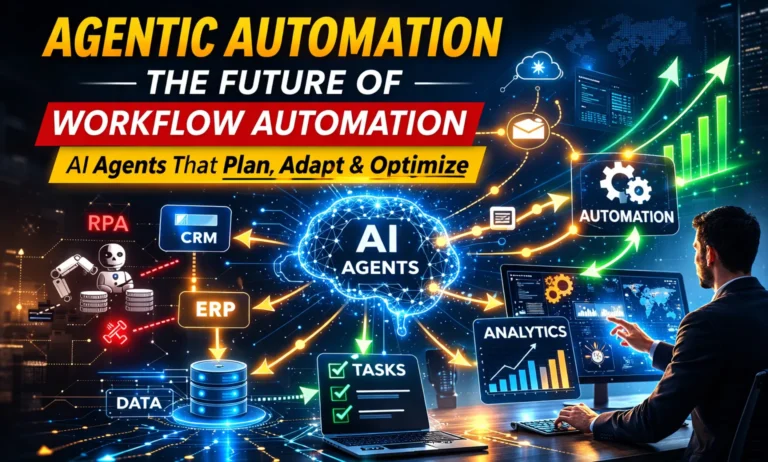
    Agentic Automation: The Future of Workflow Automation

    The Shift From Task Automation to Autonomous Systems

    For years, workflow automation meant one thing: automate repetitive tasks.

    Businesses deployed RPA bots to click buttons, copy data between systems, and follow predefined rules. It worked — to a point. Costs dropped. Manual errors decreased. Efficiency improved.

    But in 2026, the conversation has shifted.

    Companies are no longer asking, “How do we automate this task?”
    They’re asking, “How do we automate outcomes?”

    That shift is where agentic automation enters the picture.


    What Is Agentic Automation?

    Agentic automation refers to AI systems designed to act like autonomous agents rather than scripted bots.

    Instead of following rigid instructions, these AI agents:

    • Understand objectives
    • Plan multi-step workflows
    • Adjust decisions based on changing inputs
    • Optimize performance over time
    • Execute tasks across multiple systems

    In simple terms:

    Traditional automation executes instructions.
    Agentic automation pursues goals.

    If RPA is a digital worker following a checklist, agentic automation is a digital project manager figuring out the best way to get the job done.


    Why 2026 Is the Turning Point

    Several factors are converging to make 2026 a breakthrough year for agentic automation:

    1. Mature AI Models

    Large language models and reasoning engines are now capable of multi-step thinking, contextual understanding, and strategic decision-making.

    2. Better Workflow Orchestration Tools

    Modern orchestration platforms allow AI agents to interact with CRMs, ERPs, marketing systems, analytics dashboards, and internal databases seamlessly.

    3. Business Pressure for Agility

    US and UK enterprises face increasing pressure to reduce operational overhead while scaling faster. Static bots cannot keep up with dynamic markets.

    4. Data Explosion

    Companies generate massive amounts of data daily. Agentic systems can analyze and act on that data continuously — something rule-based bots struggle with.

    The result? Businesses are moving from automation scripts to intelligent orchestration layers.


    What Is Workflow Orchestration in This Context?

    Workflow orchestration is the coordination of multiple automated processes into one intelligent, goal-driven system.

    Instead of separate bots for:

    • Lead qualification
    • CRM updates
    • Email nurturing
    • Reporting

    An agentic system oversees the entire pipeline. It monitors performance, adjusts messaging, escalates exceptions, and reallocates resources when needed.

    It doesn’t just execute — it manages.


    Agentic Automation vs RPA: What Businesses Should Know

    To understand the future, we need to compare it with the present.

    1. Decision-Making Capability

    RPA:
    Follows predefined rules. If X happens, do Y.

    Agentic Automation:
    Analyzes context and decides the best action based on objectives.

    Example:
    An RPA bot sends a standard follow-up email.
    An AI agent decides whether to follow up, change tone, escalate to sales, or pause outreach based on engagement data.


    2. Adaptability

    RPA:
    Breaks when systems change or workflows evolve.

    Agentic Automation:
    Adapts to new inputs, system updates, and unexpected scenarios.

    This flexibility significantly reduces maintenance costs.


    3. Scope of Automation

    RPA:
    Automates tasks.

    Agentic Automation:
    Automates entire processes and optimizes them continuously.

    Instead of automating invoice entry, an AI agent can oversee the entire accounts payable workflow — from invoice detection to fraud checks and payment timing.


    4. Human Involvement

    RPA:
    Requires ongoing human supervision and frequent updates.

    Agentic Automation:
    Operates with minimal supervision, escalating only when judgment or compliance decisions are required.

    It augments humans instead of replacing them.


    5. ROI Potential

    RPA typically delivers incremental efficiency gains — often 20–40% improvement in specific tasks.

    Agentic automation can deliver transformational gains by:

    • Reducing operational headcount pressure
    • Improving decision speed
    • Increasing revenue conversion rates
    • Minimizing error-based losses
    • Enabling 24/7 optimization

    For enterprises, this moves automation from a cost-saving initiative to a growth strategy.


    Where Agentic Automation Delivers the Most Value

    In 2026, we’re seeing the strongest impact in:

    • Sales workflow automation
    • Marketing orchestration
    • Customer support triaging
    • Financial process management
    • Supply chain coordination
    • Enterprise IT operations

    Particularly in high-income markets like the US and UK, businesses are adopting agentic systems to remain competitive against leaner, AI-native startups.


    Should Businesses Replace RPA?

    Not immediately.

    RPA still has value for simple, stable, repetitive tasks. It’s reliable and cost-effective.

    However, forward-thinking organizations are layering agentic automation on top of existing RPA infrastructure — using RPA for execution and AI agents for orchestration.

    This hybrid approach offers the best of both worlds.


    The Bigger Picture: Automation as Strategy

    The most important takeaway isn’t technological — it’s strategic.

    Workflow automation is no longer just about saving time.

    It’s about building systems that:

    • Learn
    • Adapt
    • Scale
    • Optimize themselves

    Agentic automation represents the next evolution in business automation — moving from static scripts to intelligent operational ecosystems.

    In 2026 and beyond, the companies that win will not be the ones with the most bots.

    They’ll be the ones with the smartest orchestration layers.


    Final Thoughts

    Agentic automation is not hype — it’s a structural shift in how businesses think about workflows.

    RPA automated the past.
    Agentic systems are shaping the future.

    For organizations in the US, UK, and other advanced markets, the question is no longer if AI will manage workflows — but how quickly they can adopt it strategically.

    The future of workflow automation is autonomous, adaptive, and outcome-driven.

    And that future has already begun.
  • ·

    Top No-Code AI Agent Builders for Agencies

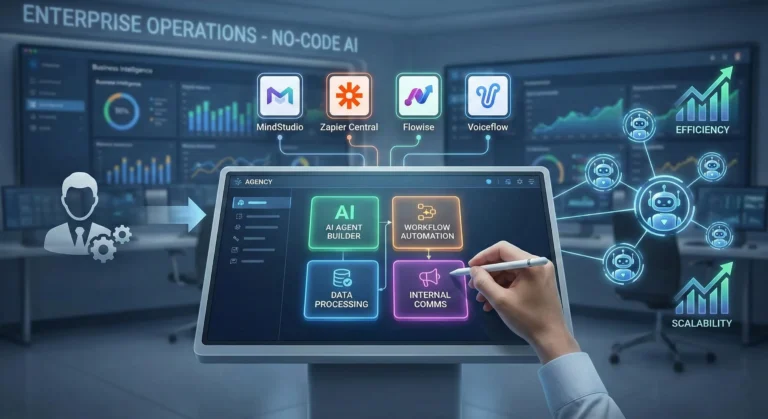
    Scaling an agency in the US or UK used to mean one thing: hiring more people. Every new client meant adding more project managers, more data entry clerks, and more administrative bloat. But operations managers are waking up to a new reality. You don’t need a bigger team to handle enterprise-level capacity; you need better internal infrastructure.

    The secret to maximizing agency margins right now is replacing repetitive administrative headcount with custom AI agents. By leveraging no-code enterprise automation, you can build digital employees that handle your backend operations 24/7. Here at AI Growth Gear, we prioritize software that directly impacts the bottom line. If you want to deploy sophisticated business intelligence and workflow software without writing a line of code, these are the platforms you need.

    MindStudio: The AI Employee Factory

    MindStudio is arguably the most robust platform right now for building highly specialized, multi-step AI agents. It allows you to build custom interfaces and connect different foundation models (like Claude 3 or GPT-4) depending on the specific task.

    • The Operations Play: Stop paying junior staff to summarize endless client discovery calls and format them into briefs. With MindStudio, you can build an internal “Strategy Agent.” You upload the raw call transcript, and the agent automatically extracts the core business objectives, cross-references them with your agency’s standard operating procedures (SOPs), and outputs a polished, ready-to-execute project brief. It turns hours of manual administrative work into a three-second automated workflow.

    Zapier Central: The Action-Oriented Assistant

    You likely already use Zapier to connect your apps, but Zapier Central transforms those passive connections into an active, conversational AI workspace. It allows you to build bots that sit directly on top of your live data.

    • The Operations Play: Zapier Central excels at data triage. Imagine a custom agent monitoring your high-value lead inbox. When a new enterprise inquiry comes in, the agent reads the context, automatically queries your CRM to see if they are an existing contact, drafts a personalized response based on their industry, and pings the correct account executive in Slack with a summary. It acts as an autonomous executive assistant that never drops the ball, perfectly optimizing your agency’s lead response times.

    Flowise: Visual LLM Orchestration

    For agencies handling vast amounts of proprietary data or complex technical documentation, Flowise is a game-changer. It provides a drag-and-drop visual interface for LangChain, meaning you can build highly complex AI logic flows without needing a Python developer.

    • The Operations Play: Build a secure, internal “Knowledge Retrieval Agent” for your team. By connecting Flowise to your agency’s internal Google Drive or Notion workspace, your team can simply ask the agent questions like, “What were the exact deliverables we promised in the Q3 contract for Client X?” The agent searches the secure internal database and retrieves the exact clause in seconds. This eliminates the endless back-and-forth messaging between departments and streamlines overall business intelligence.

    Voiceflow: Conversational Process Management

    While typically known for building customer-facing chatbots, smart operations managers are using Voiceflow to build robust internal conversational interfaces.

    • The Operations Play: Employee onboarding is a massive drain on operational resources. With Voiceflow, you can build an interactive “HR & Onboarding Agent.” Instead of handing new hires a static 50-page PDF of company policies, they interact with the Voiceflow agent. It can guide them through setting up their software stack, answer specific questions about payroll schedules, and train them on agency methodologies. It guarantees a consistent, scalable onboarding experience without tying up your senior staff.

    The Bottom Line

    B2B margins are won and lost in the backend. By investing in no-code workflow software like MindStudio, Zapier Central, Flowise, and Voiceflow, you aren’t just buying tools—you are building a scalable, automated workforce. This allows you to take on larger enterprise contracts without proportionately increasing your overhead.

  • ·

    Top Agentic AI Tools for Boutique Agencies

    For boutique agencies and solo entrepreneurs scaling in the US and UK markets, the bottleneck isn’t usually a lack of ideas—it’s headcount. You want enterprise-level marketing output without the enterprise-level payroll. Enter agentic AI.

    Unlike traditional “if-this-then-that” marketing automation, agentic AI tools don’t just follow static, rigid rules. They perceive data, make decisions, and execute multi-step workflows autonomously based on context. They act less like software and more like digital team members.

    Here is a breakdown of the top agentic AI marketing tools that are changing how lean agencies handle B2B lead generation, CRM management, and digital growth in 2026.

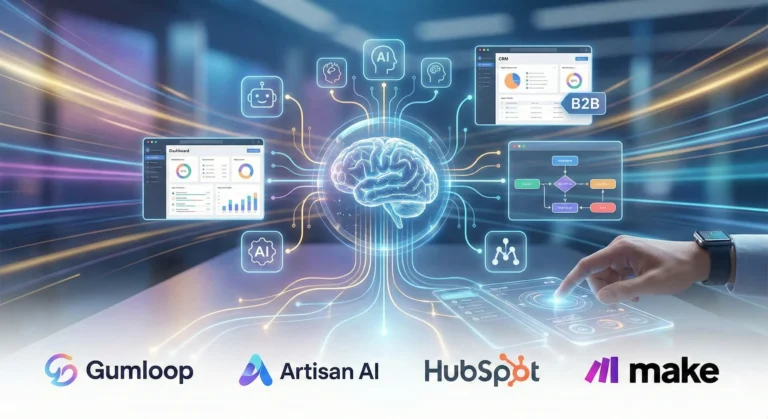
    Gumloop: The No-Code Operations Architect

    If you need to build custom AI workflows without writing a single line of code, Gumloop is your sandbox. It’s a drag-and-drop platform designed to automate heavy, logic-based marketing and sales tasks.

    • The Agency Play: Use Gumloop to build an autonomous lead-scraping agent. You can set it up to monitor specific industry triggers (like companies that just raised Series A funding), scrape their executive data, and automatically categorize the leads based on your specific Ideal Customer Profile (ICP). It handles the tedious, top-of-funnel research that normally eats up hours of a junior marketer’s week, passing only the most qualified data into your CRM.

    Artisan AI (Ava): Your Autonomous BDR

    Artisan AI built “Ava,” an AI-driven Business Development Representative (BDR). Instead of buying a fragmented tech stack for data sourcing, email warm-up, and sequence scheduling, Artisan bundles the entire outbound motion into one autonomous platform.

    • The Agency Play: Ava taps into a built-in database of over 300 million B2B contacts. You give her your target parameters, and she handles the rest. She researches the prospects, writes hyper-personalized cold outreach emails based on real-time data (such as a recent LinkedIn post or company news), and dynamically manages the follow-ups based on recipient behavior. For boutique agencies selling high-ticket B2B services, Ava keeps the outbound pipeline full while you focus entirely on closing the deal.

    HubSpot Breeze: The Enterprise CRM Brain

    HubSpot has heavily integrated agentic AI directly into its ecosystem with Breeze. It features specific agents for content, social media, and prospecting, all tied directly to your core CRM data so it never loses context.

    • The Agency Play: Breeze Intelligence automatically enriches your inbound leads with critical B2B data points (industry, headcount, tech stack). Meanwhile, the Prospecting Agent tracks buyer intent. If a prospect from a UK-based enterprise visits your pricing page, Breeze can auto-add them to the CRM, score the lead, and draft a context-aware outreach email for you to approve. It bridges the gap between marketing activity and sales execution seamlessly, ensuring no high-value lead slips through the cracks.

    Make: The Ultimate Workflow Orchestrator

    Make (formerly Integromat) isn’t strictly a standalone AI agent, but it is the visual infrastructure that makes complex agentic workflows possible. It allows you to connect thousands of different apps and inject AI decision-making (via LLMs like OpenAI or Anthropic) at any step of the journey.

    • The Agency Play: You can use Make to tie your entire marketing stack together into one autonomous loop. For example, when a high-value lead fills out a form, Make can route the data to an LLM to analyze the lead’s intent, ping your team’s Slack channel with a summary, and automatically generate a personalized proposal draft in Google Docs. It allows solo operators to build a bespoke, highly automated backend that rivals massive agencies.

    The Bottom Line

    Scaling a boutique agency no longer requires a massive hiring sprint. By integrating these agentic AI platforms into your B2B marketing strategies, you can automate the heavy lifting, keep your CRM spotless, and focus your human capital on high-value digital growth and strategy.

  • ·

    7 Best AI Agents for Business Automation in 2026

    If 2024 was the year of the Chatbot, 2026 is undeniably the year of the Agent.

    The difference is profound. A chatbot answers your questions; an agent does your work. For business leaders in London, New York, and San Francisco, the novelty of “chatting” with AI has worn off. The focus has shifted entirely to ROI and autonomous workflows.

    We are looking for tools that don’t just generate text but can open a browser, click buttons, query databases, and send Slack messages without human hand-holding.

    After testing dozens of platforms, here are the 7 best AI Agents for business automation in 2026.

    1. Zapier Central (The “Gateway” Agent)

    Best For: Connecting your existing SaaS stack.

    If you already use Zapier, this is the easiest entry point. Zapier Central isn’t just a prettier interface for their automation tools; it’s a logic layer that sits on top of them.

    • What it does: Instead of building rigid “If This, Then That” workflows, you give Central a goal: “Check my email for invoices, match them to Xero, and slack me if the amount is over $1,000.”
    • The Killer Feature: It has access to 6,000+ apps immediately. You don’t need to wait for integrations; they are already there.

    2. Microsoft Copilot Studio (The Enterprise Standard)

    Best For: Corporations living in the Office 365 ecosystem.

    For large enterprises, security is the bottleneck. Microsoft Copilot Studio (formerly Power Virtual Agents) allows you to build agents that live safely inside your corporate tenant.

    • What it does: You can build an agent that accesses your internal SharePoint, reads your Outlook calendar, and updates Excel sheets.
    • The Killer Feature: It respects your organization’s data governance. It won’t hallucinate confidential data to the wrong employee.

    3. Lindy.ai (The “Digital Employee”)

    Best For: Specific roles like Medical Scribes, HR Assistants, or Executive Assistants.

    Lindy positions itself not as a tool, but as an employee. You don’t “configure” Lindy; you “hire” her for a specific job.

    • What it does: Lindy comes pre-trained for specific verticals. An “HR Lindy” already knows how to handle onboarding documents; a “Medical Lindy” knows how to transcribe patient notes into EMR formats.
    • The Killer Feature: “Proactive” behavior. Lindy doesn’t always wait for a command; she can monitor your inbox and draft replies for you to approve.

    4. Salesforce Agentforce (The CRM Specialist)

    Best For: Sales and Customer Support teams.

    If your business lives or dies by your CRM data, Agentforce is the heavy hitter. Salesforce realized that generic AI struggles with specific customer data, so they built agents that live inside the data layer.

    • What it does: An Agentforce service agent can autonomously resolve customer tickets by looking up order history, processing a refund, and updating the case status—all without a human agent opening the file.
    • The Killer Feature: The “Atlas” reasoning engine, which is surprisingly good at handling complex customer queries that usually confuse standard bots.

    5. Relevance AI (The No-Code Builder)

    Best For: Building custom “AI Workforce” teams without code.

    Relevance AI is for the power user who wants to build a custom agent team but doesn’t want to write Python.

    • What it does: It allows you to build multi-agent chains. You can have a “Researcher Agent” that scrapes the web, passes the data to a “Writer Agent” that drafts a report, and a “Manager Agent” that critiques it.
    • The Killer Feature: The visual builder is intuitive, making it easy to visualize how your “digital team” is passing data back and forth.

    6. CrewAI (The Developer’s Choice)

    Best For: Technical teams building complex, code-heavy workflows.

    If you have a dev team, skip the no-code tools and go straight to CrewAI. It’s an open-source framework that orchestrates role-playing agents.

    • What it does: You define specific roles (e.g., “Senior Python Engineer,” “QA Tester”) and assign them goals. The agents collaborate, delegate tasks to each other, and solve problems iteratively.
    • The Killer Feature: It handles “delegation” better than almost anything else. If one agent gets stuck, it can ask another agent for help.

    7. MultiOn (The Browser Navigator)

    Best For: Tasks that require using a web browser like a human.

    Most APIs are limited. MultiOn solves this by giving the AI a web browser.

    • What it does: It can log into websites, click buttons, fill out forms, and navigate complex UIs just like a human user would.
    • The Killer Feature: It can handle “real world” tasks like booking a flight on a site that doesn’t have an API, or ordering lunch from a delivery service.

    The Bottom Line

    In 2026, the question isn’t “Which AI model is the smartest?”—it’s “Which Agent has the best access to my tools?”

    If you want a safe bet, start with Zapier Central. If you want to build a digital workforce, look at Relevance AI or CrewAI. Just stop waiting for the chatbot to do the work for you.

  • ·

    Chatbots Are Dead. Long Live AI Agents: A 2026 Guide

    Let’s be honest for a second. We all spent 2023 and 2024 being amazed that ChatGPT could write a haiku or summarize a PDF. It was cool, it was novel, but let’s face it: it was passive. You had to show up, type a prompt, wait for the text, copy it, and then paste it somewhere else to actually do something with it.

    In 2026, that workflow is already obsolete.

    If your business is still treating AI like a smart encyclopedia, you are leaving money on the table. The shift happening right now—in Silicon Valley, London, and Berlin—is the move from Chatbots to AI Agents.

    The Difference: “Talk” vs. “Action”

    The distinction is simple but critical.

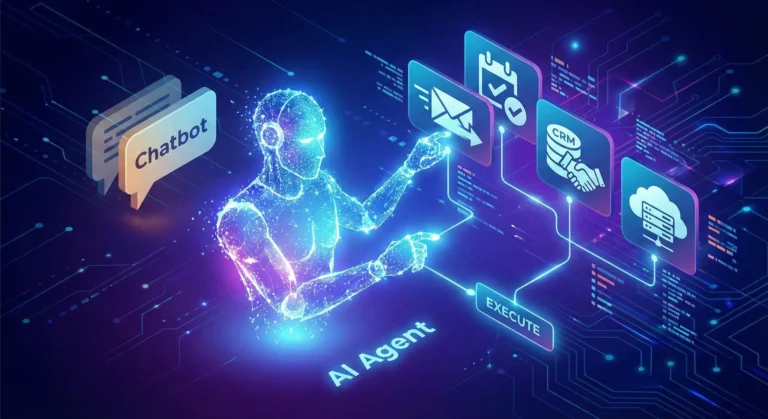
    • A Chatbot is like a library. You ask a question; it gives you an answer. It waits for you.
    • An AI Agent is like an intern. You give it a goal (“Plan my travel”), and it goes off, checks flights, compares hotels, books the tickets, and puts them on your calendar. It has agency.

    For business automation, this is the holy grail. We are no longer using AI to write the email; we are using AI to send the email, update the CRM, and notify the sales team on Slack—without you touching the keyboard.

    The Anatomy of an Agent

    You don’t need a computer science degree to build one. You just need to understand the three parts of an “Agentic Workflow”:

    1. The Brain (The LLM): This is GPT-4o, Claude 3.5, or Gemini. Its job isn’t to generate text, but to make decisions. It decides which tool to use based on your instructions.
    2. The Hands (The Tools): This is where the magic happens. You give the “Brain” access to your apps—Gmail, Salesforce, Excel, Slack—via APIs.
    3. The Rails (The Rules): Agents can hallucinate. You need guardrails to ensure it doesn’t accidentally email your entire database.

    How to Build Your First “Loop” (Without Code)

    You don’t need to hire a Python developer to start. Platforms like Zapier Central, Make.com, or Microsoft Copilot Studio have democratized this.

    Here is a simple “Lead Qualification” agent you can build this afternoon:

    Step 1: The Trigger Don’t start with “I want AI.” Start with a pain point. Let’s say: “I spend too much time reading contact forms.”

    • Trigger: A new entry lands in your Typeform or website contact form.

    Step 2: The Agent Analysis Instead of just forwarding that email to you, the AI Agent intercepts it.

    • Instruction: “Read the message. If the budget mentioned is under $5,000, label it ‘Low Priority.’ If it’s over $5,000, label it ‘High Priority’ and draft a personalized meeting invite.”

    Step 3: The Action This is the part that feels like magic.

    • If Low Priority: The Agent adds the row to a Google Sheet for later review.
    • If High Priority: The Agent pings you on Slack with a summary (“Hot lead from London, budget $10k”) and drafts the email in your Drafts folder, waiting for one click to send.

    The “Human-in-the-Loop” Rule

    The biggest mistake I see businesses make is trusting the Agent too much too soon. In 2026, the best workflow is “AI Drafts, Human Approves.”

    Let the Agent do the grunt work—the searching, the sorting, the drafting. But keep your finger on the “Approve” button for the final mile. As these agents get smarter, you can slowly remove the training wheels, but for now, trust is good; control is better.

    The Bottom Line

    The businesses that win in the next decade won’t be the ones with the smartest prompt engineers. They will be the ones who successfully outsource their repetitive, low-value cognitive loops to digital agents.

    Stop asking your AI questions. Start giving it a job description.