|

How to Use Grok AI for Research and Productivity

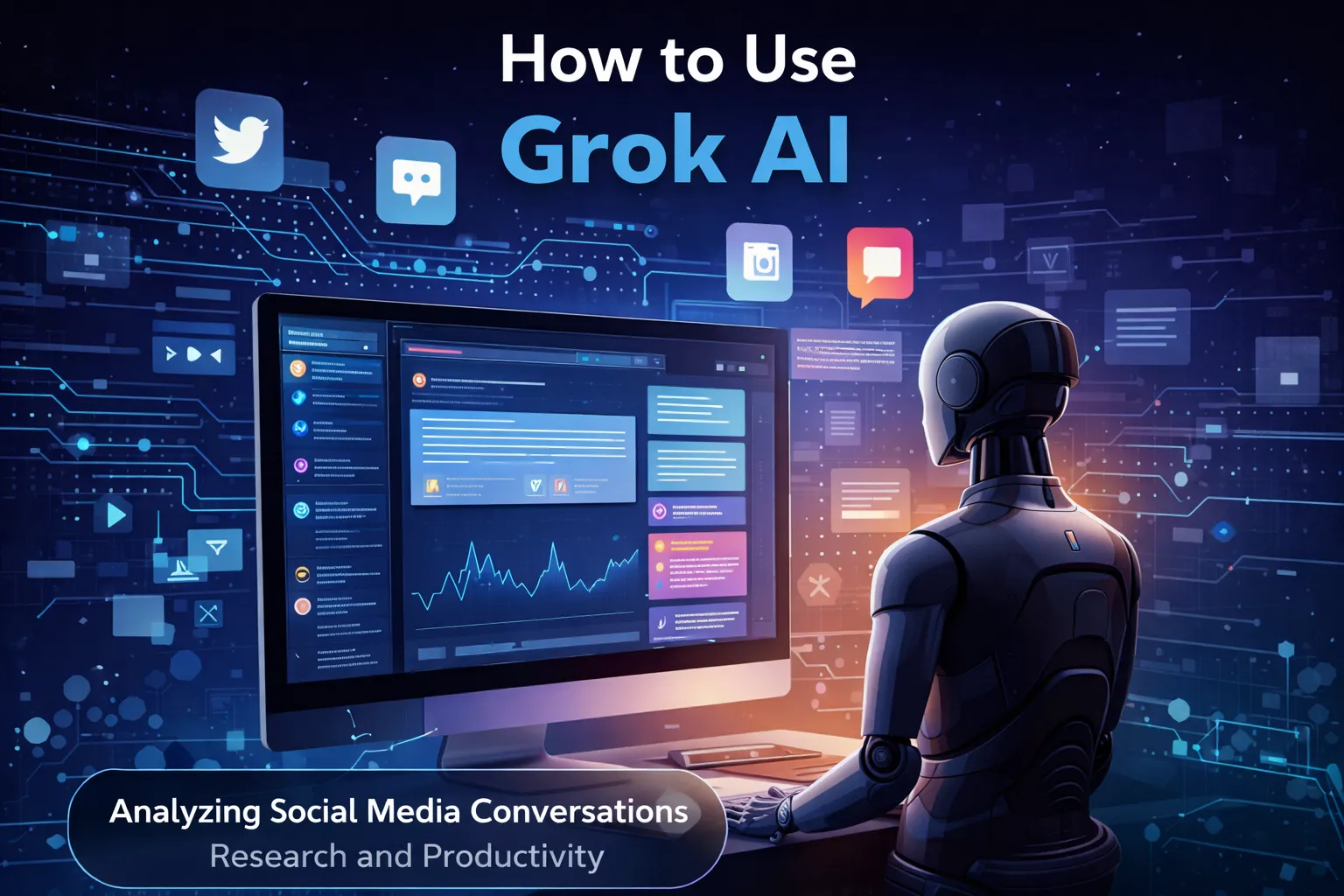
Illustration of Grok AI analyzing social media conversations for research and productivity

Most AI assistants are extremely good at structured tasks like writing emails, summarizing documents, or explaining technical concepts. But when professionals want live insights, public sentiment, or emerging trends, traditional AI tools can fall short.

A marketer researching product feedback, for example, might ask an AI assistant about a trending app only to receive generic background information. What they actually need is current conversation analysis.

This is where Grok, developed by xAI, offers something slightly different. Because it integrates with X, Grok can interpret ongoing public discussions.

Used correctly, Grok becomes less of a chatbot and more of a real-time research assistant.

This guide walks through how professionals can use Grok effectively without relying on guesswork or hype.


Before diving into the tutorial, it helps to understand Grok’s strengths.

Unlike many AI systems trained primarily on static datasets, Grok focuses heavily on social conversation analysis. That means it can detect patterns in how people are discussing topics online.

This capability makes it useful for:

Trend monitoring
📊 Public sentiment analysis
💡 Content ideation
🔍 Market research

However, Grok should not be treated as a perfect source of truth. Social media data can contain noise, misinformation, and emotional reactions.

The key is learning how to ask the right questions.


Currently, Grok is integrated directly into the X platform interface.

To access it:

• Log into your X account
• Navigate to the Grok interface
• Open a conversation window

Once inside the chat environment, you can begin asking questions similar to other AI assistants.


One mistake beginners make is asking overly generic prompts.

Instead of:

“Tell me about electric vehicles.”

Ask:

“What are people currently complaining about with electric vehicles?”

Grok works best when you ask questions related to opinions, reactions, or discussions.

Examples of effective prompts:

• “What are users saying about the latest iPhone release?”
• “What concerns are developers discussing about AI regulation?”
• “What are common complaints about popular productivity apps?”

These questions trigger Grok’s strength: conversation pattern analysis.


Grok is particularly useful for spotting patterns early.

Example scenario:

A SaaS founder researching customer needs might ask:

• “What productivity problems do remote workers complain about most?”

Grok may highlight recurring frustrations such as:

  • meeting overload
  • task management fragmentation
  • collaboration tool fatigue

Those insights can help shape product features or marketing messaging.


Content creators often struggle with topic selection.

Grok can help surface ideas based on real audience interest.

Example workflow:

1️⃣ Ask Grok what people are discussing about a topic
2️⃣ Identify common frustrations or questions
3️⃣ Turn those insights into article ideas

Example output:

• “Why remote workers dislike traditional productivity apps”
• “Top complaints about AI writing tools”
• “What freelancers actually want from automation tools”

This process grounds content in real conversations rather than assumptions.


Here are some practical ways professionals can integrate Grok into their workflow.

📈 Digital Marketing Research

Marketers can analyze how audiences react to competitors.

Example prompt:

“What are people criticizing about popular email marketing tools?”

The results may reveal usability complaints or pricing concerns.


🧩 Product Development Feedback

Startup founders can monitor how users talk about competing products.

Instead of conducting expensive research studies, Grok can reveal informal but valuable insights.


📰 News and Trend Monitoring

Analysts and journalists can track how narratives evolve around major events.

This helps identify:

• emerging opinions
• misinformation patterns
• shifts in public sentiment


✔ Advantages

• Access to real-time discussion trends
• Useful for audience research
• Helps discover unexpected perspectives
• Faster than manual social monitoring

⚠ Limitations

• Social media data can be noisy
• Trends may be temporary or exaggerated
• Not ideal for academic-level research

The most effective approach is using Grok alongside other AI tools, not replacing them.


Grok works best for professionals who rely on audience insight and trend awareness.

Ideal users include:

• digital marketers
• startup founders
• content strategists
• journalists
• social media analysts

Who may not benefit as much

• developers needing coding support
• academic researchers requiring verified sources
• enterprises needing strict data validation


Grok AI introduces an interesting shift in how AI assistants gather knowledge. Instead of relying solely on training data, it interprets ongoing conversations happening online.

For professionals in marketing, research, and digital business, that capability offers a valuable advantage: real-time awareness of what people are actually discussing.

Used thoughtfully, Grok becomes less of a chatbot and more of a social intelligence tool that helps guide better decisions.

Similar Posts

  • ·

    Grok AI vs ChatGPT: Features and Real Use Cases

    Artificial intelligence tools are evolving rapidly, but most of them follow a similar pattern: static training data, controlled outputs, and limited real-time awareness. That model works well for structured tasks like coding assistance or writing help. However, it struggles when users want current insights, cultural context, or social trends.

    That gap is where Grok, developed by xAI, enters the picture.

    Unlike many AI assistants that rely primarily on training datasets, Grok was designed to connect directly with X (formerly Twitter). This integration allows the model to analyze public conversations, trending topics, and real-time discussions.

    For professionals working in marketing, research, or online business, that difference can significantly change how AI is used in daily workflows.


    At its core, Grok functions as a conversational AI assistant similar to ChatGPT or Claude. Users can ask questions, generate text, analyze ideas, or explore technical topics.

    But Grok was intentionally designed with a different philosophy: context awareness from live data.

    Key capabilities include:

    Real-time information access
    Grok can interpret current discussions happening on X, making it useful for trend monitoring and sentiment analysis.

    📊 Social conversation insights
    It can summarize how people are reacting to a topic rather than just describing the topic itself.

    🧠 Conversational reasoning
    Grok aims to produce more informal and context-aware answers compared with some traditional AI assistants.

    🔎 Idea exploration and brainstorming
    Because it pulls from real discussions, it can surface unexpected perspectives that static datasets might miss.

    For example, a digital marketer researching a product launch could ask Grok:

    “What are people complaining about in the latest smartphone release?”

    Instead of returning a generic answer, the AI can analyze current posts and highlight common concerns.


    While both systems function as AI assistants, their strengths are slightly different.

    🔹 Data Sources

    Grok

    • Strong connection to real-time social data
    • Useful for trend discovery and sentiment analysis

    ChatGPT

    • Primarily trained on large datasets and structured knowledge
    • Strong for reasoning, coding, and documentation

    🔹 Content Tone

    Grok often responds with a more conversational tone, reflecting its connection to social platforms.

    ChatGPT generally produces more structured, formal responses, which can be useful for professional documentation.

    🔹 Business Applications

    ChatGPT remains stronger in areas like:

    • code generation
    • structured writing
    • workflow automation
    • technical problem solving

    Grok shows promise in areas such as:

    • social trend monitoring
    • public sentiment analysis
    • cultural context research

    For professionals, the tools may complement rather than replace each other.


    Here are practical scenarios where Grok can be particularly useful.

    📈 Marketing trend research

    Marketers can analyze what audiences are discussing about a brand or industry.

    Example:
    A SaaS founder launching a productivity app could analyze conversations around productivity tools to identify common complaints.

    🧩 Product feedback discovery

    Companies can quickly identify how users feel about competing products.

    This type of insight traditionally required expensive social listening tools.

    📰 News and narrative monitoring

    Journalists, analysts, and researchers can track how a story evolves across social media conversations.

    💡 Content brainstorming

    Creators and writers can explore trending topics that resonate with real audiences.

    Instead of guessing what people want to read, Grok can surface ideas based on live discussion patterns.


    Like any AI system, Grok has strengths and trade-offs.

    ✔ Benefits

    • Access to real-time conversations
    • Useful for trend discovery
    • Insight into public sentiment
    • Unique perspective compared to traditional AI tools

    ⚠ Limitations

    • Social data may contain noise or misinformation
    • Real-time data can introduce bias or emotional reactions
    • Not always ideal for technical or academic analysis

    Professionals should treat Grok as a research assistant rather than a final authority.


    If you’re running an online business or digital project, Grok works best when integrated into a broader workflow.

    Practical workflow example

    1️⃣ Trend discovery using Grok
    2️⃣ Content research and structure using ChatGPT
    3️⃣ Publishing strategy based on validated audience interests

    This layered approach combines real-time insight with structured AI reasoning.


    Grok may be especially valuable for:

    • digital marketers
    • startup founders
    • journalists and analysts
    • social media strategists
    • creators researching audience interests

    Who may not benefit as much

    • developers needing deep coding assistance
    • academic researchers needing highly verified sources
    • enterprises requiring strict moderation controls


    AI tools are gradually moving from static knowledge systems toward dynamic intelligence connected to real-world conversations. Grok represents an early experiment in that direction.

    While it may not replace traditional AI assistants like ChatGPT, its ability to interpret live social discussions creates new possibilities for research, marketing, and trend discovery.

    For professionals exploring AI workflows, Grok is less about replacing existing tools and more about adding a new layer of real-time insight to decision making.

  • ·

    Top 10 AI Writers of 2026: The Ultimate List

    Remember 2023? It felt like a new “revolutionary” AI writing tool launched every Tuesday. It was chaotic, noisy, and honestly, most of them were just cheap wrappers around the same basic OpenAI API.

    Welcome to 2026. The dust has settled. The contenders have separated themselves from the pretenders.

    Today, having an AI assistant isn’t a competitive advantage; it’s baseline table stakes. But the game has changed. We are no longer looking for tools that can just generate words. We are looking for tools that fit specific workflows, understand nuance, and most importantly, don’t sound like a robot trying too hard to impress its corporate overlords.

    At AI Growth Gear, we don’t believe in “one tool to rule them all.” A novelist needs different features than an SEO agency.

    I’ve tested the market leaders to bring you the definitive top 10 list for 2026, categorized by what they actually do best.


    The Titans (The Generalists)

    1. Claude (by Anthropic)

    The undisputed king of nuance and flow. If you want writing that feels surprisingly human straight out of the box, Claude is currently unmatched. Its latest models understand tone, context, and rhythm better than anything else. It doesn’t overuse clichéd AI words like “delve” or “unleash.” If you are writing long-form essays, newsletters, or books, this is your muse.

    • Best For: Long-form writers, authors, and anyone who hates heavy editing.
    • Pricing: Free tier available; Pro is ~$20/mo.

    2. ChatGPT (by OpenAI)

    The incredibly versatile Swiss Army Knife. You can’t make a list without the OG. While Claude might beat it purely on prose quality, ChatGPT (with GPT-5/4o) is a productivity powerhouse. Its ability to handle multimodal inputs—analyzing a chart, reading code, browsing the live web, and generating an image all in one chat—makes it indispensable for complex projects. It’s less a writer and more a brilliant, jack-of-all-trades assistant.

    • Best For: Brainstorming, coding help, and multi-step complex tasks.
    • Pricing: Free tier available; Plus is ~$20/mo.

    The Marketers (For Growth & SEO)

    3. Jasper

    The enterprise-grade marketing engine. Jasper stopped trying to be just a “chatbot” years ago. In 2026, it is a robust platform for marketing teams. Its killer features are “Brand Voice” (which it nails perfectly) and its ability to turn a single brief into an entire multi-channel campaign (blog, social, email) with AI agents. It’s pricey, but it replaces a junior marketing coordinator.

    • Best For: Marketing agencies and in-house enterprise teams.
    • Pricing: Premium pricing, starting around ~$49/mo per seat.

    4. Writesonic

    The speed demon for SEO and trending topics. If your business relies on catching trending waves on Google, Writesonic is essential. It integrates tightly with live Google data, allowing you to write factually accurate articles on current events faster than competitors. It’s designed specifically to rank, focusing on structure and keywords.

    • Best For: News sites, affiliate marketers, and high-volume bloggers.
    • Pricing: Competitive tier structure based on usage.

    5. Copy.ai

    The GTM (Go-To-Market) automation specialist. Copy.ai has pivoted brilliantly towards sales and GTM workflows. It’s less about “write me a paragraph” and more about “take this LinkedIn profile, analyze their pain points, and write a personalized 3-email cold outreach sequence.” For sales teams, it’s pure gold.

    • Best For: Sales development reps (SDRs), founders doing outreach, and social media managers.
    • Pricing: Free tier available; Pro plans focus on workflow limits.

    The Specialists (Niche Experts)

    6. Perplexity

    The research-first writer. Perplexity isn’t a traditional “writer,” but it’s the best tool to start the writing process. It’s an answer engine that cites its sources in real-time. When I need to write a fact-heavy piece and cannot afford AI hallucinations, I start here to gather my research before moving to a drafting tool.

    • Best For: Journalists, academics, and creating fact-based content briefs.
    • Pricing: Excellent free version; Pro offers deeper models.

    7. Sudowrite

    The novelist’s best friend. If you are writing fiction, ignore the other tools and start here. Sudowrite understands narrative arcs, character development, and “show, don’t tell.” Features like “Story Engine” help you map out entire novels, and its “Describe” button helps you break through writer’s block with sensory details.

    • Best For: Fiction authors, screenwriters, and creative writers.
    • Pricing: Tiered based on word count.

    8. Surfer AI

    The pure SEO optimization tool. Surfer isn’t about creative flair; it’s about math. It analyzes the top-ranking pages on Google for your keyword and tells you exactly what structure, word count, and semantic terms you need to compete. It writes to satisfy the algorithm first, humans second.

    • Best For: Hardcore SEO professionals focused on SERP rankings.
    • Pricing: Per-article pricing model (expensive but effective).

    The Integrators (Workflow Enhancers)

    9. Notion AI

    The messy workspace organizer. Notion AI isn’t trying to write your next novel. It’s trying to make sense of your messy notes. Its strength is summarizing meetings, expanding bullet points into memos, and editing directly within your existing project management workspace. It removes the friction of copy-pasting between apps.

    • Best For: Project managers and teams already living inside Notion.
    • Pricing: Add-on to existing Notion plans (~$10/member/mo).

    10. Grammarly GO

    The final polish essential. You might not think of Grammarly as a “generative” AI, but their latest features are fantastic for rewriting. It’s the ultimate safety net. No matter which tool I use to draft, everything runs through Grammarly for a final tone check and clarity polish before publishing.

    • Best For: Literally everyone who types on a keyboard.
    • Pricing: Essential free version; Premium is a staple investment.

    Final Thoughts from Surbhi

    The best tool in 2026 isn’t the one with the most features; it’s the one that fits your specific daily grind. Don’t fall for the hype. Define your output—are you selling, storytelling, or ranking?—and choose the specialist for the job.

  • ·

    Build a Custom GPT to Automate Client Onboarding

    If you run an agency or consulting business, you already know the onboarding paradox. Landing a new client is the best feeling in the world, but the administrative hangover that immediately follows—sending welcome packets, chasing down brand assets, and setting up project management boards—is a massive drain on your time.

    What if you could bottle up your exact onboarding process and hand it over to an AI?

    Building a custom ChatGPT agent to handle your new client intake isn’t just a fun tech experiment; it is a scalable business asset. By combining OpenAI’s custom GPT capabilities with AI workflow automation, you can create an assistant that guides your clients, answers their initial questions, and drafts their strategy documents while you focus on the actual billable work.

    Here is a step-by-step custom GPT tutorial to help you automate client onboarding and win back your week.

    Step 1: Map the Workflow (Don’t Skip This)

    A custom GPT is only as smart as the system you anchor it to. Before you even log into OpenAI, you need to document exactly what happens when a prospect says “yes.”

    Grab a piece of paper and outline your current bottlenecks. What do you do on repeat?

    • Do you send the same welcome email with slightly tweaked variables?
    • Do you manually review intake forms to pull out key goals?
    • Do you spend an hour writing a project kickoff brief?

    Pick one specific, repetitive phase of your onboarding process to automate first. A GPT built to “draft a custom project kickoff brief based on a client intake form” will perform ten times better than a GPT told to “handle my new clients.”

    Step 2: Configure Your Custom GPT

    Once your workflow is locked in, head over to ChatGPT. Note: You will need a paid Plus, Team, or Enterprise account to create and save custom GPTs.

    1. Click on Explore GPTs in the left sidebar, then hit Create.
    2. You will see a split screen. While it is tempting to use the “Create” tab to chat with the builder, switch over to the Configure tab. This gives you manual, granular control over how your agent behaves.
    3. Give your assistant a name (e.g., Onboarding Co-Pilot) and a brief description.

    Step 3: Write the System Prompt (The Brain)

    The “Instructions” box is where the magic happens. A standard prompt like “write welcome emails for my clients” will give you generic, robotic outputs.

    To make this tool an extension of your business, give it a strict persona, clear rules, and an expected output format. Try using this structure:

    • Role: You are the Senior Client Success Manager for [Your Agency Name]. Your job is to facilitate a seamless onboarding experience for new B2B clients.
    • Tone: Warm, professional, and concise. Avoid marketing jargon.
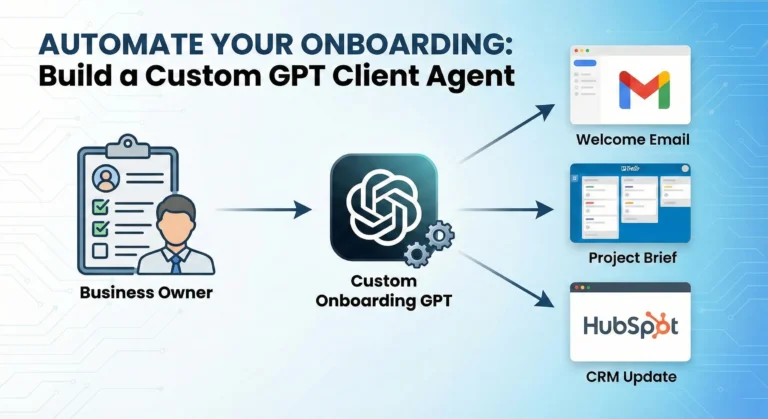
    • Task: When I upload a completed client intake form, you will generate three things: 1) A personalized welcome email. 2) A bulleted list of missing assets we need from the client. 3) An internal project brief for my team.
    • Boundaries: Never invent services we do not offer. If the intake form is missing critical budget data, explicitly flag it for my review.

    Step 4: Upload Your Knowledge Base

    This is what separates using ChatGPT for business from using it for parlor tricks. In the Knowledge section, upload the proprietary documents that make your agency unique.

    Upload your standard operating procedures (SOPs), your service pricing tiers, past examples of excellent project briefs, and your brand tone guidelines. When the GPT generates an onboarding plan, it will actively reference these files so the output actually sounds like it came from your desk.

    Pro Tip: Keep your knowledge files clean. Break large, messy PDFs into smaller, clearly titled text documents (e.g., Welcome_Email_Templates.pdf, Service_Tiers.pdf). This helps the AI pull the exact information it needs without hallucinating.

    Step 5: Connect to AI Workflow Automation

    Once your GPT is reliably analyzing intake forms and drafting emails, it is time to connect it to the rest of your tech stack.

    Under the “Capabilities” section, you can set up Custom Actions. By connecting your GPT to tools like Zapier or Make, your agent can move from just writing text to actually executing tasks. You can configure it so that once the GPT generates the onboarding brief, it automatically pushes that data into a new Trello card, updates the client’s status in HubSpot or Salesforce, and drafts the welcome email directly in your Gmail drafts folder.

    Final Thoughts

    Treat your new custom GPT like a new hire. It will make a few mistakes in its first week. When it gives you an output you don’t like, don’t just fix the output manually—go back into the Configure tab and update the instructions so it learns for next time. Within a few weeks, you will have a rock-solid, automated client onboarding system that scales as fast as your agency does.

  • ·

    Gemini vs Grok vs ChatGPT: Which AI Actually Delivers?

    AI tools are no longer novelty software. They’re embedded in marketing stacks, product teams, customer support desks, and solo founder workflows.

    But here’s the real issue: most comparisons between Gemini, Grok, and ChatGPT focus on feature checklists — not actual business impact.

    If you’re running campaigns, building SaaS products, automating workflows, or scaling digital operations, the question isn’t which AI is smartest.

    The question is:

    Which AI fits your workflow, risk tolerance, and monetization model?

    Let’s break this down from a practical, business-first perspective.


    🧠 Core Positioning: What Each Tool Is Really Built For

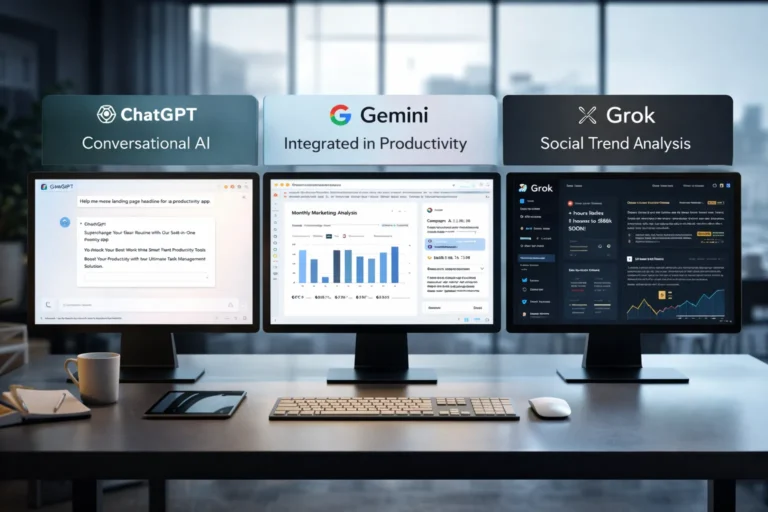
    ChatGPT has become the default AI workspace for professionals.

    It excels at:

    • Long-form content
    • Structured reasoning
    • Coding assistance
    • Workflow automation via APIs
    • Document summarization
    • Custom GPT workflows

    For many entrepreneurs, ChatGPT acts as a “digital operations assistant.”

    • Draft landing pages
    • Generate ad variations
    • Build Zapier automation logic
    • Create client reporting templates

    It’s flexible and ecosystem-friendly.


    Gemini integrates deeply into Google’s ecosystem.

    Its strength isn’t just intelligence — it’s context.

    It works well with:

    • Google Docs
    • Gmail
    • Sheets
    • Drive
    • Workspace collaboration
    • Analyze campaign data directly in Sheets
    • Draft email updates inside Gmail
    • Summarize meeting notes automatically

    Gemini is strongest when your business already lives inside Google.


    Grok operates differently. It’s closely integrated with the X (formerly Twitter) ecosystem and emphasizes real-time information access.

    Its positioning is:

    • Social intelligence
    • Real-time trend awareness
    • Edgier conversational style
    • Live internet awareness
    • Monitor sentiment shifts
    • Analyze breaking news
    • Generate rapid-response commentary

    Grok shines in live environments. It’s less structured, more reactive.


    ⚙️ Real-World Productivity Comparison

    Here’s where things matter for professionals.

    For AI Automation Builders 🛠️

    • ChatGPT wins due to API maturity and plugin ecosystem.
    • Gemini is improving but less flexible for external automation.
    • Grok isn’t optimized for backend automation yet.

    For AI Marketing Workflows 📈

    • ChatGPT: Best for structured funnel content, copy frameworks, strategy.
    • Gemini: Strong for ad analysis if you live in Google Ads.
    • Grok: Useful for trend-based content and social hooks.

    For SaaS Founders 💻

    • ChatGPT: Product ideation, UX copy, code scaffolding.
    • Gemini: Useful for internal documentation collaboration.
    • Grok: Less relevant unless your SaaS is social-data-driven.

    ⚖️ Strengths and Limitations

    ChatGPT

    Pros

    • Deep reasoning
    • Advanced coding
    • API integrations
    • Custom GPT creation

    Cons

    • May require prompt skill to maximize output
    • Enterprise pricing can scale

    Gemini

    Pros

    • Native Google ecosystem integration
    • Strong document collaboration
    • Smooth Workspace automation

    Cons

    • Less customizable outside Google
    • Not as developer-centric

    Grok

    Pros

    • Real-time awareness
    • Social sentiment alignment
    • Direct integration with X

    Cons

    • Not workflow-automation focused
    • Limited enterprise tooling

    🚀 Practical Implementation Strategy

    Instead of choosing just one, many professionals layer them.

    Here’s a smart approach:

    Step 1: Define Your Primary Use Case

    Ask:

    • Is this content-heavy?
    • Is this data-heavy?
    • Is this trend-heavy?

    Step 2: Assign Roles

    • ChatGPT → Strategy + structure
    • Gemini → Internal collaboration
    • Grok → Real-time market pulse

    Step 3: Build Repeatable AI Workflows

    For example:

    1. Use Grok to identify trending topics.
    2. Use ChatGPT to turn that into structured authority content.
    3. Use Gemini to distribute internally via Docs and Gmail.

    This layered workflow reduces blind spots.


    👥 Who Should Use What?

    Choose ChatGPT If:

    • You build automation workflows
    • You write long-form content
    • You code or build SaaS tools
    • You need structured output

    Choose Gemini If:

    • Your company runs on Google Workspace
    • You collaborate heavily in Docs/Sheets
    • You need built-in AI inside email

    Choose Grok If:

    • You depend on real-time news
    • You operate in finance, crypto, politics, media
    • You build brand presence on X

    🎯 Final Perspective

    There isn’t a universal “best AI.”

    There’s only:

    • Best for workflow
    • Best for ecosystem
    • Best for execution speed

    ChatGPT is currently the most versatile.
    Gemini is the most integrated.
    Grok is the most reactive.

    For serious professionals, the competitive edge isn’t the tool — it’s how intelligently you deploy it.

    AI doesn’t replace strategic thinking.
    It amplifies it.

  • ·

    Midjourney Branding: A Guide to Style Consistency

    We have all been there. You are playing around in Midjourney, and suddenly, you generate the perfect concept for a client’s logo. It’s the right vibe, the right colors, the right aesthetic. The client loves it.

    Then they ask the inevitable follow-up question: “This is great. Can we get a matching icon set for the website and a header image in the same style?”

    You go back to Midjourney, paste in the original prompt, hit enter, and… you get something completely different. Panic sets in.

    Midjourney is incredible at generating beautiful, singular images, but out of the box, it is terrible at consistency. And in branding, consistency isn’t just nice to have; it’s the whole ballgame. A brand identity is defined by repetition and cohesiveness.

    If you want to transition from using AI as a toy to using AI graphic design for business, you have to stop treating it like a slot machine and start treating it like a junior designer that needs very specific instructions.

    Here is a tutorial on how to force Midjourney style consistency to build a usable brand identity system.

    Phase 1: Defining the “Style Anchor”

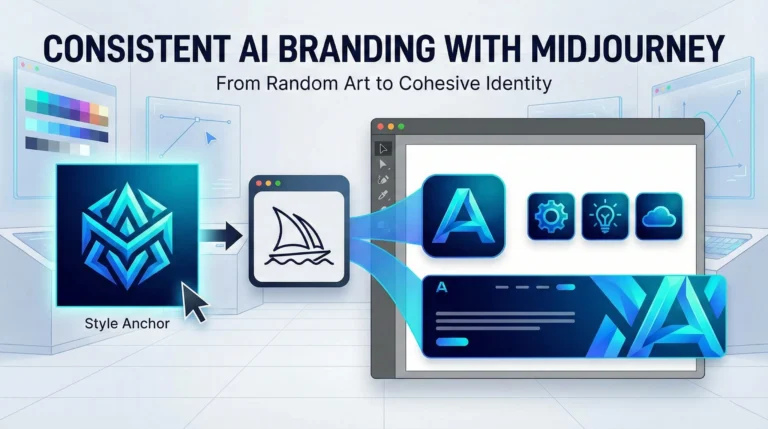
    You cannot build a consistent brand until you define what “consistent” looks like. You need one image that perfectly encapsulates the visual DNA of the brand—the color palette, the rendering technique (e.g., flat vector, 3D isometric, watercolor), and the mood.

    Don’t try to generate the final logo yet. Just generate the style.

    Example Prompt for a Tech Startup Style: /imagine prompt: A futuristic, minimalist geometric emblem, gradients of electric blue and cyan, clean lines, abstract data flow concept, white background, vector art style --v 6.0

    Reroll this prompt until you get one image that makes you say, “Yes, that is the look.” Upscale it. This image is now your “Style Anchor.” Right-click it and copy the image URL.

    Phase 2: The Secret Weapon (Style References)

    For a long time, maintaining consistency meant endlessly tweaking prompt text and praying. Then, Midjourney introduced the Style Reference parameter (--sref). This changed everything for professional designers.

    --sref tells Midjourney: “Don’t just look at the words I’m typing; look at this image and copy its vibe.”

    This is how we move from a single cool image to an AI logo design tutorial that actually works for business.

    Phase 3: Building the Asset Suite

    Now we are going to generate different assets, but we will force them all to match our Style Anchor from Phase 1 using the URL we copied.

    1. The Primary Logo Icon: Now we ask for the specific subject matter, but apply the anchor style.

    Prompt: /imagine prompt: A stylized letter 'A' icon, geometric, tech company logo --sref [INSERT YOUR STYLE ANCHOR URL HERE] --v 6.0

    2. Matching Website Icons: You need a set of three icons (a gear, a lightbulb, a cloud) for the services section of a website. They need to look like siblings to the logo.

    Prompt: /imagine prompt: A set of three UI icons: a gear, a lightbulb, and a cloud. Clean geometric style, minimalist --sref [INSERT YOUR STYLE ANCHOR URL HERE] --v 6.0

    Because you used the --sref link, Midjourney will render these new objects using the exact same electric blue gradients and clean line work as your anchor image.

    3. The Hero Background: You need a wide banner for the website header that feels connected to the brand but isn’t just a giant logo.

    Prompt: /imagine prompt: A wide website banner background, abstract data flowing, futuristic network patterns, subtle gradients --ar 16:9 --sref [INSERT YOUR STYLE ANCHOR URL HERE] --v 6.0

    Phase 4: The Professional Reality Check (Vectorizing)

    If you are an agency owner or freelancer, you know you cannot deliver a Midjourney PNG to a client as a final logo file. Midjourney creates raster images (pixels); professional brands need vectors (math).

    Midjourney is for ideation and consistency creation. Once you have the approved assets, your workflow must move off-platform. Take your finalized, consistent Midjourney outputs and use tools like Adobe Illustrator’s “Image Trace” or specialized AI vectorizers like Vectorizer.ai to convert them into scalable SVGs or EPS files.

    Final Thoughts

    Using Midjourney brand assets doesn’t replace the designer’s eye. It just speeds up the iteration process exponentially. By mastering tools like style referencing, you stop fighting the AI’s randomness and start harnessing it to build cohesive, sellable brand identities.

  • ·

    Automate Ecommerce Descriptions & Pricing with AI

    If you are a Shopify store owner or an Amazon FBA seller, you know that scaling your catalog comes with a massive administrative hangover. Every new SKU you add requires SEO-optimized copy, feature extraction, and competitive pricing strategies. Doing this manually for ten products is annoying; doing it for ten thousand is impossible.

    The smartest e-commerce managers are no longer throwing human hours at these repetitive tasks. Instead, they are leveraging artificial intelligence to build automated systems that write high-converting copy and adjust prices in real-time.

    Here is your tutorial on how to use AI for ecommerce to automate your product descriptions and supercharge your pricing strategy.

    Part 1: Automating Product Descriptions at Scale

    Writing generic product descriptions is a surefire way to kill your conversion rate. Shoppers want to know the benefits, but search engines need the features and keywords. Trying to balance both across thousands of products is where AI shines.

    Moving Beyond the “One-by-One” Prompt If you are opening ChatGPT, pasting in a manufacturer’s spec sheet, and asking it to write a description one by one, you aren’t really automating. True automation requires bulk generation.

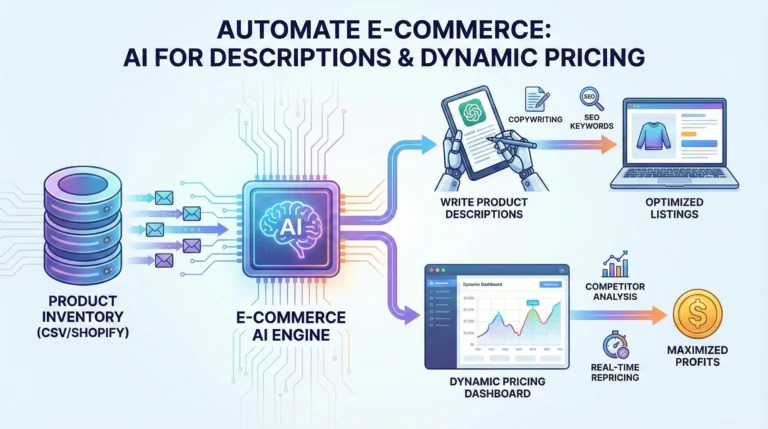
    To build an automated content factory, you need to connect your product database (like a Google Sheet or CSV export of your Shopify inventory) directly to an AI language model using tools like Zapier, Make.com, or specialized apps like Copy.ai and Hypotenuse AI.

    The Workflow:

    1. The Trigger: A new product is added to your store database with basic attributes (Name, Color, Material, Dimensions).
    2. The Prompt Template: Your automation tool sends these attributes to OpenAI with a strict prompt: “Act as an expert e-commerce copywriter. Using the provided specs, write a 100-word product description. Start with an emotional hook, follow with three bulleted benefits, and naturally weave in these SEO keywords. Tone: Premium and minimalist.”
    3. The Output: The AI generates the description and instantly updates your Shopify or WooCommerce listing via API.

    What used to take a copywriter a full week can now be executed across 5,000 SKUs while you grab a coffee.

    Part 2: Winning the Buy Box with Dynamic Pricing AI

    Having great product copy gets customers to your page, but pricing gets them to click “Add to Cart.” In the past, repricing meant setting basic rules (e.g., “always price my product $1 cheaper than Competitor X”). Today, rule-based pricing is obsolete.

    Enter dynamic pricing AI.

    Major players like Amazon make millions of repricing decisions every single day, evaluating relative market value without relying on manual input. Now, thanks to tools like Prisync, Intelis, and DynamicPricing AI, independent store owners have access to that exact same enterprise-level technology.

    How AI Pricing Works: Instead of just scraping a competitor’s website, modern AI pricing tools ingest dozens of variables simultaneously. They analyze:

    • Real-time competitor stock levels (If your competitor sells out, the AI automatically raises your price to capture a higher margin).
    • Historical sales velocity and seasonal demand trends.
    • Your specific procurement costs and target profit margins.
    • Customer price elasticity (how sensitive your specific audience is to a $2 price hike).

    Setting the Guardrails: The beauty of an ecommerce automation tutorial focused on pricing is that you remain in control. You never have to worry about the AI accidentally pricing a $100 jacket for $5. You set the absolute minimum margin floor (the “guardrails”), and the AI constantly tests price points above that floor to find the exact dollar amount that maximizes your total profit, not just your revenue.

    Final Thoughts

    The divide in e-commerce is no longer about who has the best product; it is about who has the best operational velocity. By automating your ChatGPT product descriptions and integrating dynamic pricing AI, you remove the human bottleneck from your catalog management. This frees you up to focus on what actually grows a business: sourcing better products, building a brand identity, and acquiring new customers.