|

AI Workflow Automation for Small Businesses (2026 Guide)

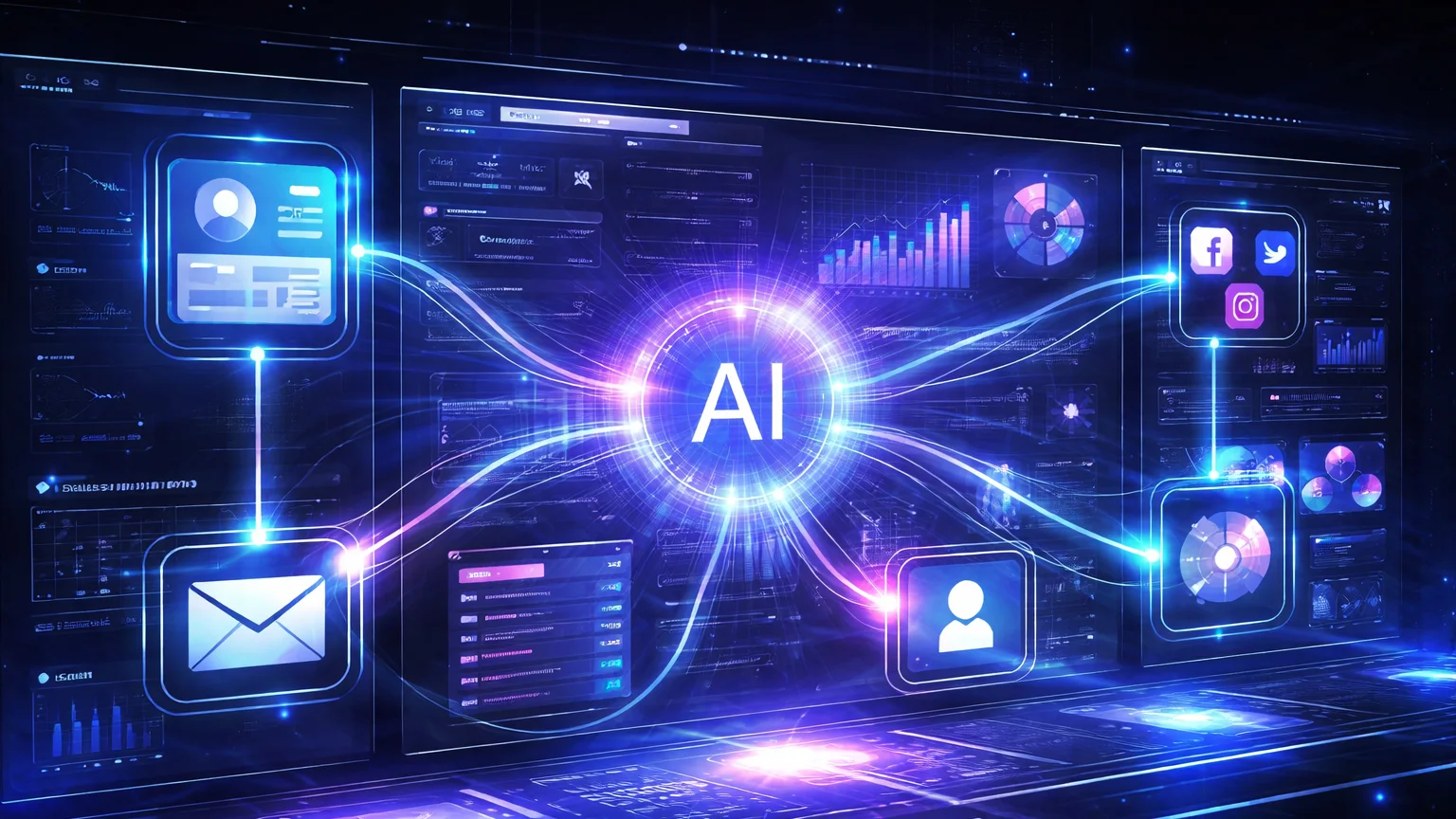
AI workflow automation dashboard connecting business apps

Running a small business means handling dozens of repetitive tasks every day—emails, invoices, customer responses, lead management, and social media updates. These tasks consume valuable time that could be spent growing the business.

This is where AI workflow automation comes in.

By using automation platforms like Zapier and Make, small businesses can automate repetitive workflows, connect multiple apps, and reduce manual work dramatically.

In this guide, you will learn:

  • What AI workflow automation is
  • Why small businesses should use it
  • The best automation tools available
  • Real examples of automated workflows
  • How to start automation in your business today

What is AI Workflow Automation?

AI workflow automation is the process of using automation tools and artificial intelligence to perform repetitive business tasks automatically.

Instead of manually transferring data between apps, sending emails, or updating spreadsheets, automation platforms create trigger-based workflows.

Example workflow:

Customer fills website form →
Lead added to CRM →
Welcome email sent →
Sales team notified →
Task created in project management tool.

All of this happens automatically without human intervention.
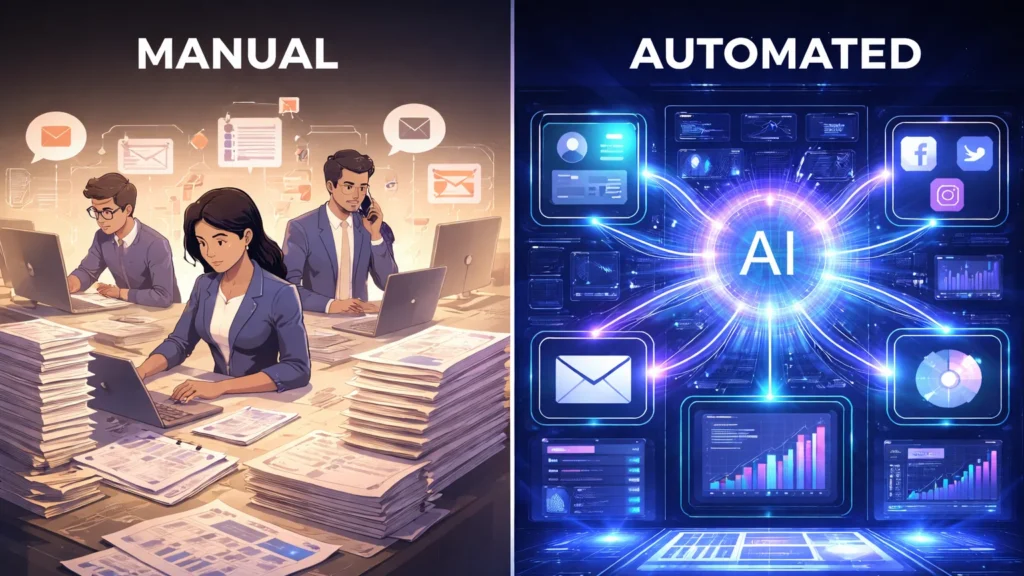
Manual business workflow compared with AI automated workflow
Comparison of manual business processes and AI automated workflows that eliminate repetitive tasks.

Why Small Businesses Need Workflow Automation

Small businesses usually operate with limited staff and resources. Automation allows teams to do more work with fewer people.

1. Save Time

Automation removes repetitive tasks such as:

  • Email responses
  • Data entry
  • Report generation
  • File organization

2. Reduce Human Errors

Manual data entry often leads to mistakes. Automation ensures accurate data transfer across systems.

3. Increase Productivity

Employees can focus on high-value activities like sales, strategy, and customer relationships.

4. Scale Operations Faster

As business grows, automation ensures workflows remain efficient without hiring additional staff.


Best AI Workflow Automation Tools

Zapier is one of the most popular automation platforms used by millions of businesses worldwide.

It allows users to connect 6,000+ apps and automate tasks without coding.

Key Features

  • No-code workflow builder
  • Thousands of app integrations
  • AI automation suggestions
  • Conditional workflows
  • Multi-step automation

Example Automation

When a customer purchases from Shopify →
Automatically add customer to email marketing list →
Send onboarding email →
Create invoice.

Zapier is ideal for small businesses, freelancers, and startups.
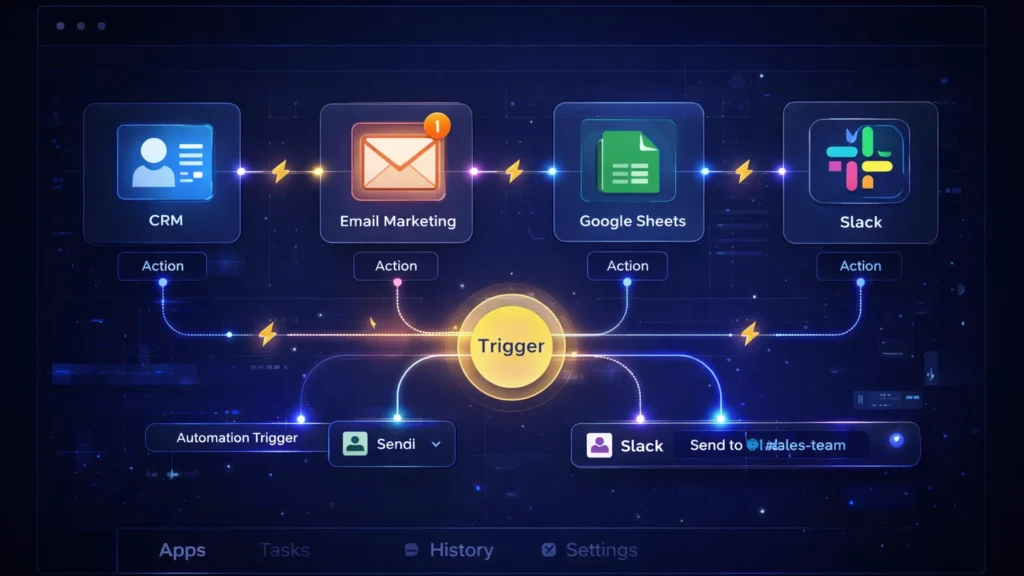
workflow automation diagram connecting CRM email marketing Google Sheets and Slack
Workflow automation tools connect apps like CRM, email marketing, Google Sheets, and Slack through automation triggers.

Make (formerly Integromat) is a powerful visual automation platform designed for complex workflows.

Unlike Zapier, Make uses a visual scenario builder where users can see how data flows between apps.

Key Features

  • Visual automation builder
  • Advanced conditional logic
  • Data transformation tools
  • Real-time automation execution
  • Powerful integrations

Example Automation

New lead from Facebook Ads →
Filter high-quality leads →
Add to CRM →
Send SMS notification to sales team.

Make is perfect for businesses that require advanced automation and detailed control.
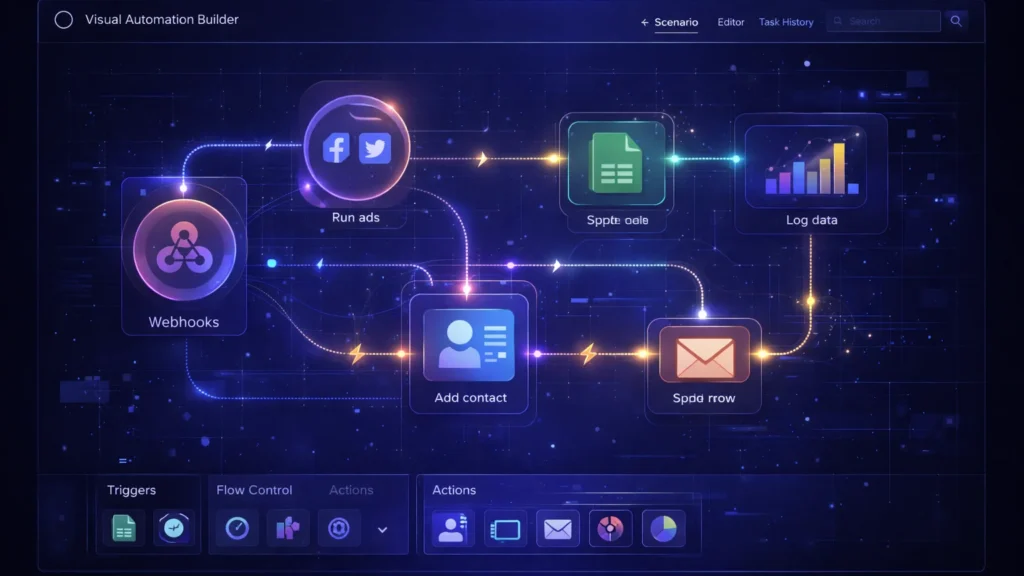
visual automation builder interface connecting marketing apps CRM and analytics
Visual workflow builders allow businesses to design complex automation scenarios using connected nodes and triggers.

Real AI Workflow Automation Examples

Here are practical automation workflows small businesses can implement immediately.

Website contact form →
Add lead to CRM →
Send welcome email →
Notify sales team on Slack.

Customer email received →
AI categorizes issue →
Ticket created in helpdesk →
Auto response sent to customer.

New blog post published →
Automatically share on:

  • Facebook
  • LinkedIn
  • Twitter
  • Pinterest

Customer order placed →
Inventory updated →
Invoice generated →
Shipping notification sent.
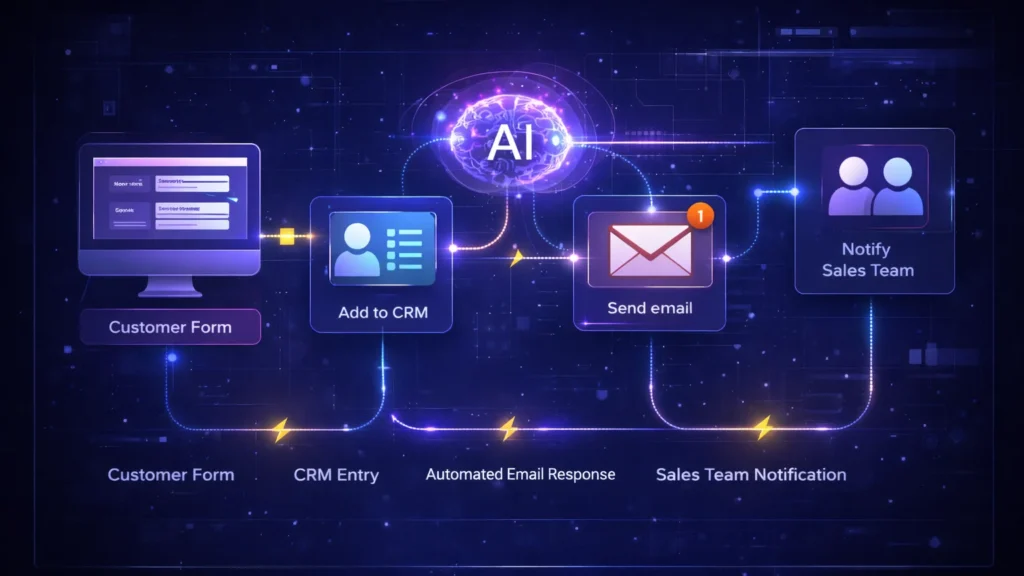
AI business automation flowchart showing customer form CRM email and sales notification
Example of an automated business workflow from customer form submission to CRM entry, email response, and sales team notification.

AI + Workflow Automation: The Future of Business

AI is rapidly transforming automation.

Modern tools now include:

  • AI-powered workflow suggestions
  • Smart data extraction
  • Automated decision making
  • AI customer support bots

This means businesses can automate not just tasks—but entire decision processes.

For example:

AI analyzes customer behavior →
Predicts churn →
Triggers retention email automatically.
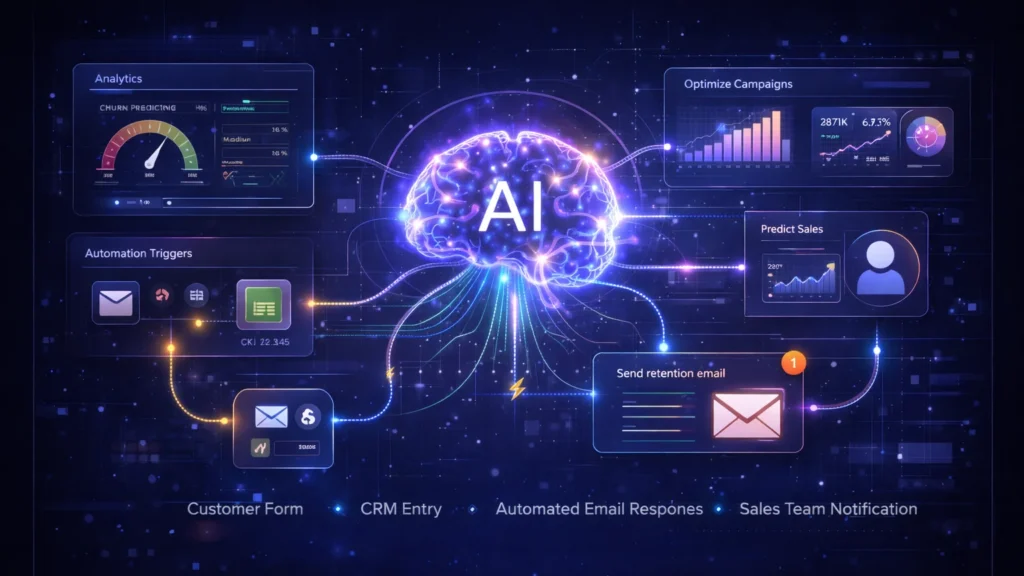
artificial intelligence analyzing business dashboards and predictive analytics automation
Advanced AI systems analyze business data and trigger automated decisions using predictive analytics.

How to Start AI Workflow Automation

Follow these simple steps:

Look for tasks that happen frequently such as:

  • Email responses
  • Data entry
  • Lead management
  • Reporting

Beginners usually start with:

  • Zapier for simplicity
  • Make for advanced workflows

Most businesses integrate:

  • CRM
  • Email marketing tools
  • Google Sheets
  • Payment gateways
  • Customer support tools

Create a trigger → action system.

Example:

New customer →
Send welcome email.


Common Automation Mistakes to Avoid

Automation should improve workflows—not automate inefficient ones.

Too many automations can create complexity and confusion.

Always test and monitor automations regularly to ensure they function correctly.


small business owner using AI automation dashboard for CRM email and marketing tasks
Small businesses can automate emails, CRM updates, and marketing tasks using AI workflow automation tools.

Final Thoughts

AI workflow automation is no longer just for large companies. Today, even small businesses can automate operations using tools like Zapier and Make.

By automating repetitive tasks, businesses can:

  • Save time
  • Reduce costs
  • Increase efficiency
  • Scale faster

If you’re running a small business in 2026, workflow automation is one of the most powerful tools you can adopt to stay competitive.
Similar Posts

  • ·

    Grok AI vs ChatGPT: Features and Real Use Cases

    Artificial intelligence tools are evolving rapidly, but most of them follow a similar pattern: static training data, controlled outputs, and limited real-time awareness. That model works well for structured tasks like coding assistance or writing help. However, it struggles when users want current insights, cultural context, or social trends.

    That gap is where Grok, developed by xAI, enters the picture.

    Unlike many AI assistants that rely primarily on training datasets, Grok was designed to connect directly with X (formerly Twitter). This integration allows the model to analyze public conversations, trending topics, and real-time discussions.

    For professionals working in marketing, research, or online business, that difference can significantly change how AI is used in daily workflows.


    At its core, Grok functions as a conversational AI assistant similar to ChatGPT or Claude. Users can ask questions, generate text, analyze ideas, or explore technical topics.

    But Grok was intentionally designed with a different philosophy: context awareness from live data.

    Key capabilities include:

    Real-time information access
    Grok can interpret current discussions happening on X, making it useful for trend monitoring and sentiment analysis.

    📊 Social conversation insights
    It can summarize how people are reacting to a topic rather than just describing the topic itself.

    🧠 Conversational reasoning
    Grok aims to produce more informal and context-aware answers compared with some traditional AI assistants.

    🔎 Idea exploration and brainstorming
    Because it pulls from real discussions, it can surface unexpected perspectives that static datasets might miss.

    For example, a digital marketer researching a product launch could ask Grok:

    “What are people complaining about in the latest smartphone release?”

    Instead of returning a generic answer, the AI can analyze current posts and highlight common concerns.


    While both systems function as AI assistants, their strengths are slightly different.

    🔹 Data Sources

    Grok

    • Strong connection to real-time social data
    • Useful for trend discovery and sentiment analysis

    ChatGPT

    • Primarily trained on large datasets and structured knowledge
    • Strong for reasoning, coding, and documentation

    🔹 Content Tone

    Grok often responds with a more conversational tone, reflecting its connection to social platforms.

    ChatGPT generally produces more structured, formal responses, which can be useful for professional documentation.

    🔹 Business Applications

    ChatGPT remains stronger in areas like:

    • code generation
    • structured writing
    • workflow automation
    • technical problem solving

    Grok shows promise in areas such as:

    • social trend monitoring
    • public sentiment analysis
    • cultural context research

    For professionals, the tools may complement rather than replace each other.


    Here are practical scenarios where Grok can be particularly useful.

    📈 Marketing trend research

    Marketers can analyze what audiences are discussing about a brand or industry.

    Example:
    A SaaS founder launching a productivity app could analyze conversations around productivity tools to identify common complaints.

    🧩 Product feedback discovery

    Companies can quickly identify how users feel about competing products.

    This type of insight traditionally required expensive social listening tools.

    📰 News and narrative monitoring

    Journalists, analysts, and researchers can track how a story evolves across social media conversations.

    💡 Content brainstorming

    Creators and writers can explore trending topics that resonate with real audiences.

    Instead of guessing what people want to read, Grok can surface ideas based on live discussion patterns.


    Like any AI system, Grok has strengths and trade-offs.

    ✔ Benefits

    • Access to real-time conversations
    • Useful for trend discovery
    • Insight into public sentiment
    • Unique perspective compared to traditional AI tools

    ⚠ Limitations

    • Social data may contain noise or misinformation
    • Real-time data can introduce bias or emotional reactions
    • Not always ideal for technical or academic analysis

    Professionals should treat Grok as a research assistant rather than a final authority.


    If you’re running an online business or digital project, Grok works best when integrated into a broader workflow.

    Practical workflow example

    1️⃣ Trend discovery using Grok
    2️⃣ Content research and structure using ChatGPT
    3️⃣ Publishing strategy based on validated audience interests

    This layered approach combines real-time insight with structured AI reasoning.


    Grok may be especially valuable for:

    • digital marketers
    • startup founders
    • journalists and analysts
    • social media strategists
    • creators researching audience interests

    Who may not benefit as much

    • developers needing deep coding assistance
    • academic researchers needing highly verified sources
    • enterprises requiring strict moderation controls


    AI tools are gradually moving from static knowledge systems toward dynamic intelligence connected to real-world conversations. Grok represents an early experiment in that direction.

    While it may not replace traditional AI assistants like ChatGPT, its ability to interpret live social discussions creates new possibilities for research, marketing, and trend discovery.

    For professionals exploring AI workflows, Grok is less about replacing existing tools and more about adding a new layer of real-time insight to decision making.

  • ·

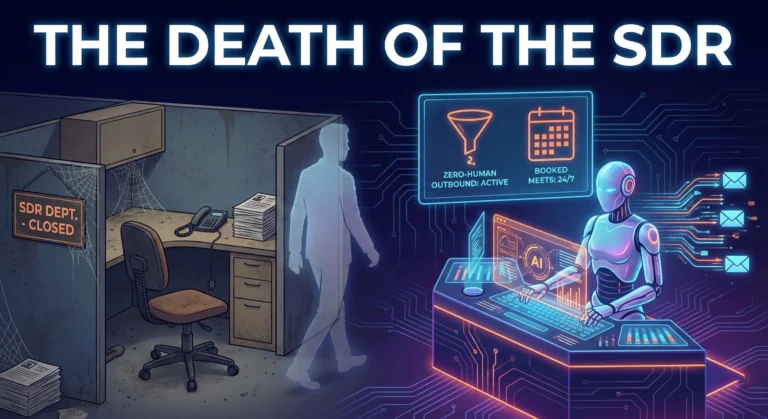
    The Death of the SDR: Building a “Zero-Human” Outbound Team

    Let’s be brutally honest for a moment. The “SDR Sweatshop” model is finally dead.

    We all knew it was broken back in 2023. But here in February 2026, continuing to run it is financial negligence. Taking bright, ambitious 22-year-olds and forcing them to act like spam-bots—sending 150 generic emails a day just to get a 0.5% reply rate—isn’t a strategy anymore. It’s insanity.

    The fundamental shift of the last two years isn’t just that AI got better at writing. It’s that AI got “agency.”

    We have moved past needing humans in the loop for low-value tasks. The future of high-growth B2B sales is the “Zero-Human” Outbound Team.

    The Math Just Doesn’t Work Anymore

    The demise of the Sales Development Representative (SDR) role comes down to cold, hard economics.

    An entry-level SDR in San Francisco, London, or New York costs anywhere from $80,000 to $120,000 fully loaded (salary, commission, tools, benefits). They work roughly 8 hours a day, they burn out in 14 months, and they spend 40% of their time just screwing around in Salesforce.

    In 2026, an autonomous AI agent—like 11x’s Alice, Artisan’s Ava, or a custom-built Agentforce flow—costs a fraction of that. It works 24/7/365. It never gets demoralized by rejection. It never forgets to follow up. It researches 1,000 leads in the time it takes a human to research ten.

    The ROI gap is now too wide for any CFO to ignore. If your competitor is using agents to book meetings at $50 a pop, and you’re using humans to book them at $500 a pop, you have already lost.

    Autonomy vs. Assistance

    The mistake most VPs of Sales are making right now is confusing “AI Co-pilots” with “AI Agents.”

    • A Co-pilot helps a human write an email faster. The human is still the bottleneck.
    • An Agent does the whole job. It finds the lead on LinkedIn, reads their recent posts to find a hook, drafts the email, sends it, reads the reply, handles basic objections, and books time on the Account Executive’s calendar. No human touches the process until the prospect says, “Sure, let’s talk.”

    We are now building outbound engines where the only human input is defining the Ideal Customer Profile (ICP), and the only human output is a booked Zoom call.

    The New Sales Org Chart

    So, do we fire everyone? No. But the pyramid is inverting.

    The bottom layer of the sales stack—the brute-force prospecting layer—is being automated away. The role of the “SDR Manager” is rapidly evolving into an “AI Ops Manager.” This person doesn’t motivate 20-somethings; they manage prompt libraries, monitor agent hallucination rates, and ensure data hygiene.

    This is liberation, not destruction. Humans are terrible at repetitive, robotic tasks. We are fantastic at empathy, complex negotiation, and relationship building.

    By outsourcing the grunt work to agents, your Account Executives (AEs) stop chasing ghosts and start spending their time actually selling to qualified buyers.

    The Final Pivot

    The transition is painful. It requires tearing down playbooks that have worked for a decade. But the companies that win in 2027 won’t be the ones with the biggest army of SDRs making cold calls. They will be the ones with the smartest swarms of autonomous agents.

    Stop hiring people for a job that no longer exists. It’s time to build the machine.

  • Scaling the Boutique Agency: How AI Multiplies Your Billable Hours

    In the professional services world—whether you are a consultant in London or a creative director in New York—you eventually hit a “ceiling.” This ceiling is defined by the number of hours in a day. Since your revenue is tied to your time, your growth is capped by your own physical limits.

    At AI Growth Gear, we call this the Expert’s Dilemma. You want to grow, but you don’t want to hire a massive team that dilutes your brand’s “soul” or increases your overhead to stressful levels.

    The secret to breaking this ceiling in 2026 isn’t working harder; it’s building a Digital Twin for your operations.

    The Math of Growth

    Most boutique owners spend 60% of their time on “Administrative Friction”—invoicing, lead qualification, meeting prep, and basic research. These are $20/hour tasks being performed by a $200/hour expert.

    By implementing specific AI Gears, we help our clients flip that ratio.

    • The Lead Filter: An AI Agent that qualifies leads before they ever reach your calendar.
    • The Briefing Engine: A system that researches a client and prepares a 1-page strategic brief while you sleep.
    • The Content Multiplier: Taking one 10-minute video of you speaking and turning it into a month’s worth of high-end social posts.

    When you remove the friction, you don’t just save time—यू (you) multiply your billable capacity.

    Quality Over Headcount

    The old way to scale was to hire junior staff. But junior staff require training, management, and a high salary. In 2026, the leanest agencies are the most profitable.

    By using Aesthetic Automation, a founder can maintain a “Boutique” feel—giving every client that high-end, personal touch—while the AI handles the data-heavy lifting in the background. Surbhi’s background at NIFT taught us that luxury is often about what you don’t see. The client sees a seamless, high-end experience; they don’t need to see the gears that made it happen so quickly.

    The 10x Consultant

    Imagine being able to take on three times the number of clients without adding a single minute to your work week. That is the power of a well-oiled AI strategy. It allows you to move from being a “worker” in your business to being the “Architect” of it.

    Is Your Business Gear-Ready?

    Scaling isn’t about doing more; it’s about being more efficient with what you already have. If you are ready to stop trading your life for billable hours, it’s time to look at your operational gears.

  • ·

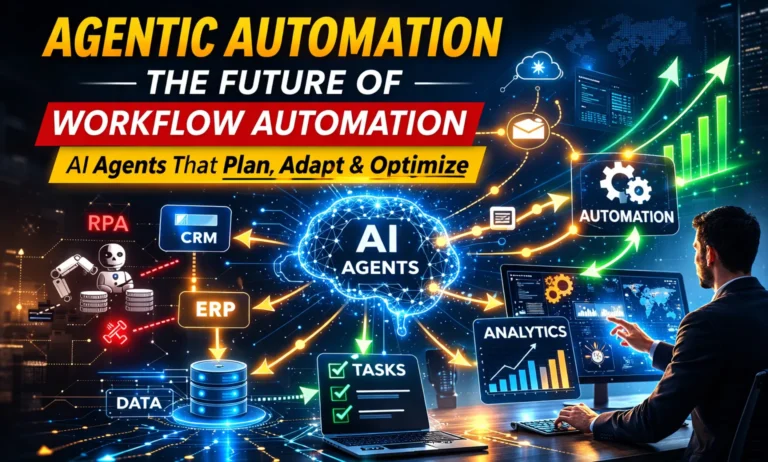
    Agentic Automation: The Future of Workflow Automation

    The Shift From Task Automation to Autonomous Systems

    For years, workflow automation meant one thing: automate repetitive tasks.

    Businesses deployed RPA bots to click buttons, copy data between systems, and follow predefined rules. It worked — to a point. Costs dropped. Manual errors decreased. Efficiency improved.

    But in 2026, the conversation has shifted.

    Companies are no longer asking, “How do we automate this task?”
    They’re asking, “How do we automate outcomes?”

    That shift is where agentic automation enters the picture.


    What Is Agentic Automation?

    Agentic automation refers to AI systems designed to act like autonomous agents rather than scripted bots.

    Instead of following rigid instructions, these AI agents:

    • Understand objectives
    • Plan multi-step workflows
    • Adjust decisions based on changing inputs
    • Optimize performance over time
    • Execute tasks across multiple systems

    In simple terms:

    Traditional automation executes instructions.
    Agentic automation pursues goals.

    If RPA is a digital worker following a checklist, agentic automation is a digital project manager figuring out the best way to get the job done.


    Why 2026 Is the Turning Point

    Several factors are converging to make 2026 a breakthrough year for agentic automation:

    1. Mature AI Models

    Large language models and reasoning engines are now capable of multi-step thinking, contextual understanding, and strategic decision-making.

    2. Better Workflow Orchestration Tools

    Modern orchestration platforms allow AI agents to interact with CRMs, ERPs, marketing systems, analytics dashboards, and internal databases seamlessly.

    3. Business Pressure for Agility

    US and UK enterprises face increasing pressure to reduce operational overhead while scaling faster. Static bots cannot keep up with dynamic markets.

    4. Data Explosion

    Companies generate massive amounts of data daily. Agentic systems can analyze and act on that data continuously — something rule-based bots struggle with.

    The result? Businesses are moving from automation scripts to intelligent orchestration layers.


    What Is Workflow Orchestration in This Context?

    Workflow orchestration is the coordination of multiple automated processes into one intelligent, goal-driven system.

    Instead of separate bots for:

    • Lead qualification
    • CRM updates
    • Email nurturing
    • Reporting

    An agentic system oversees the entire pipeline. It monitors performance, adjusts messaging, escalates exceptions, and reallocates resources when needed.

    It doesn’t just execute — it manages.


    Agentic Automation vs RPA: What Businesses Should Know

    To understand the future, we need to compare it with the present.

    1. Decision-Making Capability

    RPA:
    Follows predefined rules. If X happens, do Y.

    Agentic Automation:
    Analyzes context and decides the best action based on objectives.

    Example:
    An RPA bot sends a standard follow-up email.
    An AI agent decides whether to follow up, change tone, escalate to sales, or pause outreach based on engagement data.


    2. Adaptability

    RPA:
    Breaks when systems change or workflows evolve.

    Agentic Automation:
    Adapts to new inputs, system updates, and unexpected scenarios.

    This flexibility significantly reduces maintenance costs.


    3. Scope of Automation

    RPA:
    Automates tasks.

    Agentic Automation:
    Automates entire processes and optimizes them continuously.

    Instead of automating invoice entry, an AI agent can oversee the entire accounts payable workflow — from invoice detection to fraud checks and payment timing.


    4. Human Involvement

    RPA:
    Requires ongoing human supervision and frequent updates.

    Agentic Automation:
    Operates with minimal supervision, escalating only when judgment or compliance decisions are required.

    It augments humans instead of replacing them.


    5. ROI Potential

    RPA typically delivers incremental efficiency gains — often 20–40% improvement in specific tasks.

    Agentic automation can deliver transformational gains by:

    • Reducing operational headcount pressure
    • Improving decision speed
    • Increasing revenue conversion rates
    • Minimizing error-based losses
    • Enabling 24/7 optimization

    For enterprises, this moves automation from a cost-saving initiative to a growth strategy.


    Where Agentic Automation Delivers the Most Value

    In 2026, we’re seeing the strongest impact in:

    • Sales workflow automation
    • Marketing orchestration
    • Customer support triaging
    • Financial process management
    • Supply chain coordination
    • Enterprise IT operations

    Particularly in high-income markets like the US and UK, businesses are adopting agentic systems to remain competitive against leaner, AI-native startups.


    Should Businesses Replace RPA?

    Not immediately.

    RPA still has value for simple, stable, repetitive tasks. It’s reliable and cost-effective.

    However, forward-thinking organizations are layering agentic automation on top of existing RPA infrastructure — using RPA for execution and AI agents for orchestration.

    This hybrid approach offers the best of both worlds.


    The Bigger Picture: Automation as Strategy

    The most important takeaway isn’t technological — it’s strategic.

    Workflow automation is no longer just about saving time.

    It’s about building systems that:

    • Learn
    • Adapt
    • Scale
    • Optimize themselves

    Agentic automation represents the next evolution in business automation — moving from static scripts to intelligent operational ecosystems.

    In 2026 and beyond, the companies that win will not be the ones with the most bots.

    They’ll be the ones with the smartest orchestration layers.


    Final Thoughts

    Agentic automation is not hype — it’s a structural shift in how businesses think about workflows.

    RPA automated the past.
    Agentic systems are shaping the future.

    For organizations in the US, UK, and other advanced markets, the question is no longer if AI will manage workflows — but how quickly they can adopt it strategically.

    The future of workflow automation is autonomous, adaptive, and outcome-driven.

    And that future has already begun.

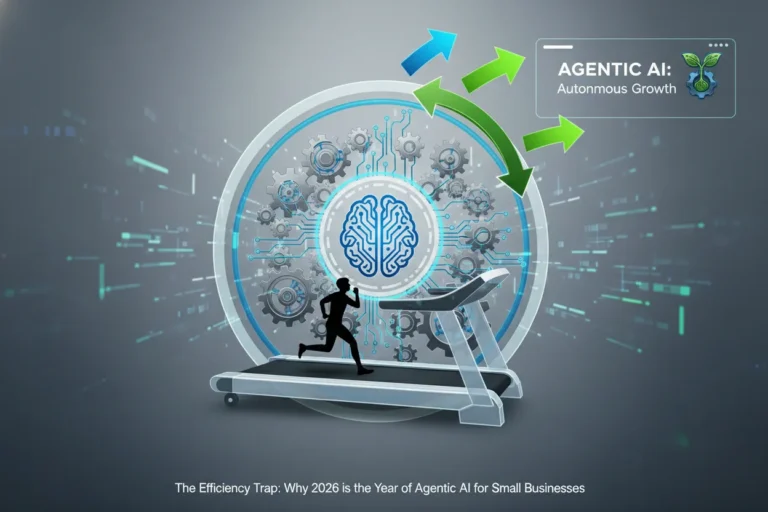
  • The Efficiency Trap: Why 2026 is the Year of Agentic AI for Small Businesses

    There is a specific kind of exhaustion that every small business owner in the US and UK knows all too well. It’s that feeling of being a “professional firefighter.” You start your Monday with a grand vision for growth, but by 10:00 AM, you are buried in the weeds—answering basic customer service emails, manually updating your CRM, and trying to figure out why your latest social post didn’t hit the mark.

    This is the Efficiency Trap. It’s the paradox of the modern digital age: we have more tools than ever, yet we’ve never been busier with low-value tasks. We are running on a digital treadmill, exhausted by the “noise” of the business, with zero time left to actually steer the ship.

    As we move through 2026, the solution isn’t just “more AI.” We’ve moved past the novelty phase of basic chatbots. The real escape route is Agentic AI.

    From Tools to Teammates

    For the last few years, most of us have used AI reactively. You give a prompt to ChatGPT, and it gives you a response. It’s helpful, but it’s still a “manual” tool. You are the one who has to remember to ask the question, verify the data, and move the output to where it needs to go.

    Agentic AI changes the fundamental nature of this relationship. Instead of a tool that waits for your command, an AI Agent is a digital teammate that understands a specific objective.

    If you tell an agent, “Nurture this lead until they are ready for a call,” it doesn’t just write a draft. It monitors your inbox, follows up at the right intervals based on the lead’s behavior, checks your real-time availability on Calendly, and sends the invite. It manages the entire workflow autonomously. In 2026, the competitive edge belongs to those who stop “prompting” and start “delegating.”

    The “Gear” Philosophy: Why Operations are the New Moat

    At AI Growth Gear, we look at business through a lens of high-end operations. My co-founder, Surbhi Chauhan, brings a unique perspective from the worlds of fashion communication (NIFT) and film production. In those industries, a brilliant creative vision is worth nothing if the “gears” of production fail.

    Most small businesses are currently suffering from a “production” problem. They have a great product, but their backend is a patchwork of manual processes. Agentic AI acts as the mechanical heart of your business. It allows a lean team of three people to have the operational output of a mid-sized corporation.

    Three Pillars for the 2026 Business Owner

    To break out of the Efficiency Trap this year, your strategy must sit on three pillars:

    1. Aesthetic Automation: In a market flooded with generic, “robotic” content, design matters more than ever. Your AI-driven communication must feel human and high-end. If it looks like a machine made it, your customers will tune out.
    2. Strategic Oversight: We don’t believe in “set it and forget it.” The most successful 2026 businesses use agents to handle the 80% of repetitive, data-heavy work, leaving the final 20%—the high-value, emotional, and strategic decisions—to the human experts.
    3. Seamless Orchestration: Your AI needs to be an “orchestrator,” not a silo. It needs to live inside your email, your project management tools (like Monday.com or Asana), and your website.

    Owning the Gears

    The reality of 2026 is that the barrier to entry for starting a business has never been lower, but the barrier to scaling one has never been higher. The digital noise is deafening.

    You can choose to keep fighting the treadmill yourself, or you can build the digital infrastructure that does the heavy lifting for you. Agentic AI isn’t a futuristic luxury anymore; it’s the only way to ensure that you, the founder, can finally step out of the daily grind and back into the vision that started it all.

    It’s time to stop being a part of the machine and start owning the gears.

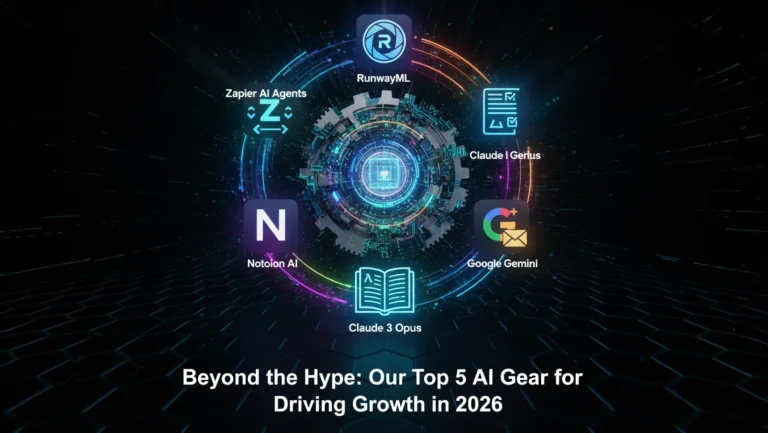
  • Beyond the Hype: Our Top 5 AI Gear for Driving Growth in 2026

    Every week, it feels like a hundred new AI tools launch. The promises are grand, the demos are dazzling, but for the busy business owner, it’s just another layer of confusion. Which ones actually work? Which ones are built for growth, not just novelty?

    At AI Growth Gear, our philosophy is simple: Don’t chase every shiny object; invest in the right gears. With my background managing the fast-paced operations at Enoxx News, and Surbhi’s eye for seamless integration from NIFT and film, we don’t recommend a tool unless it truly elevates an existing workflow. We’ve put countless hours into testing, integrating, and often, breaking these tools so you don’t have to.

    So, as we navigate 2026, here are our top 5 battle-tested AI “Gears” that are truly driving growth for businesses in the US and UK.

    1. The Orchestrator: Zapier AI Agents (for Seamless Workflow Automation)

    Think of Zapier as the central nervous system of your digital operations. Now, imagine giving it a brain. Zapier AI Agents aren’t just about connecting apps; they’re about giving an AI an objective and letting it execute multi-step tasks across your entire tech stack.

    • Why it’s essential: Instead of manually moving data from your CRM to your email marketing, or updating your project management tool based on a customer query, an Agent handles it. It’s perfect for streamlining lead nurturing, customer onboarding, and even internal reporting. It truly embodies the “Agentic AI” we champion.

    2. The Visual Storyteller: RunwayML (for Dynamic Video & Visuals)

    The demand for video content is relentless. Traditional video production is slow and expensive. Enter RunwayML. While still evolving, its capabilities in generating short video clips from text, transforming existing footage, and even isolating elements are game-changing.

    • Why it’s essential: For brands needing to create quick, high-quality social media clips, product explainers, or animated graphics, RunwayML democratizes video creation. It allows you to maintain aesthetic quality without a full production team, resonating deeply with Surbhi’s visual-first approach.

    3. The Intelligent Copywriter: Claude 3 Opus (for High-Quality Content Creation)

    While ChatGPT got all the headlines, Claude 3 Opus (and its siblings Haiku and Sonnet) has quietly become our go-to for sophisticated long-form content and nuanced brand voice. Its ability to handle complex prompts and produce less “AI-sounding” text is remarkable.

    • Why it’s essential: From drafting compelling blog posts and email sequences to generating detailed market analyses, Claude 3 Opus consistently delivers. It helps maintain the “Aesthetic Automation” principle by producing copy that feels genuinely human and on-brand, freeing up your team for strategic refinement.

    4. The Knowledge Manager: Notion AI (for Organized Operations & Idea Generation)

    If your business lives in Notion (and many successful ones do), then Notion AI is a non-negotiable. It’s an integrated AI assistant that lives directly within your workspaces, databases, and documents.

    • Why it’s essential: Instantly summarize lengthy meeting notes, draft marketing copy based on project briefs, automate task generation, and even brainstorm content ideas directly within your existing knowledge base. It transforms Notion from a powerful workspace into an intelligent operational hub, drastically improving team productivity.

    5. The Data Whisperer: Google Gemini for Workspace (for Smart Insights & Efficiency)

    We live in our inboxes and spreadsheets. Google Gemini for Workspace integrates AI directly into Gmail, Docs, Sheets, and Slides. This means AI can draft emails, summarize lengthy document threads, analyze data in Sheets, and even create presentations with simple prompts.

    • Why it’s essential: It’s about leveraging the tools you already use daily. Gemini streamlines communication, automates data analysis, and assists with content creation right where you work. It’s subtle, powerful, and an absolute game-changer for internal efficiency and external communication, ensuring every interaction is precise and purposeful.

    Equip Your Growth

    Choosing the right AI “gear” isn’t about having the most tools; it’s about having the most effective ones. These five solutions, when integrated strategically, can transform your business from being trapped in the “Efficiency Trap” to being a nimble, growth-driven machine.

    Don’t just automate; orchestrate. Let’s equip your business with the intelligence it needs to thrive in 2026.