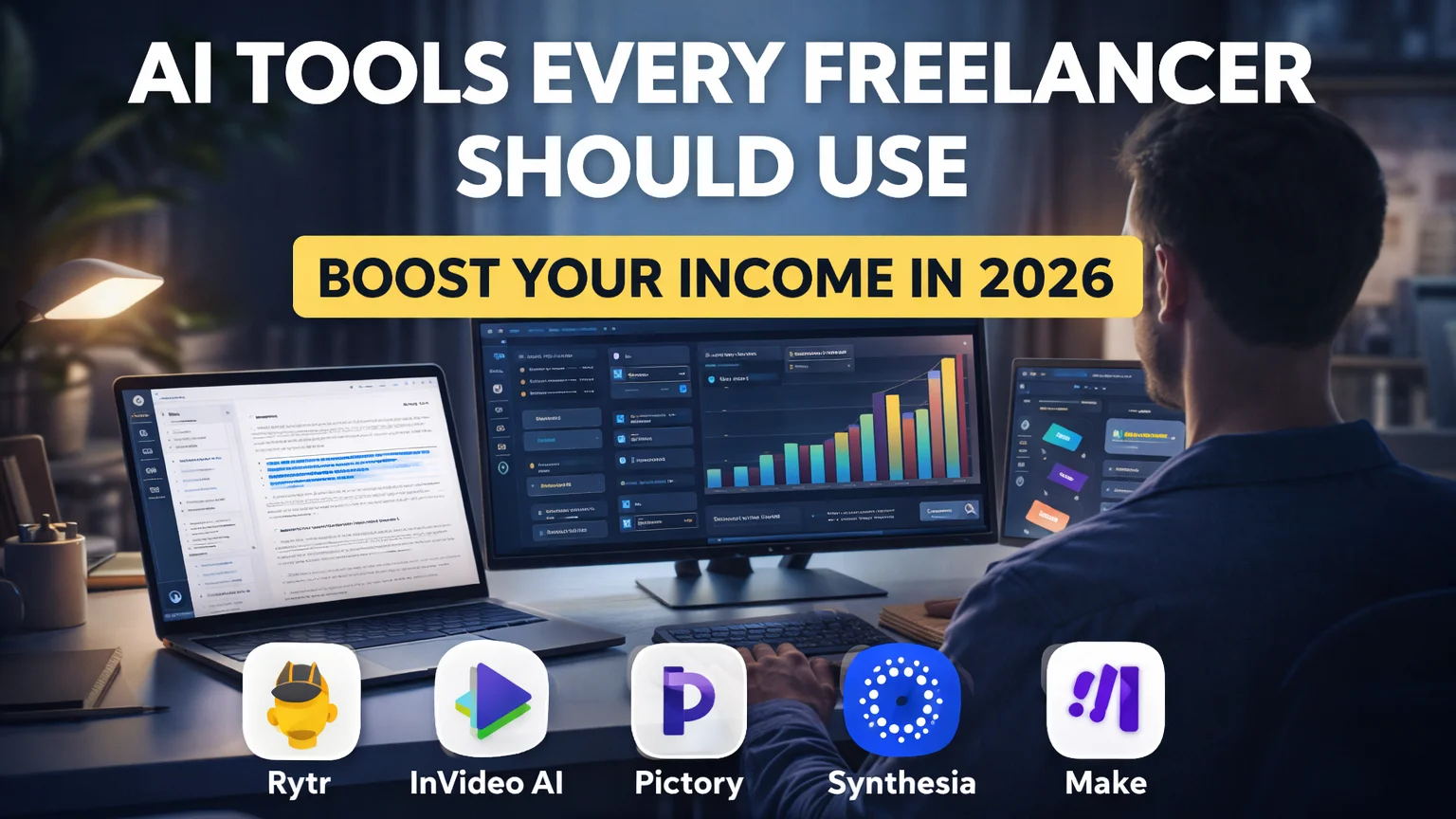
A freelancer leveraging AI tools to manage multiple income streams, with real-time analytics and growth insights displayed on a modern digital dashboard.
Artificial intelligence is transforming the way people build online businesses. Entrepreneurs, freelancers, and content creators are increasingly using AI tools to automate tasks, produce content faster, and create new revenue streams.
The biggest advantage of AI technology is accessibility. You no longer need advanced technical skills or expensive software to start an online business. Modern AI platforms allow users to create blog content, marketing graphics, and professional videos in just minutes.
Many successful online entrepreneurs are already building profitable AI-powered side hustles. With tools like Jasper AI, Canva, and Pictory, it is possible to produce high-quality digital content quickly and scale online income opportunities.
In this guide, you will learn practical strategies to make money with AI tools, the best tools available today, and how beginners can start an AI side hustle step by step.
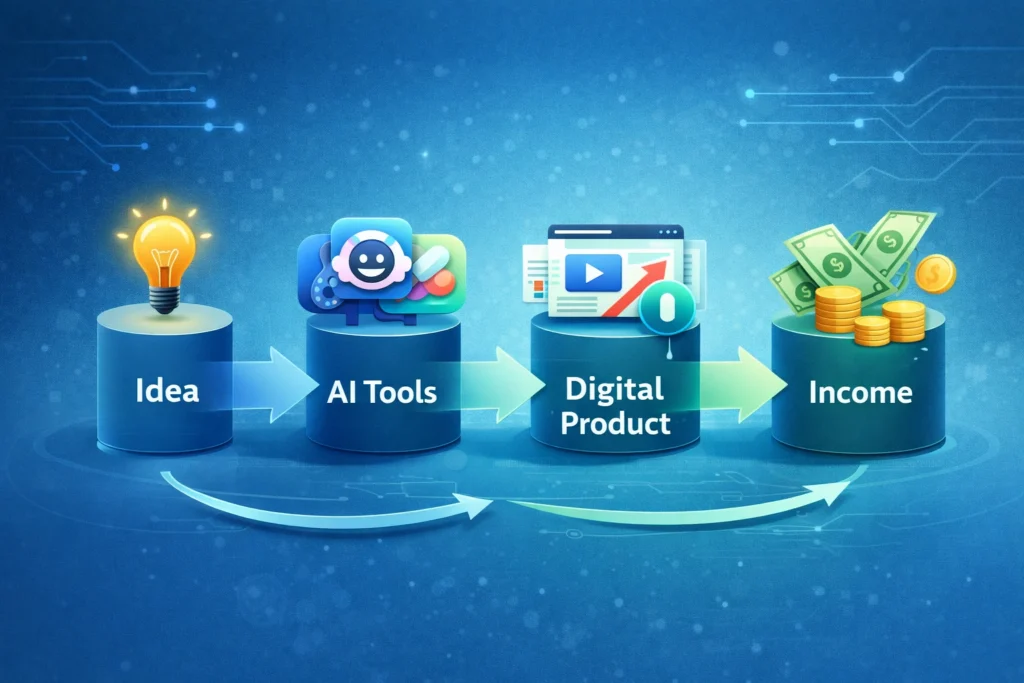
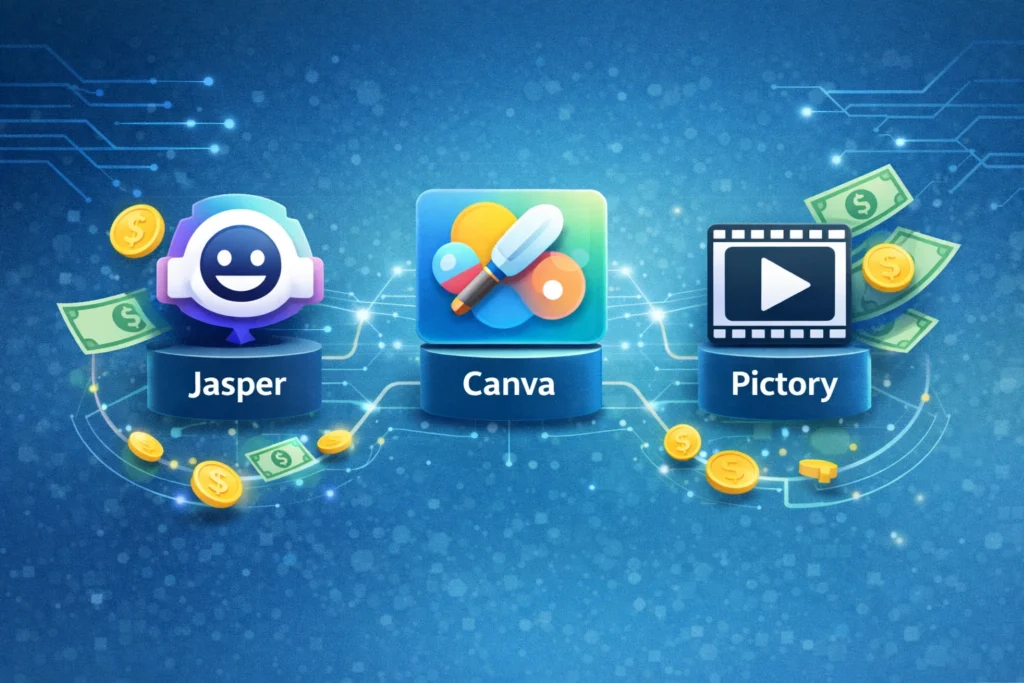
A simple AI workflow showing how an idea can be turned into a digital product and income using AI tools.
Why AI Side Hustles Matter in 2026
Artificial intelligence is becoming one of the most important drivers of the digital economy. Businesses across industries are using AI to automate marketing, create content, and improve productivity.
This growing adoption of AI has opened new opportunities for individuals who want to start online businesses.
Some key reasons AI side hustles are growing rapidly include:
• Businesses need more content than ever before • AI tools dramatically reduce production time • Startup costs for online businesses are lower • Digital marketing demand continues to increase • AI tools are becoming beginner-friendly
Because of these factors, AI-powered side hustles are becoming one of the most accessible ways to start making money online.
Best Ways to Make Money with AI Tools
There are several profitable opportunities where AI tools can help generate income.
AI Content Writing
AI writing tools such as Jasper AI allow freelancers and entrepreneurs to create blog posts, marketing copy, and product descriptions much faster than traditional writing.
Common services include:
• SEO blog writing • Website copywriting • Email marketing content • Product descriptions for eCommerce
Many freelance writers charge between $50 and $300 per article depending on the niche and content quality.
AI Graphic Design
Design platforms like Canva make it easy to create professional graphics even without design experience.
Using Canva’s AI features, users can create:
• Social media graphics • YouTube thumbnails • Marketing banners • Presentation designs • Digital product templates
These designs can be sold on marketplaces like Etsy, Fiverr, or Gumroad.
AI Video Creation
Video content is one of the fastest growing forms of digital media. AI tools like Pictory make it possible to create videos without advanced editing skills.
• Generating article outlines • Writing first drafts • Creating social media posts • Generating blog graphics
Blog monetization options include:
• Google AdSense • Affiliate marketing • Sponsored content • Digital products
Many bloggers now use AI tools to accelerate content publishing.
Best AI Tools for Making Money
Below are some of the most useful AI tools for building an AI-powered side hustle.
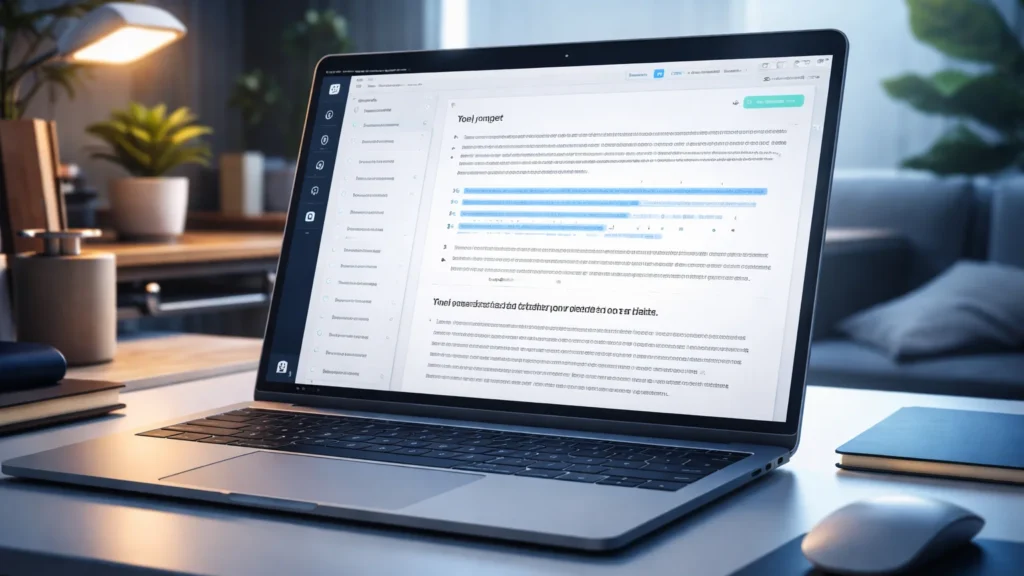
Popular AI tools like writing, design, and video creation platforms help entrepreneurs create content, digital products, and videos to generate online income.
Jasper AI
Jasper AI is one of the most powerful AI writing assistants designed for marketers, bloggers, and businesses.
It helps generate blog posts, marketing content, and long-form articles quickly.
Key Features
• AI blog post generator • SEO optimized content creation • Marketing templates • Brand voice customization
Pros
• Produces high-quality long-form content • Saves significant writing time
Cons
• Paid subscription required • Content may require editing
Best For
Bloggers, affiliate marketers, and freelance writers who want to scale content production.
Here are some real ways individuals and businesses use AI tools to generate income:
• Freelance content writing services • Selling digital design templates • Running YouTube automation channels • Building affiliate marketing blogs • Managing social media for businesses
AI technology does not replace creativity. Instead, it helps creators produce content faster and scale their work.
Benefits and Limitations of AI Tools
Benefits
• Faster content production • Lower startup costs • Beginner-friendly platforms • Ability to scale online businesses
Limitations
• AI content still requires editing • Competitive markets in some niches • Many advanced tools require subscriptions
Understanding these factors helps you build a sustainable AI-powered business.
How to Get Started with an AI Side Hustle
Starting an AI side hustle does not require major investments.
Follow these simple steps:
Choose a niche that interests you
Select AI tools that fit your goals
Start creating valuable content or services
Promote your work through social media or websites
Monetize through ads, affiliate programs, or client services
Consistency and quality will play the biggest role in long-term success.
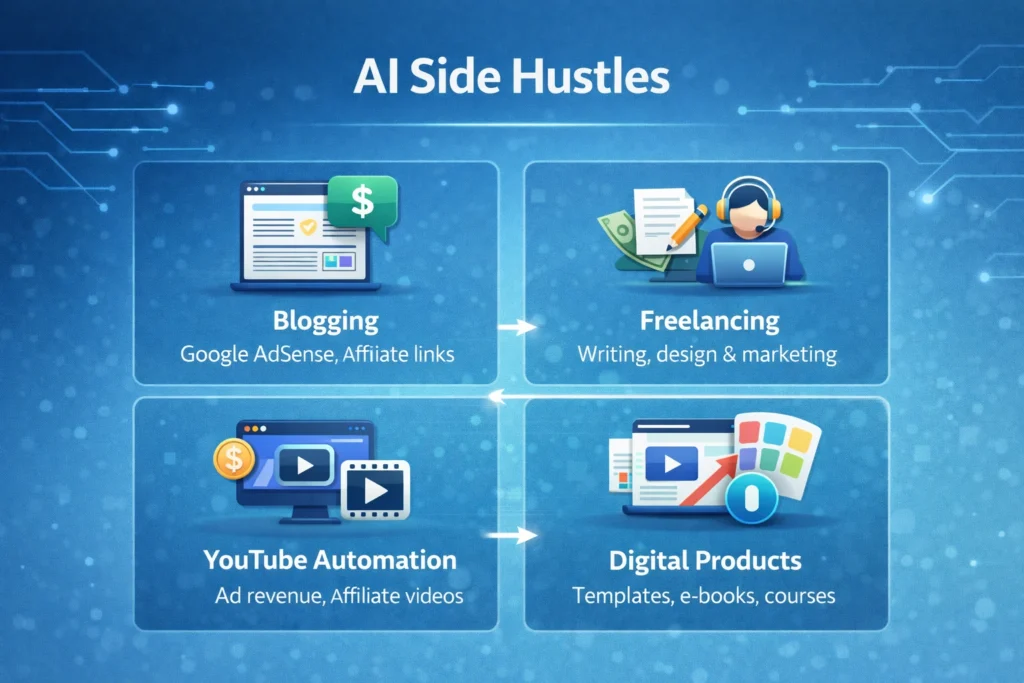
A visual comparison of popular AI side hustles such as blogging, freelancing, YouTube automation, and digital products that can generate income online.
Conclusion
Artificial intelligence is creating new opportunities for entrepreneurs, freelancers, and creators around the world. With the right strategy, AI tools can help build scalable online businesses and generate multiple income streams.
Platforms like Jasper AI, Canva, and Pictory allow individuals to produce content, graphics, and videos more efficiently than ever before.
If you are interested in starting an online business, learning how to use AI tools effectively could become one of the most valuable skills in the modern digital economy.
Many solopreneurs don’t struggle with ideas — they struggle with choosing the right digital product. The internet is crowded, attention is limited, and generic downloads don’t sell anymore.
What works in 2026? Digital products that solve specific problems, are easy to distribute, and align with growing AI-powered workflows.
Below is a curated, practical list of digital products that are in real demand — along with examples and platforms where they perform well.
📌 Why Digital Products Still Win
Digital products offer:
✅ No inventory
✅ Global reach
✅ High margins
✅ Easy automation
⚡ Scalable distribution
But success depends on positioning, not just uploading files.
The 18 Best Digital Products for 2026
❶ eBooks in Micro-Niches
Instead of broad topics like “Fitness Guide,” focus on:
Remote worker posture guides
AI tools for accountants
Budgeting for freelancers
Best platforms: Amazon KDP, Gumroad
❷ Notion Templates
Professionals love ready-made productivity systems:
CRM dashboards
Content calendars
Startup planning boards
Platforms: Gumroad, Etsy
❸ AI Prompt Packs
Curated prompt libraries for:
Marketing campaigns
SEO optimization
LinkedIn growth
Platforms: Shopify, Lemon Squeezy
❹ Digital Planners
High-demand categories include:
ADHD planners
Wedding organizers
Business goal planners
Platforms: Etsy, KDP
❺ Online Mini-Courses
Short, skill-specific lessons:
Canva design basics
AI automation workflows
Email marketing setup
Platforms: Teachable, Kajabi
❻ Website Templates
Pre-built themes for:
Coaches
Freelancers
SaaS startups
Platforms: Shopify, Creative Market
❼ Resume & CV Kits
Professionals constantly update resumes. Bundle:
Editable templates
Cover letter examples
LinkedIn optimization guide
Platform: Etsy
❽ Printables for Kids
Examples:
Learning activity sheets
Homeschool planners
Platform: Etsy
❾ Stock Photo Bundles
Niche-focused visuals:
Remote work setups
AI workspace imagery
Platforms: Shopify, Gumroad
❿ Spreadsheet Tools
Examples:
Budget trackers
Investment analysis sheets
Freelance income dashboards
Platform: Etsy
⓫ Canva Social Media Kits
Pre-designed content packs for small businesses.
⓬ AI Automation Blueprints
Step-by-step workflow documents for automating tasks.
Simple productivity or AI-powered tools solving one problem well.
⓱ Email Marketing Templates
Pre-written campaigns for specific industries.
⓲ Data & Research Reports
Industry insights packaged for professionals.
💡 Choosing the Right Platform
Each platform attracts a different buyer type:
Etsy → Creative & printable products
Gumroad → Digital creators & tech audience
Shopify → Brand builders
KDP → eBook and print products
Kajabi/Teachable → Courses
Choose based on your audience, not trends.
⚖️ Benefits and Limitations
Benefits
Low startup cost
Automation friendly
Location independent
Limitations
Competitive categories
Requires positioning
Marketing still matters
Digital products are assets — but not automatic income machines.
🛠 Action Plan for Solopreneurs
Identify a niche audience.
Study what they repeatedly struggle with.
Create one focused product.
Launch on one platform only.
Gather feedback.
Improve and expand your product line.
📌 Build a small portfolio instead of chasing viral success.
👥 Who Should Build Digital Products?
Ideal for:
Freelancers
Consultants
AI tool users
Side hustlers
Coaches
Not ideal for:
Those seeking overnight profits
People unwilling to research
Creators avoiding iteration
Final Thoughts
Digital products in 2026 are no longer about selling random PDFs. They’re about solving targeted problems with clarity and precision.
If you combine niche research, smart positioning, and consistent execution, digital products can become a reliable income stream — especially when enhanced with AI tools and automation.
The opportunity is real. The strategy determines the outcome.
If 2024 was the year of the Chatbot, 2026 is undeniably the year of the Agent.
The difference is profound. A chatbot answers your questions; an agent does your work. For business leaders in London, New York, and San Francisco, the novelty of “chatting” with AI has worn off. The focus has shifted entirely to ROI and autonomous workflows.
We are looking for tools that don’t just generate text but can open a browser, click buttons, query databases, and send Slack messages without human hand-holding.
After testing dozens of platforms, here are the 7 best AI Agents for business automation in 2026.
1. Zapier Central (The “Gateway” Agent)
Best For: Connecting your existing SaaS stack.
If you already use Zapier, this is the easiest entry point. Zapier Central isn’t just a prettier interface for their automation tools; it’s a logic layer that sits on top of them.
What it does: Instead of building rigid “If This, Then That” workflows, you give Central a goal: “Check my email for invoices, match them to Xero, and slack me if the amount is over $1,000.”
The Killer Feature: It has access to 6,000+ apps immediately. You don’t need to wait for integrations; they are already there.
2. Microsoft Copilot Studio (The Enterprise Standard)
Best For: Corporations living in the Office 365 ecosystem.
For large enterprises, security is the bottleneck. Microsoft Copilot Studio (formerly Power Virtual Agents) allows you to build agents that live safely inside your corporate tenant.
What it does: You can build an agent that accesses your internal SharePoint, reads your Outlook calendar, and updates Excel sheets.
The Killer Feature: It respects your organization’s data governance. It won’t hallucinate confidential data to the wrong employee.
3. Lindy.ai (The “Digital Employee”)
Best For: Specific roles like Medical Scribes, HR Assistants, or Executive Assistants.
Lindy positions itself not as a tool, but as an employee. You don’t “configure” Lindy; you “hire” her for a specific job.
What it does: Lindy comes pre-trained for specific verticals. An “HR Lindy” already knows how to handle onboarding documents; a “Medical Lindy” knows how to transcribe patient notes into EMR formats.
The Killer Feature: “Proactive” behavior. Lindy doesn’t always wait for a command; she can monitor your inbox and draft replies for you to approve.
4. Salesforce Agentforce (The CRM Specialist)
Best For: Sales and Customer Support teams.
If your business lives or dies by your CRM data, Agentforce is the heavy hitter. Salesforce realized that generic AI struggles with specific customer data, so they built agents that live inside the data layer.
What it does: An Agentforce service agent can autonomously resolve customer tickets by looking up order history, processing a refund, and updating the case status—all without a human agent opening the file.
The Killer Feature: The “Atlas” reasoning engine, which is surprisingly good at handling complex customer queries that usually confuse standard bots.
5. Relevance AI (The No-Code Builder)
Best For: Building custom “AI Workforce” teams without code.
Relevance AI is for the power user who wants to build a custom agent team but doesn’t want to write Python.
What it does: It allows you to build multi-agent chains. You can have a “Researcher Agent” that scrapes the web, passes the data to a “Writer Agent” that drafts a report, and a “Manager Agent” that critiques it.
The Killer Feature: The visual builder is intuitive, making it easy to visualize how your “digital team” is passing data back and forth.
6. CrewAI (The Developer’s Choice)
Best For: Technical teams building complex, code-heavy workflows.
If you have a dev team, skip the no-code tools and go straight to CrewAI. It’s an open-source framework that orchestrates role-playing agents.
What it does: You define specific roles (e.g., “Senior Python Engineer,” “QA Tester”) and assign them goals. The agents collaborate, delegate tasks to each other, and solve problems iteratively.
The Killer Feature: It handles “delegation” better than almost anything else. If one agent gets stuck, it can ask another agent for help.
7. MultiOn (The Browser Navigator)
Best For: Tasks that require using a web browser like a human.
Most APIs are limited. MultiOn solves this by giving the AI a web browser.
What it does: It can log into websites, click buttons, fill out forms, and navigate complex UIs just like a human user would.
The Killer Feature: It can handle “real world” tasks like booking a flight on a site that doesn’t have an API, or ordering lunch from a delivery service.
The Bottom Line
In 2026, the question isn’t “Which AI model is the smartest?”—it’s “Which Agent has the best access to my tools?”
If you want a safe bet, start with Zapier Central. If you want to build a digital workforce, look at Relevance AI or CrewAI. Just stop waiting for the chatbot to do the work for you.
Let’s be honest. The thought of setting up a ring light, staring down a camera lens, and trying to act excessively energetic for ten minutes sounds exhausting to most of us.
For years, the advice was: “If you want YouTube affiliate money, you have to be a personality.” You had to be the brand.
In 2026, that advice is obsolete.
We have entered the golden age of the “Faceless Channel.” These aren’t the janky, slideshow videos with robotic voices from five years ago. Today’s faceless channels use AI tools so sophisticated that viewers often don’t realize they are watching synthetic media. They are slick, professional, and incredibly profitable assets that run almost on autopilot.
If you are an introverted solo-preneur looking for a high-leverage side hustle, this is your playbook.
1. Stop Picking “Penny Niches”
The biggest mistake beginners make is choosing niches with low payouts. Forget “Top 10 Amazon Kitchen Gadgets Under $20.” The margins are too thin to sustain a real business.
In 2026, the faceless goldmine is in high-ticket digital products and services. You want niches where a single affiliate commission lands you $50 to $500.
B2B SaaS Reviews: Deep dives into CRM software, AI marketing tools, or project management platforms. Businesses spend big money here.
High-End Education: Reviewing expensive certification courses or bootcamps.
You need fewer views to make real money in these spaces. A channel with 5,000 targeted views on “Best Enterprise AI Sales Tools” will out-earn a channel with 100,000 views on “Funny Cat Toys.”
2. The 2026 “Invisible Stack”
The technology has matured. You no longer need to hire an editor or a voice actor to compete with the big channels. You just need to be a good director of AI agents.
The Brain (Scripting): Don’t just ask ChatGPT to “write a script.” Use models like Claude or Gemini Pro to analyze top-performing competitor videos and analyze their structure. Then, prompt the AI to write a script that focuses on information density—giving the viewer pure value without the fluff.
The Voice (Audio): The robotic monotone is dead. Tools like ElevenLabs or OpenAI’s Voice Engine now offer hyper-realistic voices with breath, inflection, and emotion. You can even clone your own voice once and never speak into a mic again.
The Visuals (Video): This is the game-changer of 2026. We have moved beyond simple stock footage mixing. New text-to-video models allow you to generate specific B-roll scenes, animate diagrams, or create slick motion graphics just by describing them.
3. Bridging the “Trust Gap”
Here is the catch: audiences in the US and UK are savvy. If your video feels too synthetic—like it was purely churned out by a machine with no human oversight—they will click away.
The secret to a successful faceless empire is being a “Cyborg.” You use AI for the heavy lifting, but you inject undeniable human proof.
If you are reviewing software, don’t just show generic stock footage of people typing. Use screen recording software to show the actual dashboard of the tool you are reviewing. Show the mouse moving. Show the actual results.
The AI provides the polish; you provide the evidence.
The Bottom Line
The barrier to entry for YouTube has never been lower, but the bar for quality has never been higher. The winners won’t be the loudest personalities; they will be the smartest operators who know how to leverage AI to build digital real estate that earns money while they sleep.
Let’s be real for a second: when was the last time you scrolled past the AI summary to click on a random blog link?
If you’re like most users in 2026, the answer is “rarely.”
For solo entrepreneurs and affiliate marketers, this is terrifying. We spent years worshiping the Google algorithm, learning to structure our H1s and stuff keywords into alt tags. But the game has changed. We aren’t just optimizing for a search engine anymore; we are optimizing for agents—AI models like Gemini, ChatGPT, and Claude that don’t just give users a list of options, but give them an answer.
This is Agentic SEO (sometimes called GEO or AEO). And if you want your affiliate links to survive, you need to stop writing for clicks and start writing for citations.
Here is the straightforward, no-fluff guide on how to get AI agents to recommend your products.
1. The “Answer Capsule” Strategy
AI models are impatient readers. When they scan your content, they are looking for a direct, factual answer to a specific question. If you bury your affiliate recommendation in paragraph four after a long-winded intro about “the history of running shoes,” the AI will ignore you.
You need to use Answer Capsules.
This is a specific formatting trick where you place a direct, 40-60 word answer immediately after an H2 question.
Bad:There are many factors to consider when buying a microphone…
Good:The best budget microphone for podcasting in 2026 is the Rode PodMic. It offers broadcast-quality sound for under $100 and rejects background noise better than the Blue Yeti.
By front-loading the facts, you make it easy for the AI to “grab” that snippet and serve it to the user—usually with a citation link back to your site.
2. Data is the New Keyword
In the old days, we competed on keyword density. Today, we compete on Information Gain.
LLMs (Large Language Models) are trained to prioritize unique data. If your review of a software tool just rewrites the features list from the company’s homepage, the AI has no reason to cite you. It already knows that info.
To win, you need to create new data points that the AI doesn’t have.
Don’t just say “The battery lasts a long time.”
Say: “In our stress test, the battery lasted 14 hours and 12 minutes.”
When you provide specific, hard numbers, AI agents flag your content as a primary source. This dramatically increases the chance that when a user asks, “Which laptop has the best validated battery life?”, the AI will pull your stat and your link.
3. The “Reddit” Factor
Here is a weird twist: to rank your website, you might need to spend more time off of it.
AI models like Perplexity and Google’s Gemini rely heavily on “human consensus” to verify facts. They look at platforms like Reddit, Quora, and G2 to see what actual humans are saying.
If you are a solo affiliate, you can’t just be a ghost. You need to build a brand “entity.” If people on Reddit are discussing your blog post as a good resource, or if you are mentioned in forum discussions as a trustworthy reviewer, the AI picks up on that signal. It treats your site as a verified authority.
The Action Step: Don’t just spam links. Engage in communities. Be the expert who answers questions. When the AI sees your brand name associated with “helpful answers” across the web, it starts trusting your site’s content too.
4. Structure for Machines (Schema is King)
Finally, you have to speak the robot’s language. In 2026, “Schema Markup” isn’t optional technical mumbo-jumbo; it’s mandatory.
You need to use JSON-LD schema to explicitly tell the AI what your page is about. Are you reviewing a product? Use Product schema. Are you writing a tutorial? Use HowTo schema.
This gives the AI a structured map of your content, making it effortless for it to extract your price comparisons, pros/cons, and ratings. The easier you make it for the AI to understand your data, the more likely it is to use it.
The Bottom Line
The “generic” affiliate site is dead. The “AI-Recommended” expert is the new king. Stop writing generic fluff and start building a library of hard data, direct answers, and structured facts. That is how you win the trust of the machines—and the clicks of the humans.
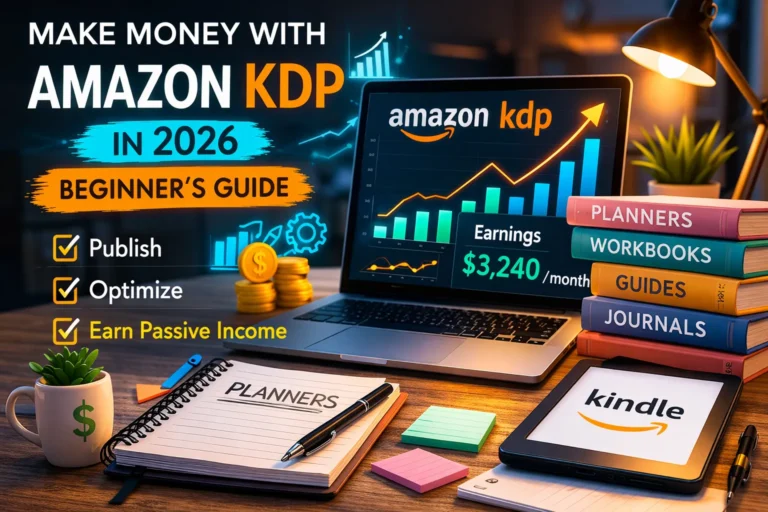
How to Make Money with Amazon KDP in 2026 (Beginner’s Guide)
Many beginners jump into Amazon KDP expecting instant passive income — and quit within months when results don’t appear. The issue isn’t the platform. It’s the strategy.
Kindle Direct Publishing (KDP) remains one of the most accessible digital product businesses in 2026. But it rewards research, positioning, and consistency — not random uploads.
Let’s break down how to approach KDP realistically and profitably.
📌 What Makes KDP Still Relevant in 2026?
Amazon is still the largest book marketplace globally. Unlike social platforms, where visibility fades quickly, books on Amazon continue generating traffic long-term through search.
You’re not “posting content.” You’re building digital assets.
KDP works especially well for:
Low-content books (planners, journals, trackers)
Workbooks and guided notebooks
Niche hobby guides
Professional templates converted into printable books
AI-assisted research-based guides
The key is niche precision.
🚀 Step 1: Choose a Niche That Has Demand — Not Just Trend
Instead of chasing generic ideas like “fitness journal,” think micro-niches.
For example:
ADHD planners for remote workers
Budget planners for single parents
Homeschool science experiment logbooks
Anxiety tracking journals for teens
These aren’t random. They solve specific problems.
💡 A quick validation method: Search your idea on Amazon. If:
There are books with reviews (demand exists)
But competition is not saturated with thousands of similar covers
And search suggestions appear in the dropdown
You’re on the right track.
⚡ Step 2: Create With Structure, Not Guesswork
You don’t need to be a designer. Tools like Canva, AI layout assistants, and research tools can speed up the process.
For low-content books:
Maintain clean margins
Use consistent page layout
Avoid over-designed interiors
Focus on usability
For informational books:
Add clear chapter structure
Include real examples
Provide actionable frameworks
Keep formatting professional
AI tools can assist with outlines and idea expansion — but avoid publishing generic AI-generated manuscripts. Add real-world thinking and clarity.
📊 Step 3: Optimize for Amazon SEO
Publishing is not enough. Visibility matters.
Key optimization areas:
✅ Title & Subtitle
Include searchable keywords naturally. Example: “ADHD Daily Planner for Remote Professionals (6-Month Productivity System)”
✅ Backend Keywords
Use all 7 backend keyword fields wisely. Avoid repeating title words.
✅ Categories
Choose less competitive subcategories. Ranking #3 in a niche category is better than #2000 in a broad one.
💰 How Much Can You Earn?
KDP income varies widely.
Royalty structure:
60% for paperbacks (minus printing costs)
70% for eBooks (in selected price ranges)
Most beginners make:
$50–$300/month initially
With 5–10 well-optimized books
Serious publishers treat it like a portfolio business.
Instead of 1 viral book, aim for: 📌 15–20 targeted assets over time.